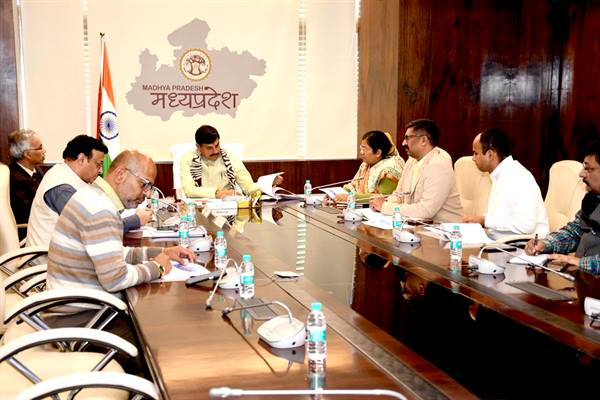
Jal Jeevan Mission to be completed ahead of target year 2028, by March 2027 : CM Dr. Yadav

Chief Minister Dr. Mohan Yadav has stated that ensuring the availability of quality and safe drinking water to every citizen of Madhya Pradesh is the government’s highest priority. He emphasised that under no circumstances should sewage-contaminated water enter drinking water sources, and directed that an effective action plan be prepared to prevent this.
Chief Minister Dr. Yadav said that while the Government of India has set December 2028 as the target for completing the Jal Jeevan Mission, Madhya Pradesh is set to achieve this goal ahead of schedule by March 2027, thereby setting an example at the national level. He directed officials to establish a robust operation and maintenance system to ensure an uninterrupted water supply under all circumstances. The Chief Minister also directed that sarpanches and women’s groups performing exceptional work under the Jal Jeevan Mission should be honoured at the state, division, district and village levels. He instructed that reports be prepared for villages that faced water scarcity during the past decade, ensuring that adequate water supply arrangements are made in those areas.
Chief Minister Dr. Yadav also said that water distribution should be scheduled according to availability to maintain a supply. The Chief Minister proposed that the Atal Bihari Vajpayee Institute of Good Governance and Policy Analysis conduct an impact analysis of the mission’s outcomes. He directed that village tube wells with perennial water sources, owned by 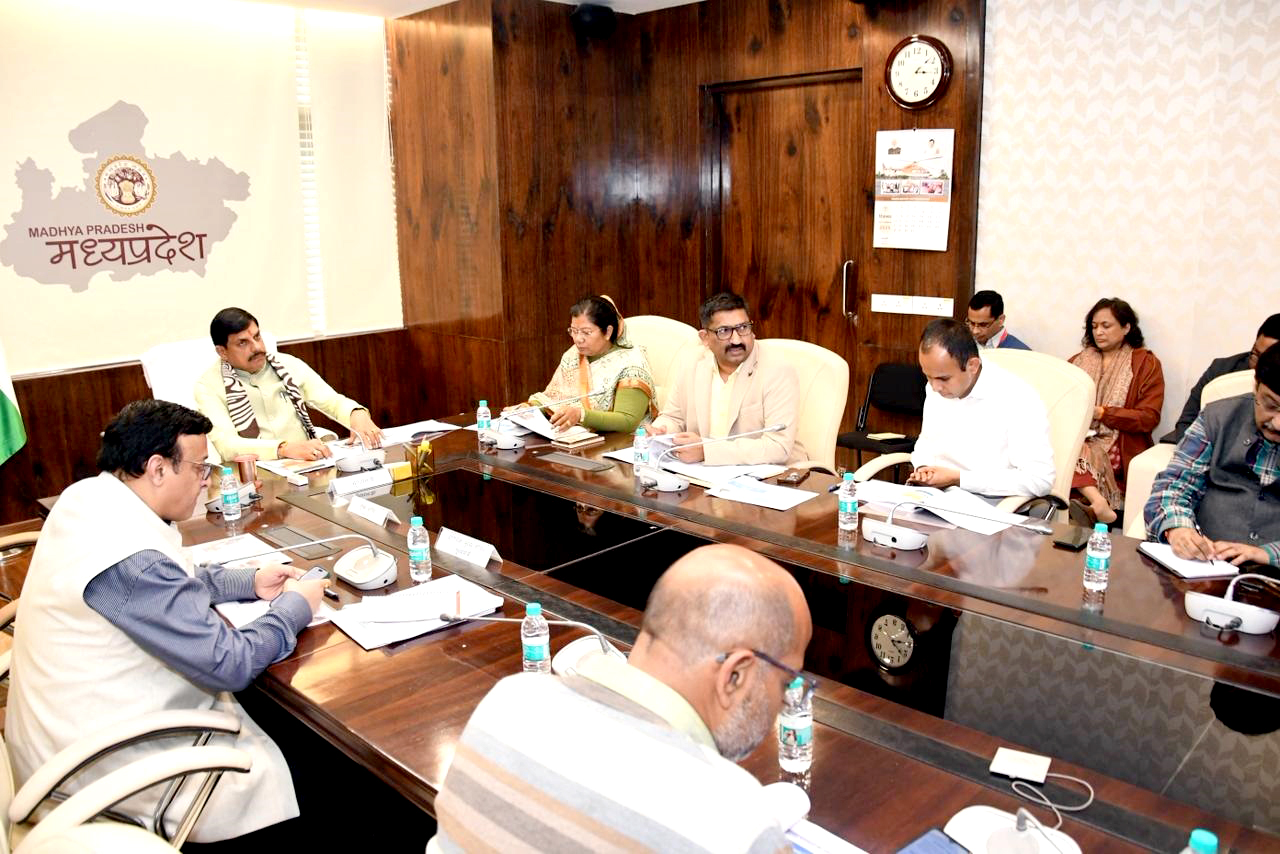 service-minded individuals, be identified so that such wells can be utilised to supply water during emergencies.
Minister for Public Health Engineering, Smt. Sampatiya Uikey emphasised the need to prepare a strong plan for the efficient operation and maintenance of the ‘Jal Jeevan Mission’.
The meeting was attended by Chief Secretary Shri Anurag Jain, Additional Chief Secretary to the Chief Minister Shri Neeraj Mandloi, Additional Chief Secretary (Finance) Shri Manish Rastogi, and Managing Director of the Madhya Pradesh Jal Nigam Shri K.V.S. Chaudhary.
Principal Secretary, Public Health Engineering, Shri P. Narhari, informed that over 8 million (80 lakh) rural families have been provided tap water connections so far, and the mission’s overall progress has reached 72.54%. In FY 2024–25, the target of 8.19 lakh connections was fully achieved, while 5.5 lakh new connections have been provided in FY 2025–26.
Madhya Pradesh — First state to enact a law to prevent borewell accidents
It was informed that Madhya Pradesh has become the first state in the country to enact a law to prevent borewell accidents. The state also secured first place nationally under the ‘Swachh Jal Se Suraksha Abhiyan’.
During FY 2024–25, expenditures amounting to ₹12,990 crore achieved 92.89% of the financial target, while ₹6,016 crore has been spent in FY 2025–26, marking 35.11% progress as of 30 September 2025. A total of 21,552 villages have been declared ‘Har Ghar Jal’, and 15,026 villages have been certified. Regular water supply has commenced in 3,890 villages under group water supply schemes, while single-tap water schemes have achieved 93% completion.
The department is prioritising technical advancement and digital monitoring. Continuous tracking of projects is being done through the Jalrekha mobile app. All 155 laboratories in the state have received NABL accreditation. Digital water tax collection has been implemented through the Panchayat Darpan portal for empowering rural bodies. An IoT-based real-time water supply model implemented in Indore has proven successful and is being expanded to other districts.
To ensure sustainable energy management, a 100 MW solar power project has been approved under the PPP model, ensuring low-cost and stable power for the next 25 years. Additionally, a 60 MW wind power project is under planning. For the convenience of citizens, the Jaldarpan portal and dedicated call centres are operational for grievance redressal. Continuous 24×7 water supply has been successfully implemented on a pilot basis in 64 villages, with plans for further expansion.
Key Highlights and Achievements
- Prepare an action plan to prevent contamination of drinking water sources through sewage.
- Complete Jal Jeevan Mission in Madhya Pradesh by March 2027, ahead of the national target of December 2028.
- Conduct impact analysis of Jal Jeevan Mission projects through the Atal Bihari Vajpayee Institute of Good Governance and Policy Analysis.
- Ensure uninterrupted and quality drinking water for all citizens.
- Recognise outstanding contributions by sarpanches and women’s groups at all administrative levels.
- Prepare reports on villages that faced water scarcity in the past ten years and ensure solutions.
- Schedule water distribution based on source availability to maintain a regular supply.
Major Achievements
- Over 80 lakh rural families provided with household tap connections (FHTC).
- Overall, 72.54% progress under Jal Jeevan Mission.
- Targets for single tap water schemes to be completed by December 2025, and group water schemes by March 2026 (current progress 93%).
- 100% achievement of 8.19 lakh connections in FY 2024–25.
- 5.50 lakh connections provided so far in FY 2025–26.
- First state in India to enact a law to prevent borewell accidents.
- Ranked first nationally in the Swachh Jal Se Suraksha Abhiyan.
Financial and Physical Progress
- Expenditure of ₹12,990 crore in FY 2024–25 (92.89% target achieved).
- Expenditure of ₹6,016 crore in FY 2025–26 (35.11% progress as of September 2025).
- 4.56 lakh connections (29.06%) achieved in FY 2025–26 physical targets.
Progress under Jal Jeevan Mission
- Total target: Over 1.11 crore household tap connections.
- Reached 80 lakh households so far.
- 21,552 villages declared ‘Har Ghar Ja’, 15,026 certified.
- 100% geotagging of villages completed.
- 93% progress in single village schemes (SVS).
- Regular supply started in 3,890 villages through multi-village schemes (MVS).
Digital Monitoring and Technological Upgrades
- The Jalrekha mobile app is used for real-time monitoring of group water schemes.
- Mobile app developed for monitoring of borewell/tubewell drilling and pump installation .
- All 155 laboratories are NABL-accredited.
- 100% geotagging of all water sources, storage tanks and information boards.
- An online inventory management system was developed to track construction materials.
Operation and Maintenance (O&M) Reforms
- State-level O&M policy implemented.
- The IoT-based water pressure system is successfully functioning in Indore district.
- Digital water tax collection is enabled through the Panchayat Darpan Portal.
Energy Management and Renewable Initiatives
- 100 MW solar project approved under PPP model at a record-low rate of ₹2.09 per unit, ensuring stable supply for 25 years.
- 60 MW wind energy project under planning.
E-Governance and Transparency
- Jal Nigam ranked first among all state departments in e-Office operations.
- Transparent selection of agencies through screening tests (503 candidates selected).
- The ‘E-Bandhan’ platform was implemented for 100% digital payments.
Service Quality and Citizen Facilitation
- 24×7 continuous water supply successfully piloted in 64 villages.
- Jaldarpan portal is operational for project tracking and citizen grievance redressal.
- Call centres established for complaints and feedback.
Multi-Village Water Supply Schemes (MVS)
- 147 group water schemes are under implementation at a total cost of ₹60,786 crore.
- 46 schemes completed, 92 in progress, and 9 in initial stages.
- 3,890 villages are receiving regular supply through group schemes.
Vision for the Next Three Years
- Ensure a safe piped water supply to every rural household.
- Provide priority connections to deprived and marginalised families.
- Maintain regular and certified water supply operations.
- Ensure quality materials and adherence to standards in construction.
- Conserve all water sources with scientific preservation techniques.
- Implement mobile app–based systems for payments and management.
- Establish training and capacity-building centres at the divisional levels.
- Install solar energy plants to meet the project’s energy needs.
- Expand drinking water facilities to new habitations, schools, Anganwadis, health centres, and public institutions.
National and State-Level Recognition
- Madhya Pradesh Jal Nigam ranked first in file movement under the e-Office system.
- Ranked second nationally on the PM Gati Shakti portal for mapping water pipeline networks.
- Achieved 100% geotagging of all sources and overhead tanks.
- Introduced Tubewell Management Software for online recordkeeping and geotagging of new borewells.
- Implemented an online inventory management system for monitoring material flow from departmental stores.



Telangana’s Abhi Chandra Clinches Two Medals at Special Olympics Nationals
Dehradun, July 2026 : Determination, discipline and an unyielding passion for sport define…

Telangana’s Abhi Chandra Clinches Two Medals at Special Olympics Nationals
Dehradun, July 2026 : Determination, discipline and an unyielding passion for sport defined the …