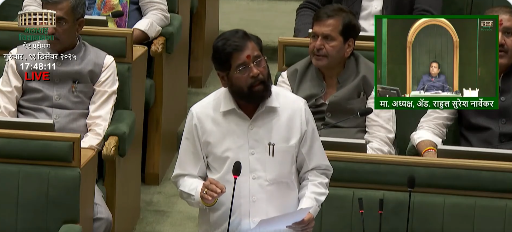
Historic Move to Redevelop Mumbai’s ‘Pagdi’ Buildings Announced by Deputy CM Eknath Shinde

Nagpur, Dec 2025 : In a landmark announcement aimed at transforming Mumbai’s housing landscape, Deputy Chief Minister Eknath Shinde declared in the Legislative Assembly today the formulation of a separate regulatory framework for redeveloping ‘Pagdi’ (rent-controlled) buildings. The move seeks to ensure fair and equitable redevelopment while safeguarding the rights of both tenants and landlords.
Deputy CM Shinde highlighted that Mumbai has over 19,000 buildings classified as Pagdi structures, most of which were built before 1960. While some of these buildings have already been redeveloped, many have deteriorated, and nearly 13,000 remain pending redevelopment. Tenants in these buildings are protected under the Maharashtra Rent Control Act, and all leases and agreements are legally recognized. Historically, landlords have raised concerns that tenant protection rights prevent them from receiving adequate compensation for their property. Legal disputes between tenants and landlords have further slowed redevelopment efforts, leading to minimal progress on reviving these structures.
To address this, Shinde emphasized the need for proper and just redevelopment while maintaining the rights of tenants and landlords. For economically weaker sections and low-income groups, mere provision of FSI (Floor Space Index) will not suffice; the government will also arrange for the cost of free reconstruction of their homes, necessitating the creation of a dedicated regulatory framework for implementation.
Key Provisions of the New Framework
- FSI Allocation: Tenants will receive FSI corresponding to the area of their current residence. Landlords will get the original FSI rights based on ownership of the land parcel.
- Incentive FSI: Economically weaker and low-income groups will be allotted incentive FSI to facilitate free reconstruction of their homes.
- TDR Provision: In case restrictions such as height limitations or other regulations prevent full utilization of the allotted FSI, the remaining FSI will be converted into Transferable Development Rights (TDR).
This framework is expected to unlock the redevelopment of old Pagdi buildings, halt structural deterioration, and prevent potential loss of life and property. Existing redevelopment options under clauses 33(7) and 33(9) will continue, but this initiative will provide a new alternative for buildings that have not benefited from previous schemes.
Fast-Track Courts to Resolve Pending Disputes
Deputy CM Shinde also noted that approximately 28,000 disputes between tenants and landlords are currently pending, some of which have trapped families for decades. To accelerate redevelopment, the government will establish additional fast-track courts, with prior approval from the High Court, aiming to resolve all pending cases within three years.
This scheme will ensure that millions of Mumbai residents living under the Pagdi system gain homes with ownership rights, while simultaneously protecting both tenants and landlords from any injustice. Shinde reaffirmed the government’s commitment to address any hurdles that may arise during implementation, ensuring a smooth and equitable redevelopment process.
This historic move marks a significant step towards modernizing Mumbai’s urban housing while balancing the rights and interests of all stakeholders.
Team Maverick






Parliament Paralysed for Second Day as Opposition Protests Over NEET Leak, Student Crackdown
New Delhi, July 2026 : Parliament remained deadlocked for the second consecutive day of th…

Parliament Paralysed for Second Day as Opposition Protests Over NEET Leak, Student Crackdown
New Delhi, July 2026 : Parliament remained deadlocked for the second consecutive day of …