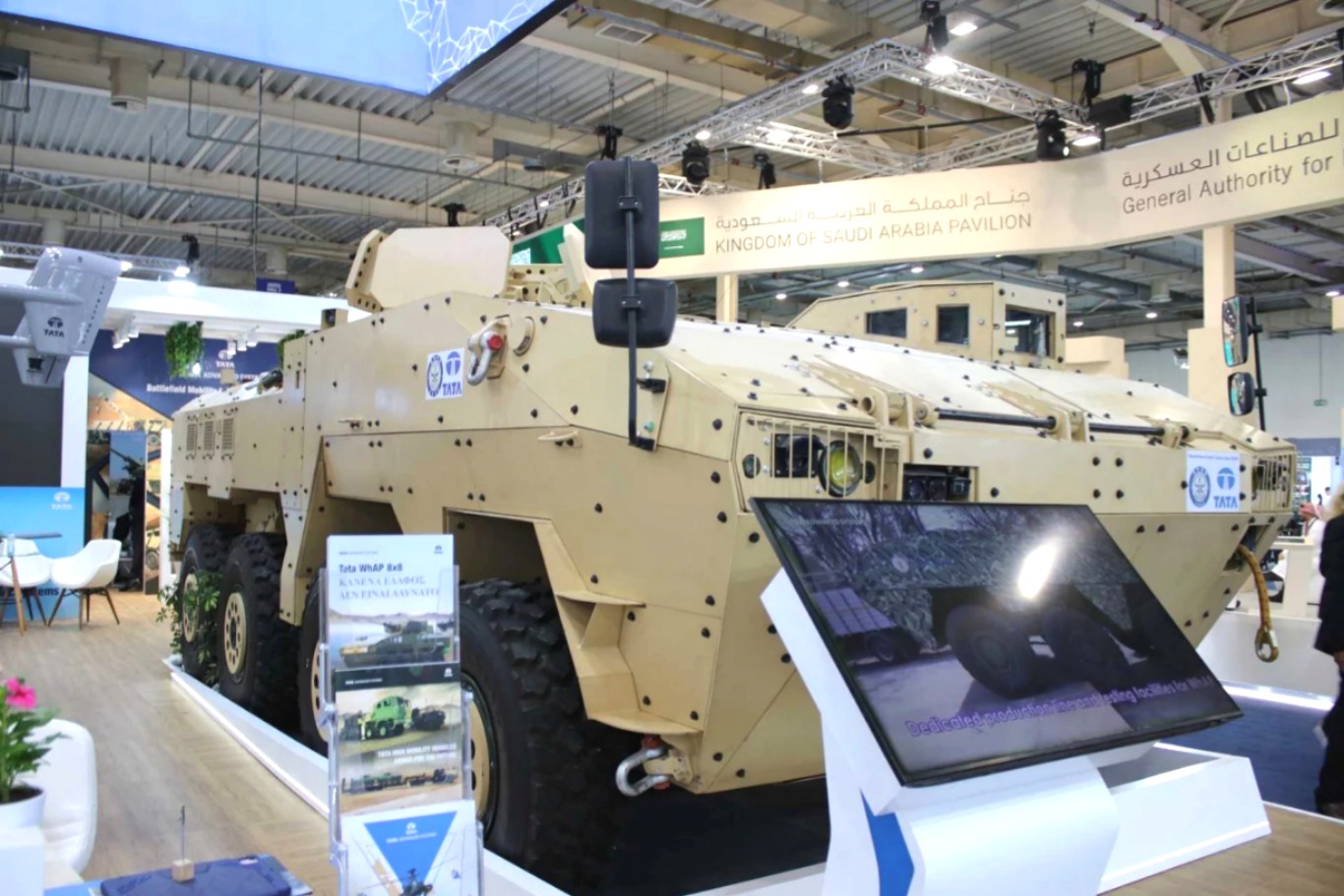
Greece To Evaluate Indian Made WhAP 8×8 Armoured Vehicle As New Contender For Greek Army.

Athens; January 2026: According to information published by Greek defence outlet NEMESIShd on January 1, 2026, and later confirmed by the Ministry of National Defence, the Hellenic Army General Staff has initiated a formal assessment of the Indian-developed WhAP 8×8 armoured infantry fighting vehicle. The evaluation follows a December 12, 2025, meeting in Athens between senior GSA officials and Tata Advanced Systems executives, during which both sides discussed the temporary deployment of the vehicle to Greece for operational trials under Hellenic Army conditions.
The decision to evaluate the Indian-made WhAP wheeled armoured vehicle is part of Greece’s broader force modernisation effort aimed at enhancing the operational mobility and survivability of its mechanised and amphibious infantry units. The platform is expected to be tested across multiple environments, including island terrain and river crossings, reflecting its potential utility in Greece’s geographically fragmented defence posture. The Hellenic Army is actively seeking replacements for aging VAB and M113-based vehicles, particularly in its motorised brigades deployed in the Aegean region.
This evaluation effort aligns with the Hellenic Army’s wider mechanised infantry modernisation roadmap, which aims to phase out legacy tracked and wheeled platforms dating back to the Cold War. The bulk of Greece’s current IFV fleet still consists of M113A1 and M113A2 armoured personnel carriers, most of which have undergone limited upgrades over the decades but remain inadequate by modern standards in terms of protection, situational awareness, and firepower. Additionally, the Hellenic Army continues to operate a number of Soviet-era BMP-1 IFVs, many of which were previously repurposed for training or second-line roles but are still fielded within island-based and border formations.
To address growing concerns about capability gaps in its frontline units, Greece has, in recent years, sought to diversify and strengthen its armoured fleet through international cooperation. A major milestone came in 2022, when Greece received an initial batch of Marder 1A3 IFVs from Germany under the ring exchange mechanism, which saw Athens transfer BMP-1s to Ukraine. The Marders have provided an immediate increase in protection and firepower, particularly in mainland mechanised infantry brigades, but they represent only a partial solution. Further acquisition plans include tracked and wheeled platforms suited for both heavy and expeditionary units, with modularity and networked integration listed as top priorities.
Jointly developed by India’s Defence Research and Development Organisation (DRDO) and Tata Advanced Systems, the WhAP 8×8 is the country’s first fully indigenous amphibious wheeled Infantry Fighting Vehicle. Its development stems from India’s Future Infantry Combat Vehicle (FICV) program, which has aimed since the late 2000s to reduce reliance on imported armoured vehicles and create a modular, multi-role platform for future battlefield conditions. The vehicle’s design integrates STANAG Level 4 ballistic protection, scalable modular armour, a remote weapon station or 30mm manned turret, and amphibious propulsion via twin water jets – capabilities that align closely with the operational needs of Greece’s island-based formations.
The WhAP is powered by a 600 hp Cummins ISXe engine mated to an automatic transmission, enabling it to reach road speeds up to 100 km/h and sustain extended off-road operations. Internally, it carries a three-man crew and eight fully armed troops, with an interior layout optimised for rapid egress and troop safety. Its amphibious design allows unassisted water crossings, a critical feature for military operations in the Aegean and Evros river regions.
The vehicle was first unveiled as a prototype at DefExpo 2014 and has since undergone several rounds of testing and configuration updates. These included improvements to hull protection, digital systems integration, and cross-country mobility. In a notable move to increase its visibility on the European market, Tata Advanced Systems displayed the WhAP 8×8 at DEFEA 2025, the international defence and security exhibition held in Athens in May 2025. Its appearance at DEFEA marked the first time the platform was formally presented on European soil, demonstrating India’s intent to position the WhAP as a credible alternative for NATO-aligned militaries seeking cost-effective yet capable armoured vehicles. Alongside the WhAP, Tata also showcased long-range drone systems, highlighting its growing dual-domain ambitions in both armoured and unmanned platforms.
Although the WhAP has completed developmental trials within India, it has yet to enter full-rate production. As of early 2026, Tata Advanced Systems has completed a limited pre-series production run, with 12 to 18 units delivered for Indian Army trials and evaluations. Procurement under India’s broader FICV roadmap has been delayed by changing specifications and structural reforms to the Ministry of Defence’s acquisition process. Nevertheless, the WhAP remains the most mature indigenous wheeled AIFV in India’s defence industrial pipeline and is positioned as a key future asset for both domestic forces and international partners.
Greece’s decision to test the WhAP 8×8 marks the first known instance of a NATO country evaluating this Indian platform for potential frontline use. While no formal procurement request has yet been issued, the Hellenic Army’s evaluation phase could pave the way for deeper defence-industrial collaboration between Greece and India, including the possibility of licensed production or technology transfer to support the Greek defence industry’s revitalisation.
The Greek Ministry of National Defence has not commented on whether other armoured vehicles will be evaluated concurrently. However, the WhAP trial occurs in the context of wider market scanning activities reportedly involving contenders such as the Patria AMV XP, FNSS PARS, and the Boxer CRV, all of which have been either demonstrated or proposed to Greece in recent years.
The arrival of the Indian vehicle for testing is anticipated in the coming weeks, with initial trials expected to begin in northern Greece before moving to amphibious training areas near Alexandroupolis and the island of Chios. The outcomes of this testing phase will directly inform the next phase of the Hellenic Army’s force transformation plan focused on rapid mobility, expeditionary capability, and interoperability with NATO-standard command systems.
Team Maverick.







Dera Chief Ram Rahim Walks Out Of Jail On 30 Days Parole.
Sirsa, Haryana; May 2026: Today (26th May 2026) Dera Sacha Sauda chief Gurmeet Ram Rahim S…

Dera Chief Ram Rahim Walks Out Of Jail On 30 Days Parole.
Sirsa, Haryana; May 2026: Today (26th May 2026) Dera Sacha Sauda chief Gurmeet Ram …