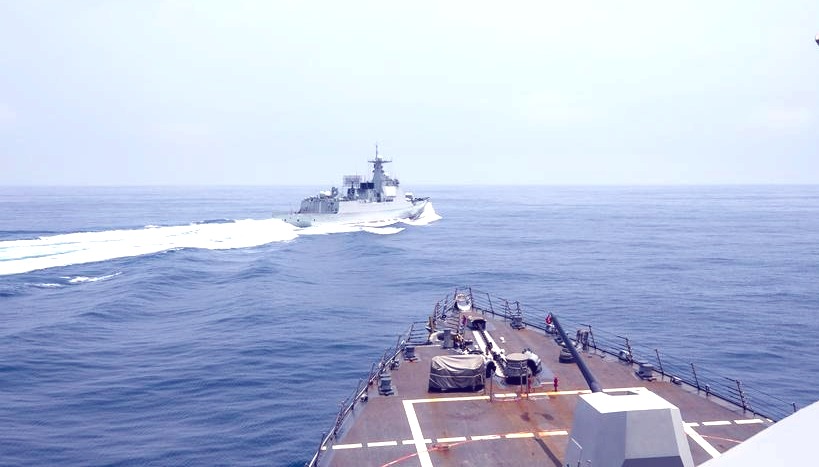
The United States Dominance Beneath The Sea Surface Face Discreet Challenges By Chinese Retro Submarine Design.

January 2026: What the United States have not done in the past 65 years, China has steadily built up its submarine fleet by making a technological U-turn. More than half of the estimated 66 submarines operated by the Chinese navy are conventionally powered. The fleet includes more than 20 newer Yuan-class diesel-electric boats.
In a sharp contrast, the U.S. Navy’s last diesel-powered submarine was the USS Blueback, a Barbel-class submarine commissioned in 1959 and retired in 1990. Moreover, The Pentagon have forecasted that China will have more than 75 submarines by 2030. The United States currently has 69 submarines, all nuclear-powered, according to the Naval Vessel Register.
| SKU | CHINA | UNITED STATES |
| Aircraft Carriers | 11 | 11 |
| Surface Combatants | 113 | 110 |
| Submarines | 67 | 69 |
| Amphibious Warfare Ships | 32 | 32 |
| Mine Warfare Ships | 4 | 4 |
| Combat Logistics Ships | 35 | 0 |
| Fleet Support | 30 | 8 |
| Auxiliary Support | 1 | 0 |
| Combatant Craft | 0 | 0 |
| Other | 0 | 2 |
| TOTAL | 293 | 236 |
The shorter construction time of the conventional submarines has allowed China to pull close to U.S. numbers and cover its strategic goals in Asia, according to a 2025 report by the nonpartisan Congressional Research Service. “The force will likely continue for some time to consist mostly of SSs”, the report said, using the abbreviation for non-nuclear-powered submarines.
China’s Yuan-class submarines are 254-foot-long boats with a displacement of 3,600 tons that can move at 20 knots submerged. They carry up to 65 crew members. The boat has 06 torpedo tubes and can launch anti-ship missiles. The Chinese Yuan-class conventional submarines use an air-independent propulsion system to recharge their batteries, which can give them a few weeks of submerged endurance.
In comparison, the main variant of the U.S. Navy’s latest Virginia-class submarine is 377 feet long, with a 7,900-ton displacement and a speed of more than 25 knots. It’s armed with 04 torpedo tubes and vertical missile launch capability. It has a crew of up to 135.
Nuclear-powered submarines are complex designs; the U.S. plans on building only 02 Virginia-class attack submarines in 2026. Meanwhile, 02 aging Los Angeles-class submarines are scheduled for decommissioning this year. The Navy is still waiting for its first of the new Columbia-class ballistic missile submarines, which the CRS says is 18 months behind schedule and not expected to be delivered prior to 2030.
The Chinese see Taiwan as a renegade province, a part of the country that split away after World War II, when Nationalist Leader Chiang Kai-shek and his supporters fled there in 1949 as Mao Tse-tung and the communists took Beijing and the rest of the country.
Then CIA-director William Burns said in 2023 that U.S. analysts believed Chinese President Xi Jinping has called on his country’s armed forces to have the capability to invade Taiwan by 2027, the 100th anniversary of the founding of the People’s Liberation Army in 1927.
The CIA did not say China would invade at that time but that the country’s political and military leaders wanted the armed forces prepared to execute a plan by then. The Taiwan Strait Risk Report, issued in 2025 by an Australian risk assessment firm, says that 50% of world container ship traffic passes through the Taiwan Strait and forecast a 30% chance of an invasion of Taiwan by China in the next five years and a 60% chance of an air and naval blockade.
Many Defence analysts have reiterated the fact that the diesel-powered submarines are a practical solution for the Chinese because any fight with the United States and its allies is likely to come close to home ports.
The potential battleground is the Taiwan Strait, in the South China Sea, which is 78 miles across from the mainland. The South China Sea is busy with ships transiting the strategically tense area, with what the Center for Strategic and International Studies has estimated is $3.4 trillion in oil, manufactured goods, and other products each year.
The Chinese have spent $50 billion to build a constellation of installations in the First Island Chain, which curves from Japan past Taiwan, the Philippines, Malaysia and Borneo, to Vietnam. It’s centered on two deepwater bays on the Chinese island of Hainan, China’s southernmost province, which is home to the Greater Yulin Naval Base and East Yulin Naval Base.
Yuan-class ships are built to operate in the relatively shallow South China Sea, with some coastal shelves just 250 feet below the surface, and many reefs, some of which China has fortified as missile-launching centres or airfields meant to give cover to Chinese ships and submarines if the U.S. and its allies intervene in the region.
The nearest American submarines are based at Guam, just over 1,700 miles from Taiwan. The next closest are 5,000 miles away at Joint Base Pearl Harbour-Hickam, Hawaii; 6,000 miles away at Naval Base Kitsap, near Seattle; or 6,800 miles away at Naval Base Point Loma in San Diego.
Nuclear power is how the Navy addresses what analysts call “the tyranny of distance” in U.S. efforts to field forces in the Indo-Pacific region. It allows the U.S. to send submarines extreme distances for long periods of time and “loiter” in and around hot spots without worrying about when or where it will have to refuel.
As it has been observed that China has used diesel submarines to spread out its “A2/AD line” — standing for “Anti‑Access/Area‑Denial” designed to keep an opponent outside an area and limit their movements within it. Submarines are one of the few weapons that can get into and around A2/AD areas, But in a combat scenario, they would be called on to carry a disproportionately large share of the fighting if other Navy ships are kept outside the zone. While these submarines could do damage to the Chinese Navy, they probably lack sufficient firepower to affect the overall outcome of a war,
Since, China has nearly achieved parity in submarine numbers with the United States, it will shift back to building more nuclear submarines with a more extended “blue sea” reach as China expands its areas of interest beyond Northern Asia. The Chinese have adeptly demonstrated the traits at building nuclear submarines and making them quieter thanks to technology sharing with Russia.
The Congressional Research Service report (CSR) have reaffirmed that the Chinese are shifting back to developing nuclear-powered submarines with the help of Moscow. A Closer tie with Russia could provide opportunities for China to overcome these enduring technological limitations by exploiting political and economic levers to gain access to Russia’s remaining undersea technology secrets, the report said.
China’s nuclear-powered attack submarine fleet consists of the larger, quieter Shang-class boats, which can fire torpedoes or TJ-18 anti-ship cruise missiles with a range of over 240 miles. The CRS notes that China’s navy is expected to grow to 435 ships by 2030. While focusing on major surface combatant ships, submarines are part of the construction mix at the three shipyards that specialize in building the boats. China is finally on the verge of producing world-class nuclear-powered submarines, the report said.
Meanwhile, a 2025 report from the Australian Naval Institute warns that the rapidly modernising Chinese Navy is taking “bold steps to field a first-rate submarine force that may be on the cusp of significant expansion”.
Team Maverick.





Gujarat Titans Post Massive 229 Against CSK After Explosive Batting Display
Ahmedabad, May 2026 : Gujarat Titans delivered a dominant batting performance to post a ma…

Gujarat Titans Post Massive 229 Against CSK After Explosive Batting Display
Ahmedabad, May 2026 : Gujarat Titans delivered a dominant batting performance to post a …