Rawalpindi; August 2026: Pakistani Filed Marshal Syed Asim Munir, Pakistan’s Chief Of Defence forces and army chief, has pledged yesterday (Thursday – 06th August 2026; late evening IST) to help Somalia in strengthening its security forces as the two countries moved to expand cooperation in counterterrorism, military training and defence capacity building.
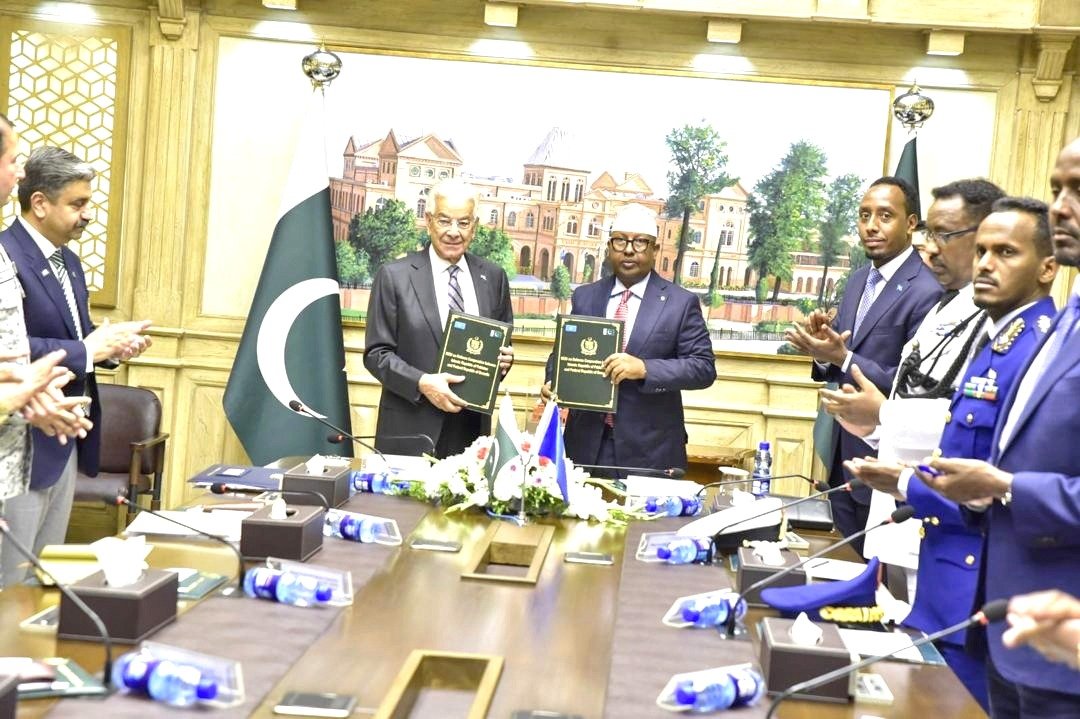
Earlier, on 04th August, 2026 (Tuesday), The Federal Republic of Somalia and the Islamic Republic of Pakistan have signed a Memorandum of Understanding (MoU) between their respective Ministries of Defence, aimed at strengthening bilateral cooperation in defence, security, and military capability development.
The MoU was signed in Islamabad by the Minister of Defence of the Federal Republic of Somalia, H.E. Ahmed Moallim Fiqi, who is on an official visit to Pakistan leading a delegation, and the Minister of Defence of the Islamic Republic of Pakistan, H.E. Khawaja Muhammad Asif.
The Memorandum of Understanding provides a framework for cooperation in counter-terrorism, military training, the exchange of military expertise and knowledge, defence capability development, and enhanced security cooperation in support of efforts to promote peace and stability. The signing of the MoU reflects the shared commitment of Somalia and Pakistan to strengthening their strategic partnership and expanding bilateral cooperation in defence and security, laying the foundation for a practical and enduring partnership that serves the mutual interests of both countries.
Munir, widely considered to be the most powerful man in Pakistan, reaffirmed Pakistan’s commitment to “supporting Somalia in strengthening its security apparatus and fostering enduring peace in the region”, the military’s Inter-Services Public Relations said.
The meeting covered regional security, shared strategic concerns and measures to expand bilateral defence cooperation, according to the statement. Both sides have stressed the importance of “deepening military-to-military ties and capacity-building initiatives to counter common security challenges”. Fiqi thanked Pakistan for its continued support and praised what he called the Pakistani armed forces’ professional role in promoting regional peace and stability.
Neither side announced an arms transfer, the deployment of Pakistani military personnel, or a timetable for implementing the proposed cooperation.
Somalia’s defence ministry said the agreement covers counterterrorism cooperation, military training and exchanges of professional expertise. The ministry said the two countries would also work together to strengthen the capabilities of the Somali Armed Forces, which remain engaged in a prolonged campaign against Al-Shabaab.
The Al-Qaeda-linked group has waged an insurgency against successive Somali governments for nearly two decades. It still controls parts of rural southern and central Somalia and regularly attacks military positions, government buildings and civilian targets. The latest agreement builds on an earlier Pakistan-Somalia defence framework signed in August 2025, which reportedly included naval training, anti-piracy coordination and technical assistance. That agreement also established a Joint Defence Cooperation Committee to review implementation and guide future collaboration.
Fiqi’s delegation also met Pakistan’s naval and air force commanders on Wednesday (05th August 2026) signalling that the partnership could extend across all three branches of the armed forces. At the Naval Headquarters, Fiqi have has held talks with Admiral Naveed Ashraf on “key matters of mutual professional interest, regional maritime security and bilateral defence collaboration”. Ashraf pledged to strengthen defence ties, while Fiqi praised the Pakistan Navy’s contribution to maritime security.
Somalia has Africa’s longest mainland coastline, stretching more than 3,300 kilometres along the Gulf of Aden and Indian Ocean. However, decades of state collapse left the country with limited capacity to patrol its waters or confront piracy, illegal fishing, weapons trafficking and other maritime threats.
At the Pakistan’s Air Headquarters, Air Chief Marshal Zaheer Ahmed Baber Sidhu discussed bilateral cooperation, professional exchanges and capacity building with the Somali delegation.
Sidhu highlighted Pakistan’s domestic defence capabilities, military training programmes and professional exchanges. He also pledged support for institutional cooperation with the Somali Air Force.
Fiqi praised the force’s “professionalism and operational capabilities”, according to the Pakistani account of the naval and air force meetings. The two governments however have not released any details about specific equipment, training numbers or possible weapons purchases.
The new partnership comes as Somalia tries to rebuild its military while reducing its dependence on foreign troops. The African Union Support and Stabilisation Mission in Somalia, known as AUSSOM, supports Somali forces in operations against Al-Shabaab and Islamic State-linked militants. The mission also protects strategic population centres and key infrastructure while gradually transferring security responsibilities to Somali institutions. But AUSSOM faces persistent funding shortages that have raised doubts about its ability to sustain operations. African countries have warned that the mission could be approaching the end of its current form unless international partners provide predictable financing.
The United States added to those concerns in July when it said it would block continued UN logistical support for AUSSOM from 2027. The UN support operation provides food, fuel, transport, medical evacuation and other essential services to African Union troops. The uncertainty has increased pressure on Mogadishu to develop security forces capable of independently planning operations, holding recovered territory and maintaining military equipment.
Pakistan and Somalia had already agreed in January to expand cooperation on internal security, border management, disaster response and counterterrorism. During those talks, Somali Interior Minister Ali Yusuf said his country was “facing a difficult situation and was actively fighting terrorists”.
The latest meetings move that cooperation further into Somalia’s military institutions, with both governments placing training, professional exchanges and long-term capacity building at the centre of the partnership.
Team Maverick.