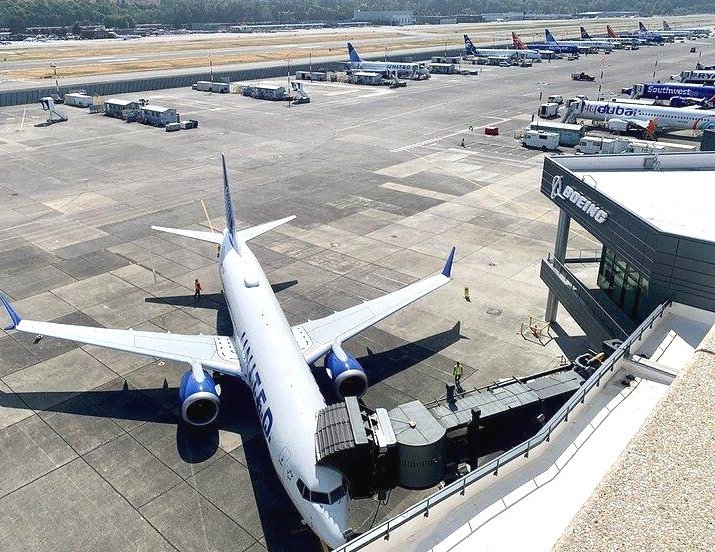
Washington DC; September 2026: Boeing continues to deliver 737 MAXs while it grapples with how to address an identified risk embedded in its latest flight management system (FMS) software that operators are refusing to use.
The problem, introduced in FMS Update 14 (U14), affects missed approaches when pilots change the published procedure in the flight management computer (FMC). In these scenarios, the aircraft’s automatic vertical navigation (VNAV) disengages, meaning pilots must intervene to ensure they maintain the correct altitude.
As per Boeing’s Press Release dated September 27th 2026 – the company is working to rectify a flaw in the 737's automated flight guidance software which, in the case of a landing missed approach, forces the crew to resort to manual control or secondary pitch control modes.
“Last month, we informed all 737 operators about a software issue where pilots may not have access to automated flight guidance during a specific landing scenario. We have shared information with operators that reinforced existing pilot procedures for safely handling such cases. Our engineers are working on a software update to permanently address the issue”, the press release read.
The software problem occurs following a missed approach, when a pilot alters the programmed flight path. At that point, according to Boeing, the flight management computer software issue may result in the flight guidance system incorrectly transitioning from VNAV (vertical navigation) mode to a simpler, more rudimentary level of automation for pitch control, like level-change or vertical speed.
Boeing says pilots are trained to safely land an airplane without automated VNAV. It notified the FAA of the issue as part of its safety review process. Work is taking place under the FAA's oversight to complete the software update. Boeing also says it is working directly with airlines to formalise a procedure that will allow pilots to re-enable automated VNAV should the situation occur.
The navigation issue, which Boeing informed operators of in August, comes as the company prepares to begin deliveries of the recently certified 737-7 and secure the long-delayed FAA approval for the stretched 737-10, the final version of the MAX family. Although Boeing says the software issue does not present a safety concern, it remains unclear if the problem will impact the timing of either milestone.
Boeing began delivering 737s with the U14.0 software load as early as 2020 and followed up with U14.1 version in early 2022, sources with knowledge of the timeline tell Aviation Week. However, it was not until November 2024 that Boeing learned of VNAV disconnect issues from operator feedback. The following February, Boeing assessed the snags with the software and found that it did not meet the necessary criteria for a safety evaluation.
Fast forward to August 2026 and, after further feedback from operators which provided a broader view of the VNAV-missed approach issue, Boeing published information on the situation in its fleet digest. The digest was published in late August, a few weeks after the FAA certificated the 737-7 with U14.0 and with the 737-10 apparently nearing the finish line of its prolonged regulatory approval program.
Both the baseline 737-8 and -9 were certificated with the U13.0 software load which was delivered beginning in 2017. These fleets will be updated to U14.0 standard, while the 737-10, which is yet to be certified, will be delivered with the U14.1 load.
Boeing 737-7s for Southwest Airlines, which will be the first to receive the smallest version, will have U14.0 as standard. Southwest, which was not planning to start taking deliveries until the November timeframe, has said it will not accept aircraft that have the problematic software.
Deliveries of 737-8s and 737-9s are continuing, but Boeing is rolling back the FMS software to U13 if customers request it. A subset of the in-service fleet that upgraded to U14 or U14.1 have also rolled back to U13 in recent weeks, an airline source confirmed. The software can be installed on the in-service 737 MAX and 737 Next Generation families.
Alaska Airlines, a 737-10 customer, confirmed its 737 MAXs are running version U13, while its 737NGs are operating U12. United Airlines declined to discuss software versions, but confirmed that none of its fleet is affected and it is not accepting deliveries with U14-version software. The carrier has taken at least 10 737 MAX deliveries since August 01.
But hardware configuration changes mean the 737-7 and 737-10 must use a version of U14 unless the software or flight management computers are modified. Boeing has 27 737-7s and 25 737-10s in its undelivered inventory.
FMS U14.1 addressed a known issue that caused flight management computers to re-set when loaded with a flight plan containing a specific set of parameters. The re-set is triggered by the combination of a vector as the go-to waypoint, followed by a route discontinuity, then a waypoint with a required navigational performance, an NTSB document linked to the investigation of a 2022 737 MAX wrong-runway landing explained. In the incident, the dual FMC reset was flagged as a contributing factor.
“We did certify” U14.1 as part of the 737-7 approval, FAA Administrator Bryan Bedford said during a September 28 press briefing on air traffic control modernisation. “It fixed a known bug on the vertical navigation system and unexpectedly introduced a new bug”, he added, noting that the VNAV issue is “smaller” than the FMC reset issue.
“The issue that we’re looking at right now is the workload component under these more obscure situations and how we feel about that”, Bedford said. “We will be delaying the 737-10’s certification until we realise, until we’re satisfied, that we don’t have an issue here”.
The FAA’s review could go several ways. It could determine the issue must be addressed before affected aircraft enter service or, in the 737-10’s case, are certified. A more likely outcome is developing an approved procedure for pilots to follow if they face the VNAV issue while Boeing and software supplier GE Aerospace fast-track a fix.
“In this particular case, due to the focus that’s on it, GE may try to get this software correction in much quicker”, Bedford said. “Is that weeks, days, months? I don’t know. It remains to be seen”.
Team Maverick.