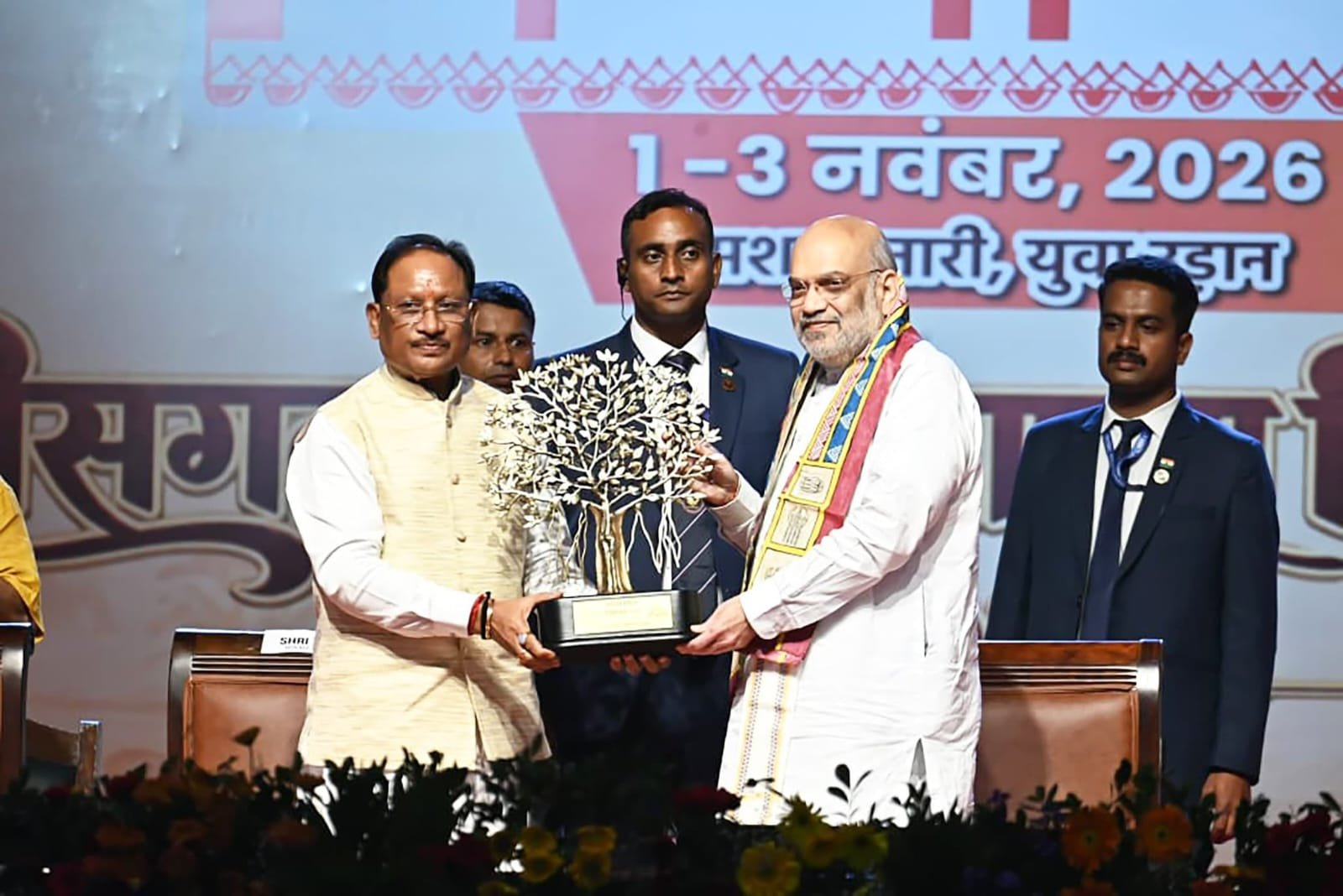
Union Home and Cooperation Minister Amit Shah on Tuesday addressed the concluding ceremony of the Chhattisgarh Rajyotsav celebrations in Raipur, congratulating the people of the state, particularly members of the tribal community, on Chhattisgarh becoming free of Naxalism. He also commended the Central Armed Police Forces (CAPF) and Chhattisgarh Police for their role in the achievement.
Chhattisgarh Chief Minister Vishnu Deo Sai, Deputy Chief Minister Vijay Sharma and several other dignitaries were present at the event.
Shah paid tribute to former Prime Minister Atal Bihari Vajpayee, crediting him with the creation of Chhattisgarh as a separate state in 2000. He said that while Vajpayee had established the state, Prime Minister Narendra Modi had worked towards its development.
Describing the occasion as a day of pride, achievement and renewed commitment, Shah said the state had fulfilled its long-standing resolve to become Naxal-free. He added that the next goal was to build a developed Chhattisgarh under the leadership of Modi and Chief Minister Sai.
Highlighting the state's cultural heritage, Shah referred to the messages of Guru Ghasidas and Guru Nanak Dev, particularly their emphasis on service, equality and truth. He said the state government was organising Chhattisgarh Pandum and Bastar Olympics to preserve and promote local traditions. Folk forms such as Panthi, Pandavani, Raut Nacha, Karma and Saila, along with Dhokra art, bell-metal craft, woodwork and Kosa silk, had received renewed recognition. He also highlighted the unique 75-day Bastar Dussehra festival.
Shah questions criticism of anti-Naxal operations
Shah said the people of Chhattisgarh had given his party a mandate to govern, following which the government resolved to eliminate Naxalism within two months. He alleged that areas which should have developed as cultural corridors had instead become part of the Red Corridor.
He referred to the impact of Naxal violence on tribal communities, saying children who should have been holding books were forced to take up weapons, schools were destroyed and roads meant to facilitate development became targets of violence.
Questioning those who supported Naxalism in the name of human rights, Shah asked whether the rights of poor tribal people were not equally important. He said the government was providing artificial limbs to people who had lost their hands or legs in explosions over the past three decades.
He also invited writers and commentators who had criticised anti-Naxal operations from a distance to visit the region, witness the development taking place and write about the suffering of tribal communities.
The Home Minister accused the opposition party of supporting Naxal groups and referred to a statement made by a senior minister in the previous government in 2010, suggesting that Naxals did not need to surrender their weapons as long as they stopped creating trouble.
Shah said his government's position was that those willing to surrender would be welcomed into the mainstream, while security forces would confront those who continued armed violence. He claimed that 90 per cent of Naxals had surrendered and 10 per cent had been killed. He added that the government's approach was to treat those who obeyed the law as citizens while taking action against those who violated it.
Criticism over parallel Naxal administration
Shah alleged that the opposition had supported unconstitutional establishments, referring to the Naxal-run 'Jantana Sarkar' in Chhattisgarh. He said the parallel administration had designated its own ministers, including a Home Minister, Chief Minister and Finance Minister, and had punished innocent journalists, social workers and students.
He questioned the constitutional authority of such a parallel government and accused opposition leaders of supporting it. He also criticised the opposition for holding a mock Parliament, alleging that it had made a mockery of parliamentary proceedings.
Shah said the Modi government was ready to discuss every issue, including the Special Intensive Revision (SIR), in Parliament. He challenged the opposition to allow Parliament to function and participate in a debate, saying that the public would then be able to judge the arguments presented by both sides.
He added that carrying a copy of the Constitution was not enough and that respect for it had to be reflected in one's conduct.
Government's development agenda
Shah said the Chhattisgarh government, led by the Chief Minister and two Deputy Chief Ministers, had fulfilled more than 70 per cent of the guarantees given by the Modi government. He cited the 33rd instalment of the Mahtari Vandan Yojana, ongoing paddy procurement and progress in agriculture, forest produce, animal husbandry and the MSME sector.
He expressed confidence that a Naxalism-free Chhattisgarh would emerge among the country's top three tourism destinations. He cited Chitrakote and Tirathgarh waterfalls, Kanger Valley National Park, Maa Bamleshwari temple, Maa Danteshwari temple in Dantewada and the Bastar Dussehra festival as attractions capable of drawing visitors from across the world.
Referring to the state's economic and educational progress, Shah said Chhattisgarh's annual budget had increased 30 times and per capita income 17 times. The state's Gross State Domestic Product (GSDP), he said, had grown 25 times. The number of ITIs had doubled, engineering colleges had increased threefold, and polytechnic colleges, colleges and universities had grown sixfold. He also claimed that literacy had risen from 65 per cent to 79 per cent.
Shah said the earlier perception that Chhattisgarh had rich natural resources but poor people would change over the next decade. He said the government's objective was to ensure prosperity for both the state's people and its natural resources.
He concluded by saying that the government's fourth term in Chhattisgarh would seek to move the state from fear to trust and from resources to prosperity, while transforming its potential into tangible development.