Detailed Discussion on Finalising 20-Point Action Plan in Compliance with Supreme Court Directions
River Rejuvenation, Drainage Line Treatment, Groundwater Quality Monitoring and Full-Capacity Operation of CETPs Given Priority
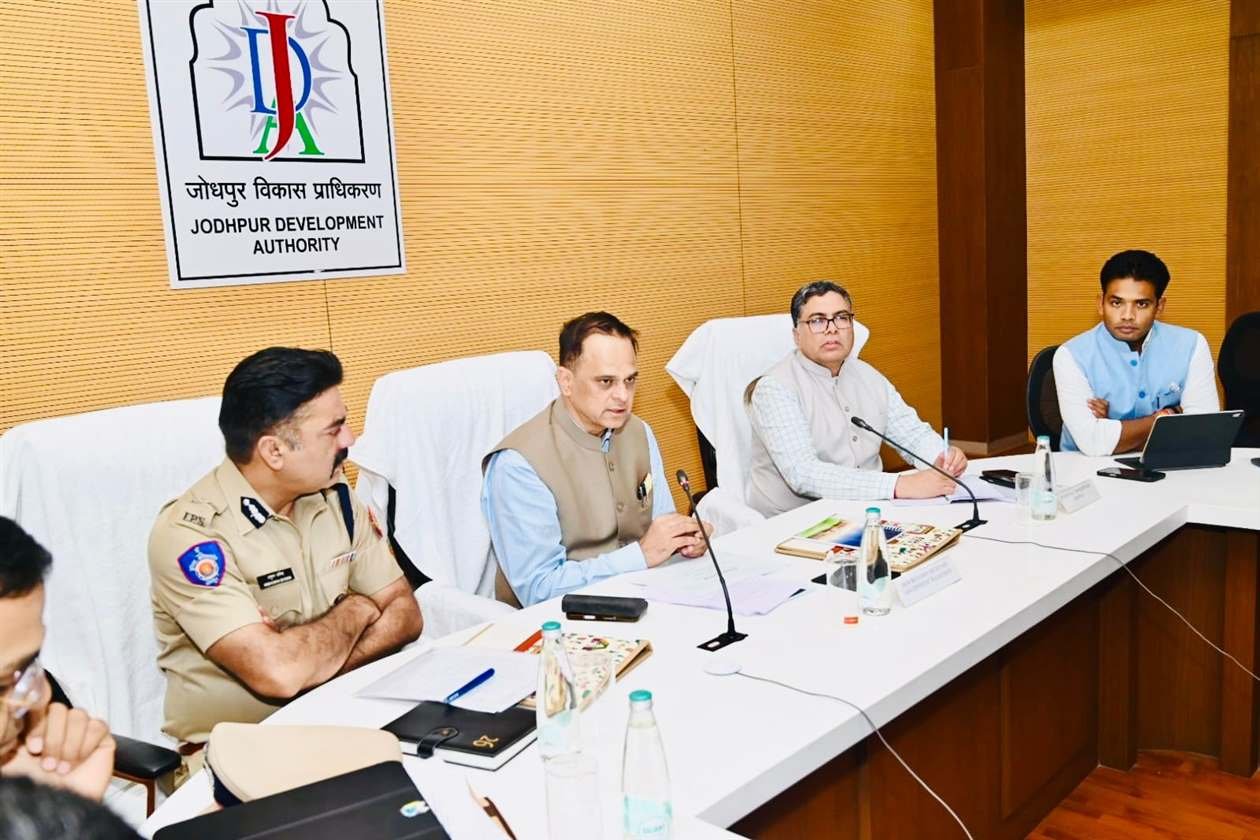
Jaipur, September 2026 : A high-level meeting chaired by Chief Secretary V. Srinivas was held on Saturday at the auditorium of the Marwar International Centre to review issues related to water management, pollution control and environmental improvement in Jodhpur, Pali and Balotra districts.
Jodhpur District Collector Alok Ranjan, Pali District Collector Dr Ravindra Goswami, Balotra District Collector Sushil Kumar, Jodhpur Police Commissioner Anshuman Bhomia, Chief Executive Officer of Jodhpur Zila Parishad Ashish Kumar Mishra, Municipal Corporation and JDA Commissioner Rahul Jain, Jodhpur Superintendent of Police Kamal Shekhawat, along with senior officials from the Rajasthan State Pollution Control Board, Police Department, Discoms, RIICO, Agriculture Department, Municipal Corporation, Water Resources Department and other concerned departments, attended the meeting.
During the meeting, all three district collectors made PowerPoint presentations on issues related to water management, pollution control and environmental improvement in their respective districts.
20-Point Action Plan to be Prepared in Compliance with Supreme Court Directions
Chief Secretary V. Srinivas said that an integrated group has been constituted at the level of the Chief Secretary of Rajasthan in accordance with the directions of the Supreme Court. The group will prepare a 20-point action plan.
He said that following consultations with the high-level committee, the action plan is proposed to be presented before the Supreme Court next week. He directed the concerned departments to work in coordination and prepare a concrete, practical and outcome-oriented action plan.
Ground-Level Inspection of Ongoing Works
Before the meeting, the Chief Secretary visited the Sewage Treatment Plants (STPs) at Basni-Benda and Salawas and inspected the treatment processes and functioning of the plants on the ground.
He reviewed the operation of the STPs, treatment processes and arrangements for optimal utilisation of their available capacity. He said that the action plan would be made more effective and practical based on facts gathered during the site inspections, suggestions received from industrial units and discussions held with the concerned departments.
River Rejuvenation and Drainage Line Treatment to Receive Priority
The meeting held detailed discussions on measures required for river rejuvenation, treatment of drainage lines and scientific management of polluted water.
The Chief Secretary stressed the need for a coordinated approach to ensure proper treatment of waste and sewage coming from different sources and management of treated water in accordance with prescribed standards.
Data-Based System for Regular Groundwater Quality Monitoring
Strengthening groundwater quality monitoring was also discussed in detail. The meeting considered the collection of necessary datasets through scientific processes based on piezometers and hydrogeology.
Officials were directed to prioritise the development of an effective mechanism for regular monitoring of groundwater conditions and undertaking necessary corrective measures based on scientific analysis of the available data.
Ensure Full-Capacity Operation of CETPs
The Chief Secretary described the effective functioning of Common Effluent Treatment Plants (CETPs) established in industrial areas as extremely important and stressed the need for optimal utilisation of their available treatment capacity.
It was informed during the meeting that an investment of around Rs 500 crore has been made in establishing CETPs. However, some plants are not operating at their expected capacity, while several CETPs are functioning below capacity.
In view of this, detailed discussions were held on measures to ensure maximum utilisation of the available infrastructure and operate CETPs at their full capacity.
Better Coordination Between CETP Trusts and District Administration
The meeting also discussed the need for effective coordination between trusts and institutions associated with CETP operations and the district administration.
Discussions were held on developing appropriate institutional mechanisms for better coordination in plant operations, monitoring, capacity utilisation and fulfilment of related responsibilities. Officials were directed to develop practical solutions through mutual coordination.
Emphasis on Inter-Departmental Coordination and Time-Bound Implementation
The Chief Secretary said that issues such as river rejuvenation, treatment of sewage and industrial waste, groundwater quality monitoring and effective operation of treatment plants are interconnected.
Therefore, these issues should not be addressed separately at the departmental level but should be taken forward through an integrated approach. He directed the concerned departments to provide the required information, suggestions and action-plan points at their respective levels and work proactively to finalise the proposed 20-point action plan within the stipulated timeframe.
The meeting also held detailed discussions on the key elements of the action plan proposed to be presented before the Supreme Court next week, the priority of required interventions, departmental responsibilities and the roadmap for implementation.