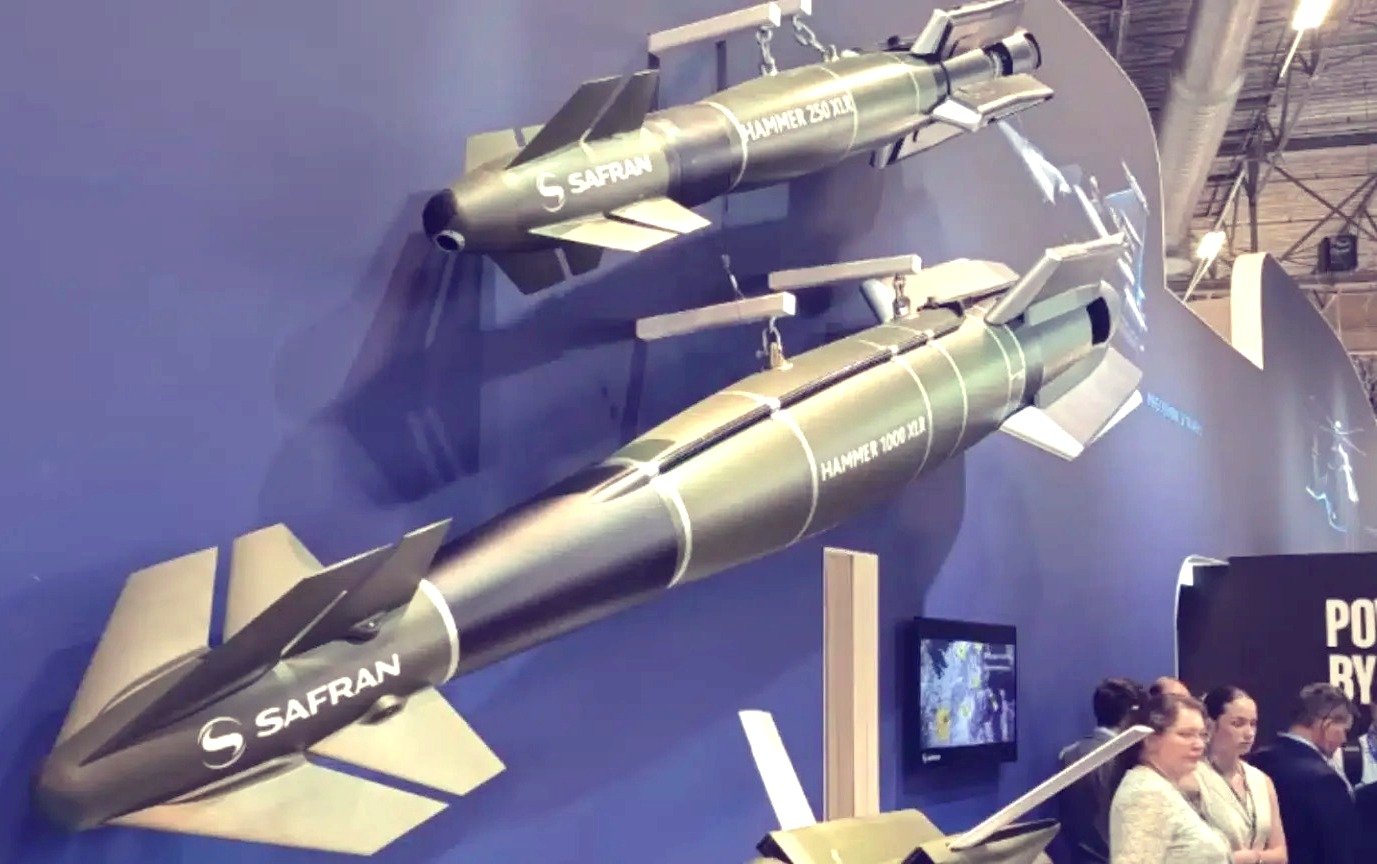
Paris; October 2026: France is preparing to give the Rafale a longer-reaching weapon against enemy air defences, with Safran’s Hammer 250 XLR intended to provide an interim strike capability from around 2028 while a more specialised missile remains years away. The development addresses a consequential weakness in French combat aviation: aircraft equipped with sophisticated self-protection systems and precision weapons have nevertheless operated for roughly three decades without a dedicated missile designed to attack hostile radar emissions directly.
The Hammer 250 XLR would extend the reach of the existing AASM Hammer family to approximately 140 kilometres from high-altitude release, creating additional separation between the launch aircraft and selected radar installations or associated air-defence infrastructure during an attack. However, that distance does not establish a universal sanctuary against modern surface-to-air missiles, and the munition’s precision guidance must not be confused with the specialised emission-homing mechanism normally associated with an anti-radiation missile used for reactive radar suppression.
The longer-term plan centres on MBDA’s Stratus RS and the Rafale F5 around the mid-2030s, leaving France with a phased recovery in which an earlier precision-strike improvement must bridge the interval before a more ambitious capability becomes available. France’s earlier dedicated capability rested on the AS.37 Martel anti-radiation missile, carried principally by the Jaguar and previously the Mirage IIIE, providing a specialised means of attacking radar emitters before the withdrawal of the weapon during the late 1990s.
The disappearance of that capability followed the dissolution of specialised formations, including EC 2/11 Vosges in July 1996, demonstrating how force-structure decisions can remove operational expertise alongside equipment and make later recovery more demanding than simply purchasing another munition.
Martel’s passive seeker required selection of the relevant frequency band before flight, an important limitation because an aircraft could not freely adapt that setting during a mission as the electromagnetic threat picture changed or an unexpected radar became relevant. Its employment against a Libyan surveillance radar at Ouadi Doum in January 1987 illustrated both its value and its constraints, with the wider operation requiring reconnaissance support, decoy activity, aerial refuelling, and conditions that encouraged the target to emit.
That historical example remains operationally relevant because successful radar attack requires more than a weapon able to detect radiation, particularly when an opponent can manage emissions, exploit uncertainty, or force the attacker to commit supporting aircraft before revealing a target. The post-Cold War reduction in emphasis on heavily layered air defences coincided with budget pressure and force reductions, while precision weapons and the Rafale’s SPECTRA electronic-warfare suite offered alternative ways to manage threats without replacing the specialised Martel mission directly.
SPECTRA’s detection, identification, jamming, and decoying functions support aircraft survivability, but their presence does not automatically provide the physical destruction of a radar installation that a separate kinetic weapon and a successful targeting sequence might achieve during combat operations.
Similarly, weapons directed at known coordinates can strike air-defence infrastructure without providing the same response to a newly detected emitter, making the distinction between preplanned attack and reactive suppression central to judging what France lost and what it now proposes. Reliance on allied suppression capabilities offered another means of addressing the shortfall, but DSA assesses that such reliance can constrain independent mission planning whenever the required aircraft, weapons, intelligence, or supporting assets must be coordinated across national command arrangements.
Safran’s Hammer 250 XLR builds on a modular weapon architecture combining a conventional bomb body, a forward guidance section, and a rear propulsion package, allowing the proposed improvement to draw on an established family rather than an entirely separate weapon concept.
The principal propulsion change replaces the standard solid-fuel rocket booster with a miniature turbojet, using sustained thrust to increase reach while preserving an external configuration broadly similar to existing Hammer weapons despite the requirement to accommodate an air intake.
Safran’s stated high-altitude range for the XLR variants is at least 140 kilometres, compared with more than 70 kilometres commonly associated with standard Hammer under suitable conditions, although operational release altitude, aircraft speed, and flight profile remain essential qualifications. For Rafale crews, the resulting advantage would be greater choice in release position against a located target, potentially reducing the requirement to approach some defended areas as closely as a shorter-reaching weapon would require under otherwise comparable mission conditions.
That advantage must be evaluated against the actual defence network, because a 140-kilometre weapon release can still occur within the engagement envelope of some long-range systems and does not prevent other sensors from detecting or tracking the launch aircraft.
The 250-kilogram class uses a conventional bomb body in the approximately 227-kilogram category, making the proposed weapon a means of delivering a substantial explosive payload against selected installations rather than merely disrupting radar operation through electronic effects alone.
A larger 1,000 kilogram XLR version is also envisaged, but the lighter configuration is the one specifically associated with the interim French air-defence suppression role, and the supplied information does not establish a final operational mix or procurement allocation.
Existing Rafale configurations carrying multiple standard Hammer weapons suggest a potentially useful foundation for mission planning, but imagery showing six conventional Hammer 250 munitions does not establish an identical certified XLR loadout, operational radius, or available combat payload configuration.
Longer reach also changes the supporting mission’s geography, because launch points can be selected farther from some targets, although DSA assesses that fuel planning, fighter protection, sensor coverage, and the route into a release position still govern usable operational freedom. The practical breakthrough would therefore be an expanded set of attack options against established locations, with the scale of any survivability improvement determined by the relationship between weapon performance, hostile sensor coverage, and the specific threat confronting the aircraft.
The Hammer family’s guidance options combine inertial navigation and GPS with optional infrared or semi-active laser terminal guidance, providing different methods of reaching and identifying a target without making those methods equivalent to a specialised radar-emission-homing seeker in combat. A dual-mode laser-infrared seeker underwent three successful firings within less than 24 hours in the month of March this year (2026), but those family-level tests do not independently confirm the complete seeker configuration, qualification status, or operational availability of the future XLR suppression weapon.
Infrared scene matching and laser designation can add terminal targeting options, while navigation support remains important throughout flight, particularly where satellite-navigation interference complicates the relationship between the programmed target position, the weapon’s estimated location, and the desired impact point.
The central operational risk is target movement between detection and impact, because a radar vehicle that leaves an accurately identified position can invalidate the coordinates on which a precision attack depends even if the munition performs as designed throughout flight.
The ASTAC electronic-intelligence pod on upgraded Mirage 2000D aircraft is intended to help locate and characterise emitters, making those aircraft relevant to the targeting process even though the supplied plan does not envisage integrating Hammer XLR on that platform.
The three planned Falcon ARCHANGE signals-intelligence aircraft would add another element to the collection architecture, with first delivery targeted by the end of 2028, although aircraft delivery alone would not demonstrate a fully operational or continuously available targeting service.
Data links are consequently important to the proposed approach because information collected by one aircraft must become usable targeting knowledge for another, and any delay, uncertainty, or failure to maintain identification can reduce the opportunity to attack a mobile system. An opposing force could complicate this process through radar silence and relocation, while DSA assesses that attacks on fixed or semi-fixed installations would generally offer a more tractable targeting problem than attacks on emitters able to move rapidly after detection. Electronic warfare remains complementary because temporary suppression may create a useful passage without destroying equipment, whereas destruction of enemy air defences requires sufficient target identification and physical effects to remove the relevant capability for a more sustained operational period.
Integration on the Rafale F4 standard offers a nearer-term path than waiting for the Rafale F5, but an aircraft already cleared for standard Hammer still requires the relevant work to accommodate a changed propulsion system, software, and flight behaviour. The supplied account places prospective operational availability around 2028 without confirming a public production award or intended quantities, leaving the future inventory, replenishment capacity, and sustainable number of suppression sorties unresolved despite the clarity of the stated operational requirement.
Those omissions matter because a limited stock could support occasional attacks without sustaining a prolonged campaign, while a deeper inventory would offer commanders more opportunities to revisit surviving installations or exploit newly identified weaknesses in an air-defence network over time. Using an established modular family could offer commonality benefits, but the turbojet introduces a changed propulsion element whose maintenance demands, support equipment, and supply arrangements cannot be assumed identical to those associated with the current rocket-assisted Hammer inventory in service.
Force posture must also account for the aircraft collecting intelligence, since a Rafale strike package depending on Mirage 2000D or Falcon support draws on several fleets whose availability and positioning influence when a credible suppression mission can actually be generated. The projected arrival of the first ARCHANGE aircraft near the same period as the proposed XLR capability creates a potential coordination challenge, because weapon fielding and intelligence-fleet delivery are distinct milestones that do not necessarily produce simultaneous operational maturity.
Training must connect those elements into a repeatable mission, with crews understanding target confidence, weapon limitations, identification requirements, and the difference between temporary radar silence and confirmed destruction before commanders can assess whether a defended route has become usable.
Strategically, announcing the recovery of a neglected capability signals intent to strengthen French freedom of action, but DSA assesses that opponents would judge its credibility through deployment evidence, demonstrated integration, available stocks, and the consistency of associated operational preparation.
For allies, the relevant question is whether France can eventually contribute a dependable suppression capability alongside its existing precision-strike forces, thereby expanding coalition options while reducing the extent to which particular missions depend on scarce support supplied by other countries.
Team Maverick.