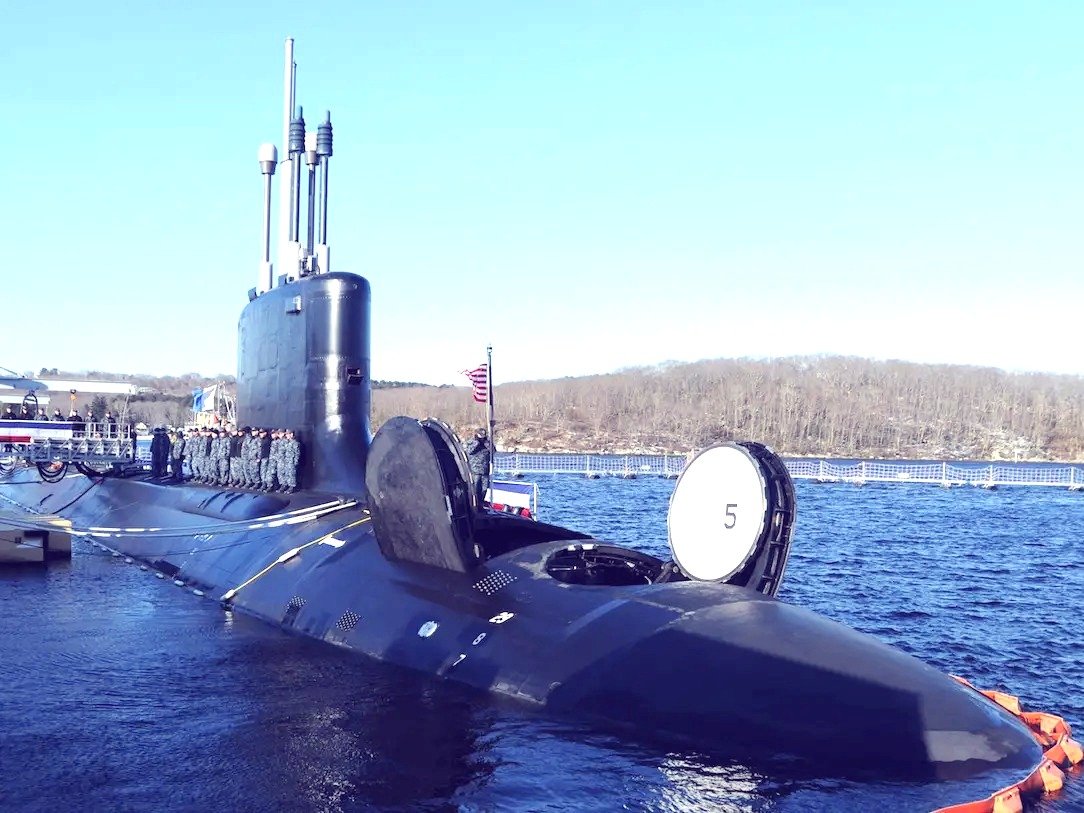
Washington DC; October 2026: US Secretary of War Pete Hegseth, Australian Deputy Prime Minister and Minister for Defence Richard Marles, and UK Secretary of State for Defence Wes Streeting are pleased to announce the designation of the USS Colorado (SSN 788) as the first US Navy Virginia-class fast-attack submarine assigned to Submarine Rotational Force-West (SRF-West) beginning in late 2027.
This announcement comes ahead of the upcoming United States Submarine Maintenance Period, which begins later this week and will further demonstrate Australia's growing ability to sustain US and UK nuclear-powered fast-attack submarines.
SRF-West is projected to host up to 04 US fast-attack submarines and one UK fast-attack submarine on a rotational basis at HMAS Stirling, a Royal Australian Navy base in Western Australia. SRF-West will accelerate Australia's readiness in owning, operating, maintaining, and regulating a sovereign, conventionally armed, nuclear-powered submarine capability, as well as support submarine deployments by expanding maintenance options and sustainment infrastructure in the region for AUKUS partners.
SRF-West, established at Australia's invitation and as mutually determined, will operate in accordance with relevant international agreements between and among the United States, Australia, and the UK, including the United States – Australia Force Posture Agreement. AUKUS activities associated with SRF-West will be conducted consistent with the AUKUS partners' respective international obligations, including those under the Treaty on the Non-Proliferation of Nuclear Weapons, and Australia's obligations under the South Pacific Nuclear Free Zone Treaty (Treaty of Rarotonga).
As President Donald Trump has stated, and Prime Minister Albanese and Prime Minister Burnham have reaffirmed, AUKUS is moving "full steam ahead". The selection of USS Colorado (SSN 788) as the first submarine assigned to SRF-West in 2027 marks a significant milestone for AUKUS Pillar I and is a decisive step in strengthening collective deterrence in the Pacific.
The Virginia-class Block III attack submarine is scheduled to operate from HMAS Stirling, near Perth, making its assignment a concrete force-posture milestone within a programme whose strategic value depends on maintenance capacity, trained personnel, and dependable infrastructure ashore.
For Australia, the immediate development concerns hosting and supporting allied submarines before operating its own, creating a transitional arrangement in which access to advanced undersea capabilities develops alongside the industrial competence necessary to sustain a sovereign fleet independently. The planned force could comprise up to 04 American Virginia-class submarines and 01 British Astute-class submarine, although that ceiling describes the intended rotational framework rather than demonstrating that 05 boats will immediately become operationally available from Western Australia.
Nuclear propulsion gives these conventionally armed attack submarines sustained submerged endurance, but their practical availability still depends on provisions, crew performance, equipment condition, and maintenance scheduling, making the supporting logistics footprint central to the military significance of Colorado’s selection. The rotational arrangement is intended to expand allied sustainment options across the Indo-Pacific while giving Australian sailors and maintenance personnel practical experience, combining an immediate operational purpose with a longer transition toward nationally operated nuclear-powered attack submarines and their support requirements.
Australia describes the model as rotational rather than permanent foreign basing, a distinction that preserves its stated policy framework while still permitting extended allied submarine activity and the establishment of support organisations with a substantial local personnel footprint. The deployment therefore carries strategic signalling beyond the arrival of one submarine, indicating that the partners intend to anchor undersea cooperation in physical facilities, maintenance procedures, and trained teams rather than relying exclusively on future procurement commitments alone. However, the material does not establish Colorado’s patrol routes, rotation duration, operational tasking, or weapons load, leaving the scale of its immediate contribution uncertain even as the assignment clarifies the platform selected to begin this phase of AUKUS.
Colorado brings an established Virginia-class configuration to the planned rotation, with a submerged displacement of approximately 7,800 tons and a length approaching 115 metres, combining nuclear propulsion with sensors and weapons suited to several distinct undersea warfare missions. Its S9G pressurised-water reactor drives a low-noise pump-jet propulsor, supporting submerged speeds above 25 knots, although those specifications do not reveal the tactical speed, acoustic signature, or machinery condition that would determine performance during a particular operational deployment.
The submarine’s Large Aperture Bow sonar replaces the traditional air-backed spherical arrangement with a water-backed array, a design change associated with improved passive detection and longer-life transducers that also reduces hull penetrations and the burden of through-life maintenance requirements. Passive sensing matters because an attack submarine must develop an underwater picture while managing its own detectability, but the supplied information provides no detection ranges or comparative acoustic data sufficient to quantify Colorado’s advantage against any particular opposing submarine.
·02 numbers of large-diameter Virginia Payload Tubes replace 12 individual vertical-launch tubes, retaining capacity for up to 12 Tomahawk cruise missiles while introducing greater payload flexibility, although the configuration does not establish which weapons Colorado would actually carry during Australian rotations.
·04 numbers of 21-inch torpedo tubes support the submarine’s additional weapons options, including Mk 48 ADCAP torpedoes, giving its anti-submarine and anti-surface missions a separate delivery mechanism from the vertical-launch system used for its potential Tomahawk land-attack cruise missile loadout.
These capabilities create competing mission demands because weapons allocation, surveillance requirements, and deployment endurance must be reconciled within one hull, meaning a submarine configured for one task cannot automatically be assumed to provide maximum capacity across every other role. The class also supports intelligence, surveillance, reconnaissance, and special operations, expanding its possible utility beyond weapons employment, although the presence of suitable design features should not be treated as confirmation that Colorado has received any specific mission assignment locally.
Colorado’s approximately 130–135 personnel illustrate the human demands behind nuclear-powered endurance, since a reactor’s ability to sustain propulsion does not remove the need to manage watchkeeping, specialist qualifications, food supplies, accommodation, and recovery between operational periods at sea.
Its Block III identity also matters for capability comparisons: Colorado is the initial rotational platform described here, while the later Australian acquisition pathway refers to Block IV-standard boats, making the two phases related but operationally and administratively distinct commitments.
HMAS Stirling, which is the primary Royal Australian Navy (RAN) base on the west coast of Australia -serves as the home of Fleet Base West.HMAS Stirling’s strategic importance rests on the range of support functions being developed around submarine access, with upgrades to Diamantina Pier and reliable shore power intended to provide foundations for recurring nuclear-powered submarine visits and associated maintenance activity ashore.
Shore power is an enabling service rather than a headline combat capability, yet dependable utilities help support alongside work, illustrating how infrastructure reliability can influence the duration and complexity of maintenance periods conducted away from a submarine’s established homeport.
A purpose-built submarine training centre is intended to connect classroom preparation with operational requirements, allowing the hosting programme to develop a more durable skills pipeline as increasing numbers of Australian personnel move into nuclear-powered submarine operations and technical support roles.
The planned Emergency Preparedness and Response Complex addresses another prerequisite for expanded activity, because credible local response arrangements must accompany the decision to host nuclear propulsion systems and cannot be replaced by the visiting submarines’ own onboard procedures alone.
A Controlled Industrial Facility is intended to support nuclear propulsion component servicing, specialised tools, dosimetry, laboratories, and low-level waste handling, indicating that the programme requires controlled technical processes beyond conventional naval berthing and routine logistical replenishment at the waterfront.
Those facilities should not be interpreted as proof that Stirling will replicate every function of an American or British submarine shipyard, because the supplied material describes intermediate maintenance and supporting activities without establishing an unrestricted capacity for major submarine overhauls.
The operational benefit is consequently conditional: work performed locally could reduce selected support demands on distant facilities, but the actual effect on submarine availability will depend on which tasks are authorised, staffed, equipped, and completed to the required standard.
Base security, accommodation, logistics buildings, entry improvements, and small-boat facilities widen the programme’s physical footprint, showing that sustained submarine rotations require a functioning support community as well as specialised engineering infrastructure concentrated around nuclear-powered vessels and their waterfront maintenance areas.
Additional housing and transport planning likewise have readiness implications, because attracting and retaining specialist workers depends partly on their ability to live near the facilities where technical responsibilities, training schedules, and operational support requirements must be maintained over time locally.
Environmental approvals and management plans introduce further delivery obligations, including monitoring marine impacts, meaning that construction progress and operational preparations must advance within Australia’s domestic approval framework rather than treating a strategic deployment deadline as sufficient authority for all activity.
More than 200 Royal Australian Navy personnel are described as undertaking American training or postings linked to nuclear-powered submarine operations, creating a foundation for future crewing while exposing Australian sailors to the qualifications and routines underpinning allied submarine service.
Over 220 Australian industry workers are also described as gaining Virginia-class sustainment experience, particularly through Pearl Harbor Naval Shipyard, connecting Australia’s hosting preparations to practical maintenance tasks rather than relying solely on recruitment targets or domestic training facilities under development.
Some personnel have already returned to Australia, making knowledge transfer an immediate implementation issue, because experience acquired overseas must become repeatable local practice through supervision, approved procedures, suitable tooling, and teams capable of carrying out work collectively at Stirling.
Submarine Maintenance Periods involving USS Vermont, USS Hawaii, and HMS Anson provide practical opportunities to develop that system, although completing individual maintenance events does not by itself demonstrate the capacity to sustain the full planned rotational force simultaneously over time.
The distinction between training participation and independent maintenance competence is critical, since personnel can gain valuable experience within an allied team before Australia possesses the organisational depth needed to manage more demanding responsibilities under its own future submarine programme independently.
Submarine Squadron 3, reestablished at HMAS Stirling, adds an American organisational element for supporting rotational boats, while its integration with Australian counterparts is intended to connect operational requirements with the maintenance and logistics arrangements being developed around the base.
A Lead Maintenance Activity and Pearl Harbor technical detachments provide additional oversight and training, indicating that the transition depends on institutional support as well as individual qualifications, particularly where nuclear-related work requires tightly controlled authorisation and documented technical accountability processes.
Naval Support Activity Stirling addresses services for American personnel, contractors, and families, reinforcing the distinction between a submarine’s temporary presence and the more persistent shore organisation needed to make successive rotations administratively manageable and operationally sustainable over an extended period.
Colorado’s own extended maintenance availability reportedly ended on June 10 this year (2026), 29 days ahead of schedule, followed by successful sea trials, but that milestone establishes a recent return to fleet service rather than guaranteeing unrestricted readiness throughout its planned Australian assignment.
DSA’s assessment is that workforce depth will be tested most clearly by repeated maintenance delivery, with the available information leaving unresolved the throughput, repair turnaround times, and contingency staffing margins achievable as submarine activity expands beyond initial preparatory visits locally.
The broader AUKUS Optimal Pathway links near-term rotations with subsequent Australian ownership of Virginia-class submarines and eventual SSN-AUKUS construction, making Colorado’s assignment an enabling stage whose relevance extends beyond the operational contribution of a single visiting American submarine platform.
The supplied acquisition outline envisages 03 Block IV-standard Virginia-class boats arriving around 2032, 2035, and 2038, with an option for additional submarines, but those dates remain planned sequencing rather than completed transfers or evidence that all delivery conditions have been satisfied.
That intermediate fleet is intended to bridge Australia’s transition from Collins-class submarines, making delivery timing strategically important because any mismatch between retirement schedules, incoming hulls, and trained crews could affect the continuity of nationally controlled undersea capability during the transition.
SSN-AUKUS is described as drawing on Britain’s next-generation submarine design with Australian requirements and American technology, creating a longer-term industrial undertaking whose successful integration will depend on coordinating design, production, workforce development, and sustainment across three national submarine enterprises simultaneously.
The Australian construction effort at Osborne, South Australia, is therefore a separate but connected requirement, since competence in hosting and maintaining allied submarines can support workforce development without automatically delivering the specialised production capacity needed to build new nuclear-powered boats domestically.
Supplier qualification and investment in American Virginia-class production also underpin the pathway, reflecting the industrial constraint identified in the supplied material: future transfers and expanded operational activity depend on submarine production and support capacity rather than political endorsement alone over time.
Pillar II cooperation in artificial intelligence, cyber, quantum technologies, hypersonics, electronic warfare, and undersea systems runs alongside this effort, but it should not be treated as an automatic capability package already installed on Colorado or available for its first Australian rotation.
The immediate implementation test remains the late-2027 rotational start, where infrastructure completion, workforce readiness, regulatory arrangements, and submarine scheduling must converge, because progress in one area cannot compensate fully for a critical shortfall elsewhere in the supporting operational system ashore.
For global defence observers, the useful indicators are therefore completed maintenance activity, qualified personnel returning to operational roles, commissioned support infrastructure, and actual rotation patterns, each offering a firmer measure of military effect than general statements that the pathway remains on schedule. Colorado’s selection makes AUKUS more concrete by identifying the first American hull for its Australian rotational force, but the lasting change to the battlespace will depend on whether Stirling becomes a reliable sustainment node capable of supporting repeated allied undersea deployments.
Team Maverick.