Focus on Accelerating Development Projects, Public Welfare and Expanding Basic Infrastructure: Chief Minister
Uttarakhand's Achievements in Fiscal Management, Economic Growth and Innovation Reflect Collective Efforts
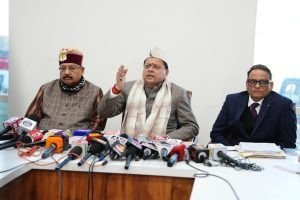
Uttarakhand Chief Minister Pushkar Singh Dhami said on Tuesday that the state government's resolve is to transform Uttarakhand into a developed, prosperous and self-reliant state by 2047. Addressing a press conference at Bhararisain in Gairsain, he said the government was continuously working to accelerate development projects and ensure that the benefits of public welfare schemes reach the last person.
He said the supplementary budget for the financial year 2026-27 had been prepared in line with this vision, taking into account both the state's present requirements and its future needs.
The Chief Minister said that in nearly 26 years since its formation, Uttarakhand had covered a long journey of development. The achievement was the result of the struggles of statehood activists, the hard work of the people and public participation. He added that Uttarakhand was committed to playing an important role in Prime Minister Narendra Modi's vision of a developed India by 2047.
Dhami said the state's economic and development indicators were encouraging. Uttarakhand's Gross State Domestic Product (GSDP), which stood at approximately ₹2.55 lakh crore in 2022, is estimated to reach around ₹3.82 lakh crore in 2026-27. During the same period, per capita income has increased from approximately ₹1.95 lakh to ₹2.74 lakh.
Multidimensional poverty has declined, while the number of startups in the state has increased from 702 to 1,978. The number of micro, small and medium enterprises (MSMEs) has also grown from approximately 60,000 to one lakh. The state has recorded significant growth in solar energy capacity as well.
The Chief Minister said Uttarakhand had jointly secured the first position nationally, with a score of 79, in NITI Aayog's SDG India Index 2023-24. The state has also received national recognition for its investment-friendly environment and financial management.
He said the government's endeavour was to ensure that the benefits of economic progress reached villages, farmers, women and young people.
₹7,844 Crore Supplementary Budget
Dhami said an allocation of ₹7,844.18 crore had been proposed in the supplementary budget for 2026-27. Of this, ₹4,164.32 crore has been earmarked for capital expenditure and ₹3,679.86 crore for revenue expenditure.
In accordance with the recommendations of the Sixth State Finance Commission, the government has proposed increasing the share of state tax revenue allocated to local bodies from 10.5 per cent to 12.5 per cent. An allocation of ₹721 crore has been made for this purpose, providing additional resources to rural and urban local bodies for development projects.
The Chief Minister said ₹1,100 crore had been allocated for procuring paddy and wheat from farmers under the Annapurti Yojana. Another ₹500 crore has been proposed under the special assistance scheme for infrastructure development, while ₹300 crore has been earmarked for the Jal Jeevan Mission.
An allocation of ₹122 crore has been proposed for the Gairsain Water Supply Dam Project. Approximately ₹290 crore has been earmarked for arrangements and infrastructure facilities for the upcoming Divya Kumbh. The budget also addresses projects associated with the Nanda Raj Jat Yatra and the Haridwar-Ganga Corridor.
Healthcare and Digital Education
Dhami said ₹100 crore had been proposed for the Atal Ayushman Yojana and ₹125 crore for the Golden Card Scheme for state employees to strengthen healthcare facilities.
Approximately ₹160 crore has been earmarked for medical education-related projects, including the medical colleges in Pithoragarh and Rudrapur. An allocation of ₹200 crore has also been proposed for digital learning in school and higher education.
He said provisions had also been made under the Chief Minister's Yuva Bhavishya Nirman Yojana to help young people prepare for competitive examinations. Funding has also been proposed for a sports university, a women's sports college, athletes' training programmes and scholarship schemes.
Women's and children's welfare, nutrition initiatives, honorariums for midday meal cooks, farmers' pensions and other social security schemes have also received priority in the supplementary budget.
Focus on Financial Discipline and Public Participation
The Chief Minister said the government's focus was not merely on launching new schemes but also on ensuring that their benefits reached people on time.
To achieve this, public participation had been encouraged during the budget preparation process. Over the past five years, pre-budget consultations had been held to obtain suggestions from farmers, women, youth, entrepreneurs and representatives of various sectors.
He said the government had maintained a revenue-surplus position while emphasising fiscal discipline, transparency and the effective utilisation of public funds.
Disaster Management, IT and Employment Opportunities
Dhami said special attention was being given to disaster management and the development of safe infrastructure in Uttarakhand. Work was underway in areas affected by land subsidence, including Joshimath, as well as on disaster-resilient construction and basic infrastructure for road and helicopter services.
He also said that a Software Technology Parks of India (STPI) facility had been established in Dehradun for the first time in the state, creating new opportunities for young people in the information technology and startup sectors.
The Chief Minister emphasised that preserving the state's heritage and culture alongside development remained a key priority. The government was working towards building a prosperous Uttarakhand by 2035 through quality investments, local employment generation, improved public services and the expansion of modern infrastructure.
Dhami said the state's achievements were the result of the collective efforts of its people. The government's objective was not merely to formulate schemes but to ensure that their benefits reached every citizen.
He concluded that building a developed Uttarakhand would be possible only through public participation, good governance and sustained development.