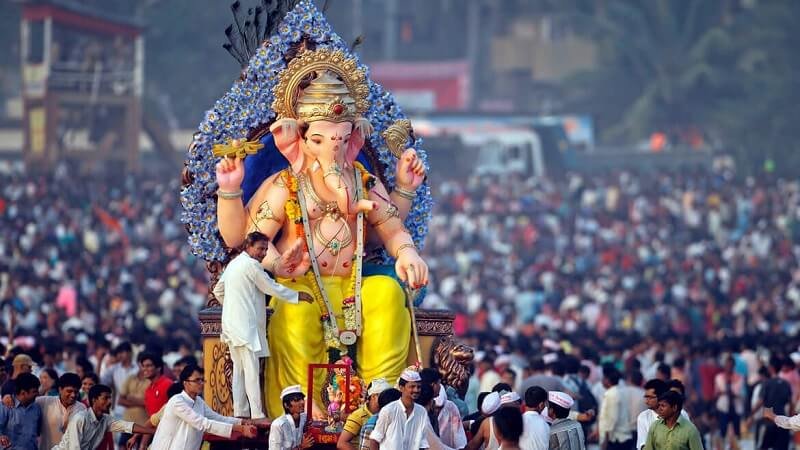
When one thinks of Sindhudurg, the images that immediately come to mind are the deep blue sea, lush green hills, red-earth pathways, tiled-roof houses, the sacred basil plant in courtyards and the warmth preserved in people’s hearts. Festivals hold a special place in the cultural life of this land, but Ganeshotsav has a unique significance. Here, Ganpati is not merely an idol installed in a household shrine; it is a festival that brings a sense of belonging back to homes, reunites people and brings villages alive once again.
As soon as the month of Shravan begins, the arrival of Ganeshotsav is felt across Konkan. Homes are cleaned, decorative structures are prepared, courtyards are decorated, markets become bustling and families begin waiting for relatives who have travelled elsewhere for work or business to return. People from Mumbai, Pune, Thane, Navi Mumbai and other parts of the state return to their ancestral homes in Konkan for Ganpati. Siblings, relatives and friends who remain separated throughout the year come together once again. This is perhaps the greatest feature of Ganeshotsav in Sindhudurg—Bappa arrives, and people come closer.
Ganeshotsav in Sindhudurg is therefore a celebration of faith, family, village life and tradition. Ganesh Chaturthi occupies an important place in the district’s cultural traditions, with bhajans, fugdi and various folk arts closely associated with the festival. In villages across the district, rehearsals for devotional bhajans begin well in advance. Abhangs, Gaulans, devotional chants and the sounds of traditional musical instruments add a distinctive charm to the celebrations.
This tradition carries the fragrance of the soil. Household Ganpati, the arrival of Gauri, aarti, offerings, modaks, bhajans, fugdi, meetings with relatives, the excitement of children, memories shared by grandparents and collective planning by villagers—all these elements together shape Ganeshotsav in Sindhudurg. In some homes, elders pass down traditions, while mothers and grandmothers teach children the methods of preparing traditional offerings. Young people, meanwhile, take responsibility for decorations, organisation and digital initiatives. In this way, every generation participates in the festival in its own way.
The state government has now given Ganeshotsav the status of a state festival and has proposed various cultural, social, environment-friendly and awareness initiatives on the occasion. These include competitions for outstanding public Ganeshotsav mandals at the taluka, district and state levels, cultural programmes, reels and digital initiatives related to Ganeshotsav, online darshan of prominent Ganesh temples and encouragement for local participation across different fields.
The objective of these initiatives is not merely to make the festival bigger, grander or more expensive. Rather, the real thought behind them is how the festival can be made more meaningful while preserving our traditions.
This year, Ganeshotsav mandals should make traditional arts and local culture the centrepiece of their decorations and programmes. Displays, exhibitions, storytelling sessions and cultural programmes can focus on themes such as Sindhudurg’s Dashavatar folk theatre, local handicrafts, traditional musical instruments, Konkani-Malvani culture, village history, local temples, forts and folk traditions. Along with Dashavatar, Chitrakathi, Ganjifa, Koli dance and various village traditions hold an important place in Sindhudurg’s cultural identity.
For children, Ganpati is a festival of joy. It is the responsibility of elders to create a celebration that gives their imagination space to flourish. Workshops on making Ganesh idols from natural clay, drawing and essay competitions, elocution, storytelling, traditional games, quizzes and activities based on local history can be organised. Young people can be provided opportunities in digital design, reels, photography and documentary-making. The older generation can share memories of Ganeshotsav from earlier times and pass them on to the younger generation. Ganeshotsav is not merely entertainment; it is a cultural bridge connecting generations.
This year, let us add an environmental dimension to this bridge. Every household and mandal can easily choose idols made of Shadu clay or other eco-friendly materials, avoid plastic, use natural materials for decoration, collect nirmalya separately and arrange for environmentally responsible immersion wherever possible. Decorations made using flowers, leaves, coconut fronds, bamboo, cloth, paper, clay and locally available materials are not only beautiful but also connect the festival with the traditions of our soil.
Immersion is an emotional moment. Therefore, it must be celebrated with equal responsibility. Let us ensure that water bodies remain clean and that water and nature are not harmed. Nirmalya should be collected separately rather than being thrown into water. Where necessary, the use of artificial immersion tanks can also be an environmentally friendly option. Broad public awareness about eco-friendly Ganeshotsav, nirmalya collection, recycling and plastic-free celebrations has also been emphasised in the proposed initiatives this year.
Energy conservation can also become a meaningful resolution during the festival. Instead of unnecessary electric illumination throughout the day, lighting can be used only when required, LED lights can be preferred and, wherever possible, solar-powered decorations can be adopted. Proper scheduling can also help. None of this reduces the joy of the festival; rather, it creates a new identity for a responsible celebration. A Ganeshotsav that conveys the message of energy conservation will be a valuable lesson for the next generation.
Festivals are meant to bring society together. Therefore, local self-help groups, artisans, artists, farmers, small entrepreneurs and local products can be given space in the programmes organised by Ganeshotsav mandals. Promoting Ganesh idols, makhars, decorations, puja materials, traditional food, handicrafts and local artworks can help the celebrations contribute to the village economy as well. Women’s self-help groups can be involved in local food and prasad initiatives. Providing a platform to local artists is also a way of taking our culture forward. This direction of greater local participation is also part of the proposed initiatives.
Another important aspect is ensuring everyone’s participation in the festival. A mandal’s celebrations should not remain limited to a few organisers but should become a celebration for the entire neighbourhood. Cultural programmes for senior citizens, traditional games or skill showcases for women, creative activities for children, sports and digital competitions for young people, and collective aarti, bhajans and cultural programmes for everyone can make the festival more inclusive. Small initiatives related to public health, cleanliness, safety and assistance to those in need can further strengthen the social character of the celebrations.
This year, let us also participate enthusiastically in the competition for outstanding Ganeshotsav mandals. The competition need not be limited to decorations and displays. It can become a platform to recognise how the festival was celebrated, how traditions were preserved, how community participation was increased, how much attention was given to the environment and what positive messages emerged from the initiatives.
In today’s digital era, everyone has an opportunity to take the Ganpati celebrations of their village to the world. The idea of encouraging reels, photography and digital initiatives has also been proposed. However, the soul of the actual celebration must not get lost in digital excitement. Instead of viewing Bappa only through a mobile camera, let us put our phones aside for a few moments, participate in the aarti, talk to our grandparents, distribute prasad with children and visit neighbours to seek Bappa’s blessings. These small things give the festival its true essence.
Ganeshotsav in Sindhudurg is essentially a celebration of people. The Bappa installed in a courtyard of red earth feels equally close to someone living in a high-rise building in a city and someone living in a small house near the seashore. Here, Bappa arrives with the warmth of human relationships. The Konkan resident returning to the village for the festival, the activity at home, the prasad prepared by neighbours, meetings with friends, evening bhajan gatherings, children playing and the emotions that fill people’s eyes during immersion—all these elements have created a distinct Konkani identity for Ganeshotsav.
This identity must be preserved. But preservation does not mean keeping tradition confined exactly as it is. True cultural enrichment lies in retaining the spirit of tradition while adding positive elements suited to changing times.
Therefore, this year, let us welcome Bappa in the traditional manner. Let us preserve local art. Let us provide opportunities to village artists. Let us connect children with our culture. Let us preserve the memories of our elders. Let us care for the environment. Let us understand the importance of water and electricity. Let us say no to plastic. Let us manage nirmalya responsibly. Let us promote local products. Let us participate in the competition for outstanding Ganeshotsav celebrations. And let us send a message through our celebrations that happiness does not have to come at the cost of nature.
During Ganeshotsav, different beliefs, traditions and social sentiments coexist around us. Therefore, respecting the faith and feelings of others along with celebrating our own happiness is also an essential part of the festival’s culture. Patience, mutual respect, warmth and harmony make celebrations even more joyful. If we celebrate with the awareness that no one’s sentiments should be hurt, the dignity of our festival will rise even further.
We believe that Bappa blesses us with wisdom, discernment and goodwill. So why should this year’s celebrations not reflect those very values?
Let there be joy, but let it be accompanied by sensitivity.
Let there be enthusiasm, but let it be guided by discipline.
Let there be tradition, but let it also embrace the creativity of the new generation.
Let there be decoration, but not at the cost of nature.
Let there be illumination, but no unnecessary wastage of energy.
Let there be celebration, but let everyone have a place in it.
This is the true identity of Ganeshotsav in the red soil of Sindhudurg—a celebration that brings together devotion, tradition, family, village, art, nature and humanity.
This year, let us welcome Bappa with this same spirit of richness and togetherness.
Ganpati Bappa Morya!