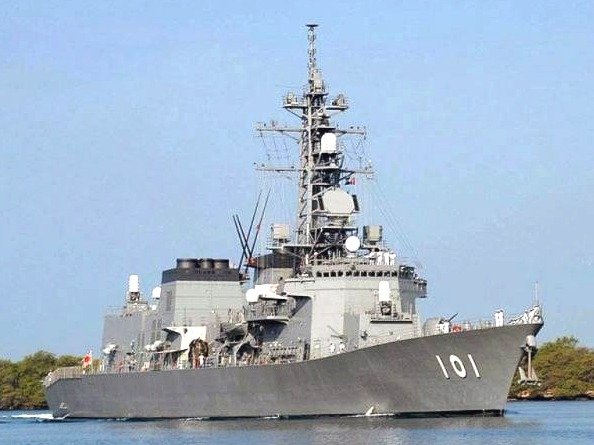
Tokyo; September 2026: Japanese authorities have reportedly raised the possibility of transferring general-purpose destroyers from the Maritime Self-Defence Force to the Chilean Navy . The units most frequently mentioned are those of the Murasame, Takanami, and Akizuki classes. The Murasame class represents the minimum offer, while the Akizuki class represents the maximum .
The logic behind this conversation isn't to replace all the ships in the Fleet. It's something else entirely. Today, the surface combat component consists of eight frigates: the Type 22 Almirante Williams, the three Type 23 Almirante Cochrane, Almirante Condell, and Almirante Lynch, the two M-class Almirante Blanco Encalada and Almirante Riveros, and the two Adelaide-class Capitán Prat and Almirante Latorre. This number of eight is the minimum the institution has advocated for operating in open waters, covering the exclusive economic zone, and maintaining a presence in the Pacific.
The 2025-2040 Naval Construction Policy aims to move beyond the purchase of second-hand ships and build future frigates in Chile, in a single series, starting in the 2030s. The problem is the timeline. Building a new frigate takes 04 - 05 years, and the detailed engineering, an industrial partner, and government decisions are still pending. Meanwhile, some of the current units, several with hulls over thirty years old, could be decommissioned before the first ship built in Talcahuano enters service. A gap of one or two ships would leave the fleet with fewer than eight vessels.
In that gap, they would fit alongside the Japanese destroyers. Not as a definitive solution, but as the last bridge of used equipment: ships in good condition, with remaining service life, to maintain the number of eight until domestic construction truly gets underway. If the transfer goes through, these would be the last second-hand frigates the Navy incorporates before embarking, in a sustained manner, on the path to building its own shipyard.
It should be noted that in August 2025, the then Minister of Chilean Defence, Adriana Delpiano, signed a memorandum of understanding in Santiago with the Parliamentary Vice Minister of Defence of Japan, Kazuhiro Kobayashi. The document covers the exchange of experiences in defence policy, military technology, and cooperation for peace. Days earlier, the document had already been signed in Tokyo by Minister Gen Nakatani.
In January 2026, Chile opened its Defence Attaché Office in Tokyo , under the command of the Navy. Captain Cristóbal Rodríguez assumed the post and began establishing channels of communication with Japanese civilian and military authorities. On August 30, 2026, Chilean Foreign Minister Francisco Pérez Mackenna met in Tokyo with his counterpart, Toshimitsu Motegi . The Japanese statement again mentioned defence cooperation, at a time when Tokyo had already relaxed restrictions on the export of military equipment.
But naval ties between Japan and Chile are not recent. In August 2025, the training ship “Kashima” and the destroyer “Shimakaze” called at Valparaíso. There was a wreath-laying ceremony at the Monument to the Chilean Navy, a visit to the Arturo Prat Naval Academy, and a naval pass with the frigate FFG-11 “Arturo Prat” off the coast of Valparaíso, Viña del Mar, and Concón. Going back further, in 1894, Chile sold the cruiser “Esmeralda” to Japan, which was renamed “Izumi” and fought in the Battle of Tsushima.
The three classes in play, Murasame, Takanami, Akizuki, are the most modern options and the closest to what the Chilean Navy Squadron would seek if the replacement of the Williams, Type 23 and M class is accelerated.
Neither side has confirmed figures, timelines, or conditions. What is clear, however, is that Tokyo is already in talks with Jakarta (Indonesia) regarding used Asagiri-class ships, and that Canberra (Australia) has chosen an upgraded version of the Mogami-class for its future frigates. In this context, the Murasame, Takanami, and Akizuki-class ships appear as an intermediate option for the Chilean Navym — ships with years of service, but still capable. This, coupled with the Chilean Fleet's dilemma—which cannot wait until 2032 or 2033 at the risk of losing some of its eight ships, nor does it want to continue buying used vessels as a permanent policy — would close that cycle if a Japanese shipment were to arrive. Afterward, replacement ships would have to be built in Chile.
It remains to be seen whether the conversation will move beyond technical consultations to a formal offer. For now, it's just that: a negotiation that, if it comes to fruition, would change the landscape of suppliers for the National Team.
Team Maverick.