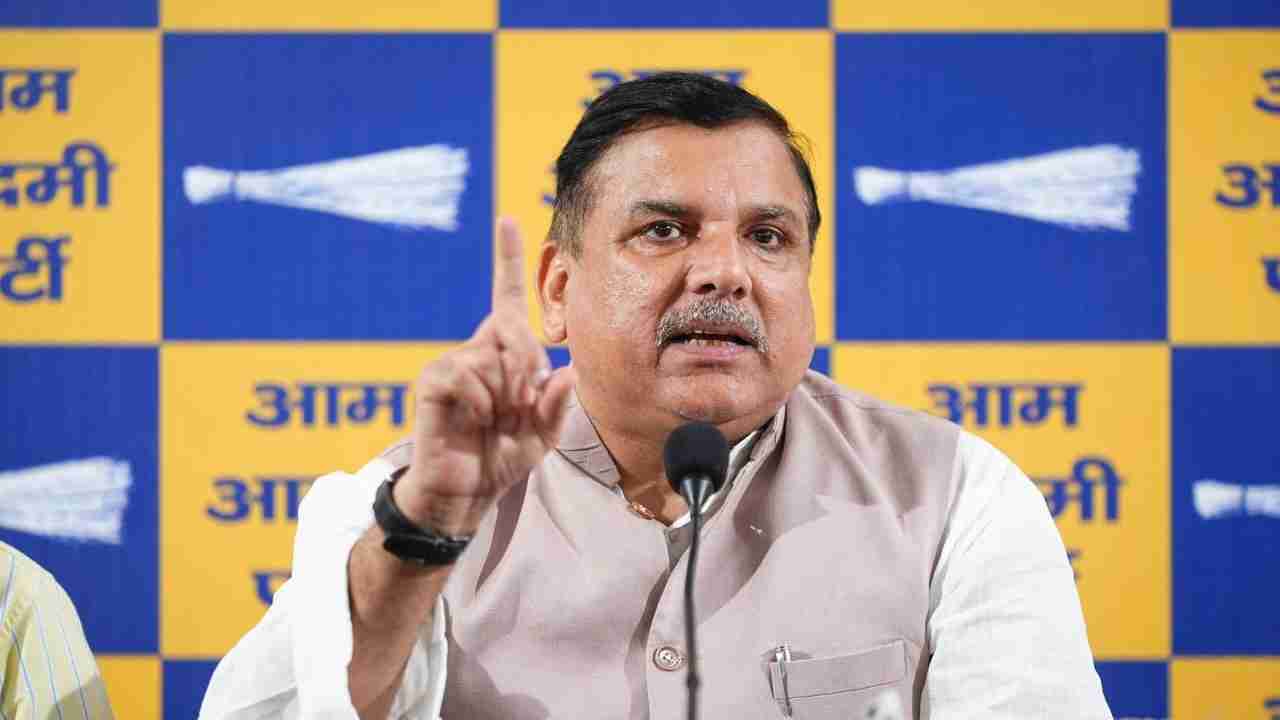
NEW DELHI Aug 2026 : The Aam Aadmi Party (AAP) has opposed the Centre’s bill proposing a tax on UPI (Unified Payments Interface) payments and demanded its withdrawal, warning that the measure will place an additional burden on small traders and ordinary consumers. Speaking during the discussion in Parliament, senior AAP leader and Rajya Sabha MP Sanjay Singh called out the Modi government for pushing the country towards greater inflation under pressure from Donald Trump, arguing that traders would pay the tax on UPI transactions and pass the burden on to consumers.
The AAP MP questioned the government’s approach to the so-called ‘Digital India’ initiative, saying that while it once promoted digital payments, it was now imposing a tax burden on small businesses while offering relief to foreign investors. Calling it a “return-to-square-one bill,” he asserted that the legislation is against ordinary people and small traders and must be withdrawn.
Senior AAP leader and Rajya Sabha MP Sanjay Singh opposed the bill, calling it a step backwards from the government’s earlier push for digital payments.“If this bill is to be summed up in one line, it is a case of ‘returning to where we started’. The government had earlier said that India should become digital, that all businesses should adopt digital payments and even small payments should be made digitally.”
He continued, “The Prime Minister proudly says that he comes from a tea seller’s background, but through this bill, the businesses of tea sellers, vegetable vendors, samosa sellers, street vendors, auto drivers, taxi drivers and rickshaw pullers are all being disrupted.”
Objecting to the proposed UPI tax, Sanjay Singh stated,“This bill proposes that when a payment is made through UPI, the merchant whose account receives the money will be taxed. Why is this additional burden being imposed on small traders, vegetable vendors and tea sellers? If the government puts this burden on them, they will ultimately increase the prices of their goods because they are not anyone’s relatives who will simply absorb the cost. The common people will have to bear the consequences, and inflation will also rise because of the increased tax. Therefore, this is a tax that will hurt people from both sides.”
On the circumstances in which the bill was introduced, he asserted, “It is also important for the country to know the circumstances in which this bill has been brought. On March 31, 2026, the United States Trade Representative objected that the zero tax on UPI in India was causing losses to them. This bill has been brought by mortgaging India’s sovereignty under pressure from Donald Trump, which is why we oppose it. A bill is being brought under foreign pressure by compromising India’s sovereignty, under which foreign investors are being given a 100% tax exemption, while small businesses operating in India are being subjected to tax.”
Questioning the government’s justification for the measure, the AAP MP added, “The government says that money has to be spent to manage the entire UPI system. But in the last two years alone, the government has collected ₹27,000 crore from crores of consumers in the name of minimum balance charges. Therefore, I want to tell the government that this bill is against the common people and small traders of the country. While opposing this bill, I request that it be withdrawn.”