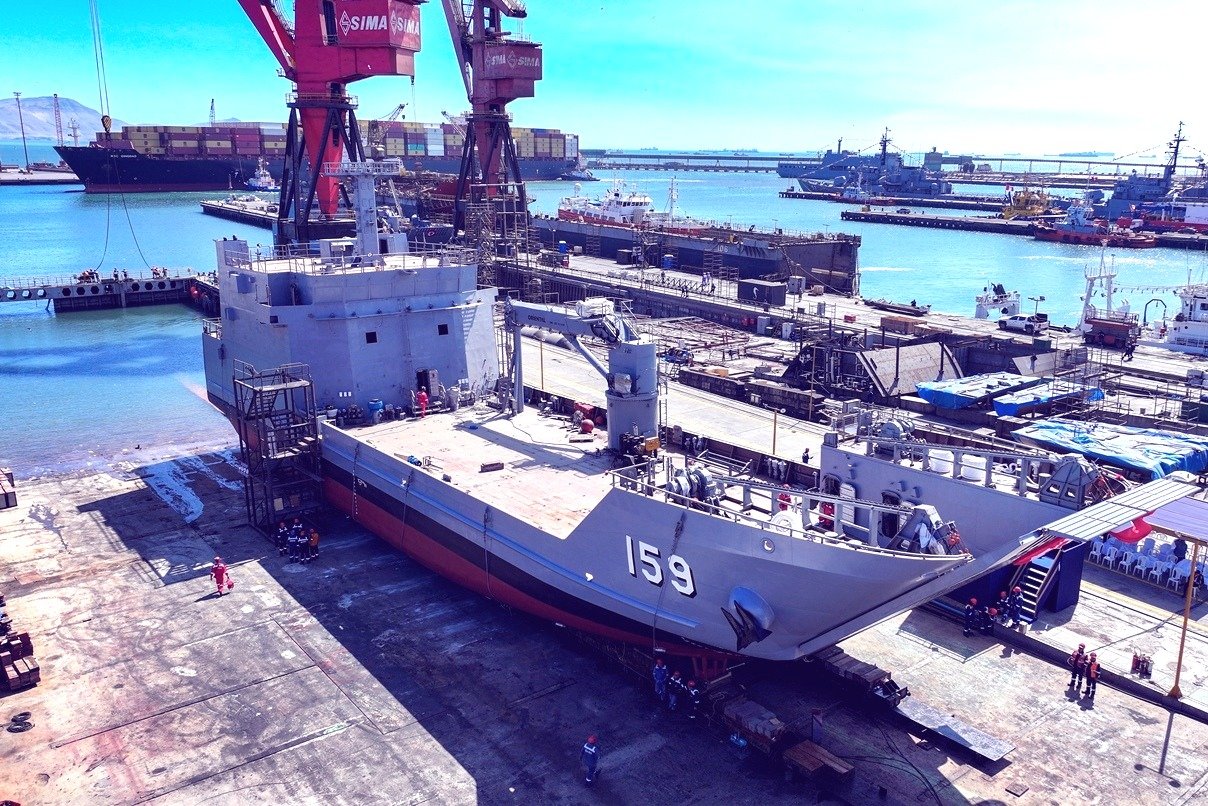
Callao Naval Base; August 2026: At the Naval Industrial Service Shipyards (SIMA), located at the Callao Naval Base in Peru, the christening and launching ceremony of the second Logistics Support Ship (BALOG), the BAP Chimbote (AAL-159), and the launching of the submarine BAP Antofagasta (SS-32) took place. The ceremony was attended by the President of the Republic of Peru, Keiko Fujimori Higuchi, who was accompanied by the Minister of Defence, Rafael Belaunde Llosa, and the Commander General of the Peruvian Navy, Admiral Javier Bravo de Rueda, as well as high-ranking officers and SIMA-PERU personnel.
In his keynote address, Admiral Bravo de Rueda stated, regarding the BAP Chimbote (AAL-159), that “it has been conceived as a modern logistics supply ship, equipped with capabilities that will strengthen our capacity to transport cargo, vehicles, machinery, fuel, drinking water, and personnel, allowing us to sustain operations for the naval forces and, in the event of an adverse natural situation, a disaster such as El Niño or high-intensity earthquakes, to provide timely support in those places where geographical conditions or emergencies demand a rapid, efficient, and sustained response”, adding that “these capabilities will reinforce the logistical projection of the administration and expand our capacity for action for the benefit of the country”.
Regarding the BAP Antofagasta (SS-32), Admiral Bravo de Rueda stated that “its launching represents the beginning of a new stage, the controlled investment in the quantity and integrity of the capability, subsequently giving way to stability tests, buoyancy, commissioning of systems, configuration, adjustment and integration, before returning to sea trials and fully rejoining our submarine forces as a modernised naval unit capable of contributing to the defence of our maritime domain”.
In turn, President Fujimori stated that "these ships will allow us to transport water, food, fuel, machinery, vehicles, and humanitarian aid to those places where an emergency might disrupt land transportation routes. This project also represents something that we as a government must especially highlight: the strengthening of our national industry. The construction of these ships at the SIMA Peru Shipyards demonstrates that our country has talent, technical capacity, and workers prepared to undertake increasingly complex projects".
Logistics Support Ship BAP Chimbote (AAL-159) –
Construction of the Logistics Support Vessel BAP Chimbote (AAL-159), like that of the BAP Talara (AAL-160), began in mid-January and was carried out using CKD (Complete Knock Down) packages, comprising 32 steel and aluminum modules supplied by Hyundai Heavy Industries - HHI (South Korea), a strategic partner of SIMA-PERU. Both vessels, which are part of the "Program for Expanding Maritime Logistics Supply Capacity on the Peruvian Coast" - Code No. 2397495, which envisions the construction of a total of four units, are scheduled to be commissioned this coming December. They will operate under the command of the Pacific Operations Command (COMOPERPAC), carrying out support missions for the fleet and transporting aid, civic action, and humanitarian assistance to coastal populations in the event of natural disasters.
The BAP Chimbote (AAL-159) and BAP Talara (AAL-160) are based on the HHI HDL-1500 series. They have a length of 58.9 metres, a beam of at least 13.2 metres, and a draft of 2.7 metres. They displace approximately 1,646 tons and have a range of 1,500 mm. The propulsion system comprises 02 450 HP Caterpillar C18 diesel engines, allowing them to reach a maximum speed of 10 to 12 knots and a cruising speed of 08 knots. They also have 03 generator sets, reduction gears, and a shaft system with fixed-pitch propellers (FPP). The nominal crew will consist of 31: 5 officers and 26 specialists, with capacity for an additional 16 personnel. Its equipment includes, among other things, an Integrated Platform Management System (IPMS), which will allow integrated digital control and monitoring of the main propulsion control and monitoring systems, generator sets, auxiliary machinery and damage control.
They are equipped with a 20-ton hydraulic telescopic crane for loading and unloading materials on deck, as well as a RHIB (Rigid Inflatable Boat). The deck cargo capacity, an area of approximately 250 m², can accommodate around 285 tons of cargo, or at least 21 TEU containers of 13.5 tons each, plus two additional refrigerated containers. Alternatively, they can accommodate seven GDLS LAV II Caiman (8x8) or BMR-600 armoured personnel carriers, or four MAN TG-MIL 29.440 (6x6) troop carriers. Their fuel capacity is 198.85 tons, and their potable water capacity is 211.68 tons.
Modernisation of the 209/1200 Submarines -
The BAP Antofagasta (SS-32), after leaving the Submarine Hangar at the Naval Arsenal, was launched to begin tests verifying its stability and watertightness, as well as the ballast tank blowout. According to pre-established procedures, it will soon leave the slipway area for the Submarine Pier, where it will undergo several months of testing on a ship lift platform. This testing will include its propulsion system and the installation of equipment such as the periscope masts, snorkel, and navigation radar, before beginning the sea trials. These trials will consist of periods of surface navigation, submerged navigation, and maximum depth testing.
The modernisation of the Type 209/1200 submarines (Angamos Class), officially designated as the "Submarine Capability Recovery Program in the Maritime Theater of Operations" – Code No. 137495, began in December 2017 with the arrival of the BAP Chipana (SS-34) at the Naval Arsenal. The Arsenal was expanded and upgraded with an investment of approximately US$198 million, which included, among other things, the construction of a hangar, the installation of a synchronised ship lift with a lifting capacity of up to 2,500 tons, and a transfer yard and parking areas for ship construction and repair work. The third unit currently undergoing modernisation is the BAP Angamos (SS-32), and the last will be the BAP Pisagua (SS-33).
The modernisation of the Type 209/1200 submarines, undertaken by SIMA with technical advice and assistance from ThyssenKrupp (Germany), will extend their service life by at least 15 to 20 years. This includes, among other things, the installation of new 2,400 hp MTU 12V493 AZ80 GA31L engines, identical to the originals but specially manufactured for the Peruvian Navy, which ensures the submarine maintains its operational performance, and a new hatch that will allow the docking of a DSRV rescue submarine for crew rescue in case of disaster. In addition, they will have the Kallpa Combat System, developed by SIMA-SAE, Hensoldt SERO 250 periscopes, EFAS (Expanded Flank Array) flank sonars, MAGE Qhawax and Timnex II ESM/ELINT systems, as well as the capability to fire the MBDA SM39 Exocet anti-ship missile.
Team Maverick.