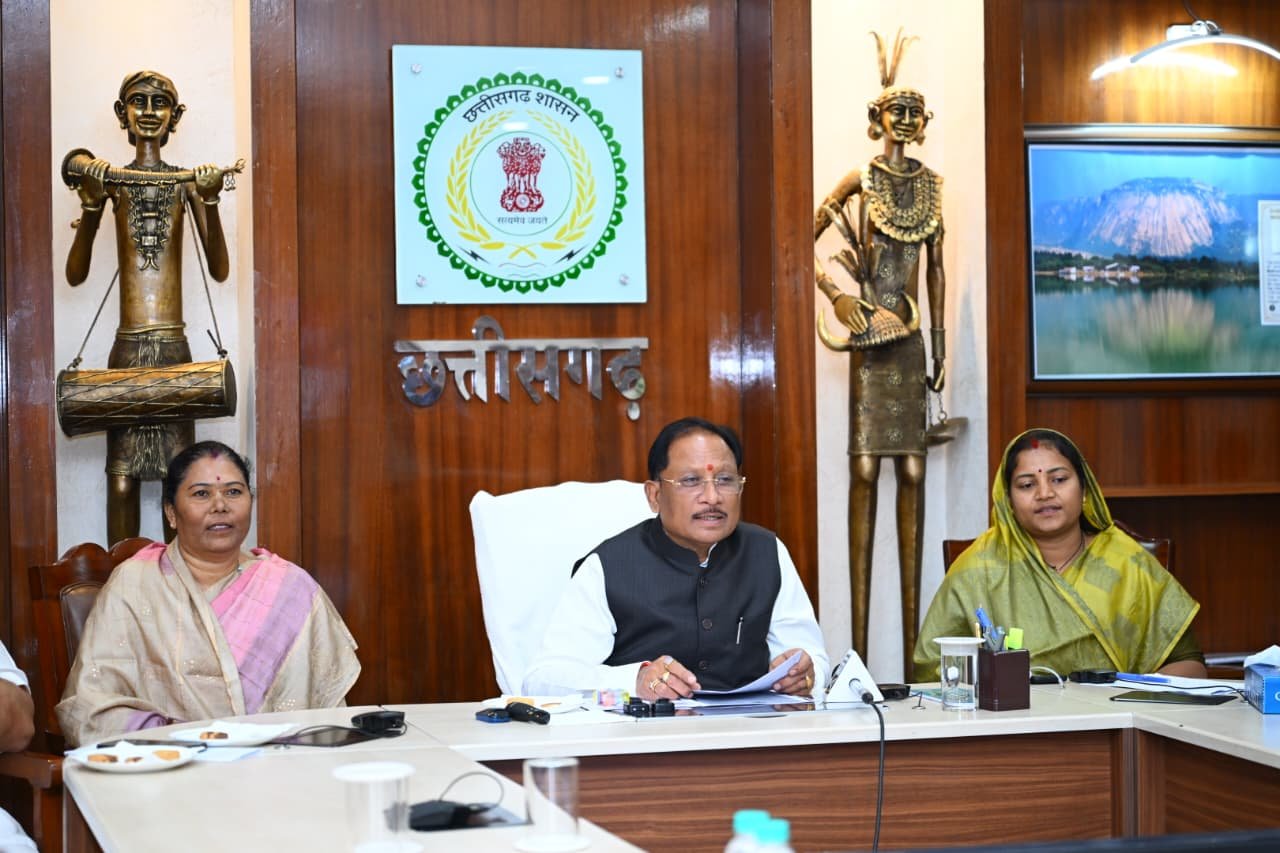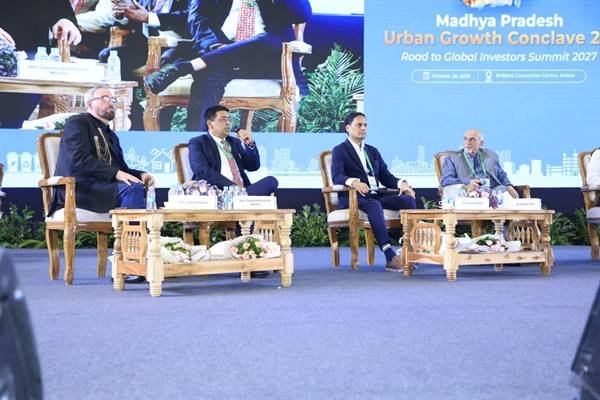
Chief Minister Dr. Mohan Yadav emphasised the importance of planned urban development that addresses future needs and requirements. In line with this vision, the Madhya Pradesh Urban Growth Conclave 2.0 (Road to Global Growth Summit 2027) was held on Wednesday at the Brilliant Convention Centre in Indore. The conclave featured four panel discussions, bringing together experts, industry representatives, academic institutions and various organisations to deliberate on key urban development issues.The discussions covered planned urban development, modern infrastructure, digital technology, climate-resilient cities, water security, resource management, and opportunities for urban investment and financing.
Urban Development Beyond Metropolises Through Redevelopment, TOD and TDR
The first panel discussion focused on ‘Beyond Metropolises: Urban Development Through Redevelopment, Transit-Oriented Development and Transferable Development Rights’. Sushri Mriganka Saxena, Founding Partner of Habitat Tectonics Architecture and Urbanism, moderated the session.
Panel Chair and Managing Director of Madhya Pradesh Metro, Shri Krishna Chaitanya, said that creating cities with better living facilities was not possible without planned development. He highlighted cleanliness, green energy, improved connectivity, ease of doing business, and industrial and economic corridors as important factors in urban development. He also explained the Transferable Development Rights (TDR) regulations and the online Transit-Oriented Development (TOD) portal.
Shri Vivek Damani, President of NAREDCO Madhya Pradesh, emphasised the need to consider the requirements of both developers and consumers in urban planning. He also stressed the importance of a single-window system to ensure timely project approvals.
Shri Jimmy Mistry, Chairman and Managing Director of Della Group, emphasised human-centric urban development. He highlighted the need for integrated master planning in accordance with TOD, TDR and Floor Space Index (FSI) norms, supported by efficient architectural planning.
Shri Shantanu Sharma, Founder and Chief Executive Officer of Medulla Soft Technologies, stressed the importance of urban planning based on actual traffic demand, better management of urban density and improved last-mile connectivity.
Professor Shri Shashwat Bandyopadhyay of CEPT University highlighted the importance of planning urban expansion in line with infrastructure availability and market demand. He also emphasised land pooling and easy access to information for stakeholders.
Dr. Ruma Chakravarty, Country Head of Esri, highlighted the role of GIS-based urban planning. She stressed the use of the Madhya Pradesh Government's Garuda MP platform, digital twin technology and the digitisation of processes ranging from master planning to building approvals.
Sushri Anna Roy, Programme Director at NITI Aayog, emphasised convergence and coordination in urban development plans. She also called for developing mass rapid transit systems through the public-private partnership (PPP) model and adopting flexible urban planning to meet future requirements.
Reimagining Urban Governance Through Reforms and Digital Enablement
The second panel discussion focused on ‘Reimagining Urban Governance Through Reforms and Digital Enablement’. The discussions focused on digital public infrastructure, e-governance, data management, artificial intelligence and the expansion of citizen-centric services.
Shri Nandakumar M., Joint Secretary in the Ministry of Electronics and Information Technology, Government of India, said that clear standards and recognised frameworks were essential for the effective implementation of digital public infrastructure. He emphasised improving efficiency, adopting systems thinking and making government functioning more citizen-centric.
Panel Chair and Commissioner, Urban Development and Housing Department, Shri Sanket Bhondve, said that technology was bringing significant changes to urban governance. He highlighted the need for citizen-centric digital public infrastructure, a hub-and-spoke model to extend the benefits of Digital India to the grassroots, and effective strategies to address emerging cybersecurity challenges.
Shri Rakesh Doshi, Chief Business and Product Officer of Protean eGov Technologies Limited, highlighted the role of digital identity, property records, documents and open network systems. He emphasised flexibility in software development and digital coordination among citizens, the government and businesses.
Shri Suhas Dutta, Founding Partner of Unnayan, stressed the importance of data-driven digital infrastructure and digital transformation to improve the efficiency of government departments and make citizen services more effective.
Sushri Jyoti Malde of Yotta Infrastructure said that the effective integration of data centres, cloud computing, data security and artificial intelligence was essential for building robust digital public infrastructure.
Shri Aman Mittal, Joint Chief Executive Officer of MITRA, said that the effective use of digital public infrastructure could lead to substantial savings in time, workload and resources.
Shri Sandeep Shrivastava, President of CREDAI Indore, emphasised digitisation and improved staff efficiency for the smooth functioning of urban infrastructure. He suggested developing a coordinated system to resolve technical issues promptly, provide user-friendly software, ensure timely technical upgrades and improve services related to real estate and urban planning.
Deliberations on Climate-Resilient Cities, Water Security and the Circular Economy
The third panel discussion focused on “Building Climate-Resilient Cities, Water Security and the Circular Economy.” The session placed special emphasis on environmentally sustainable urban infrastructure, water conservation, scientific solid waste management and resource recycling.
The session was chaired by Shri Shishir Gamevat, Additional Commissioner, Directorate of Urban Administration and Development, Bhopal, and moderated by Dr. Rajesh B. Biniwale, Chief Scientist at the National Environmental Engineering Research Institute (NEERI).
The panel included Shri Prakhar Singh, Additional Commissioner of Indore Municipal Corporation; Shri Sumit Suri, President of the Indore Hotel Association; Shri Satish Chikodi, Vice President—Operations at Apex Urban Resource Management India LLP; Sushri Upneet Singh, Senior Water Specialist at the World Bank; Shri Neeraj Shrivastava, Chairman and Managing Director of NeerCare India Limited; and Shri Rajinder Singh, Senior Vice President of Reliance.
The session deliberated on urban development requirements in response to climate change, ensuring water security, wastewater reuse and efficient resource management. Experts stressed that water conservation, scientific waste management, resource recycling and inter-sectoral coordination are essential for sustainable and environmentally friendly urban development.
Promoting Urban Investment Through Collaboration and Global Expertise
The fourth panel discussion focused on “Promoting Urban Investment Through Collaboration and Global Expertise.” Discussions covered urban infrastructure financing, public-private partnerships, municipal bonds, global investment and the use of modern financial instruments.
Shri Abhishek Saraf, Additional Commissioner, Directorate of Urban Administration and Development, Bhopal, outlined various policies being implemented in Madhya Pradesh and presented a roadmap for major future projects through multilateral and bilateral development finance, institutional finance and market-based financing.
Sushri Nidhi Siwach, Deputy Municipal Commissioner of Surat Municipal Corporation, shared the city's experiences and achievements in urban development, cleanliness, civic amenities and e-governance.
Shri Suraj Mohan, Policy Head at the Securities and Exchange Board of India (SEBI), shared his views on the municipal bond market, infrastructure financing, pooled financing and financial challenges associated with urban development.
Shri Neeraj Gupta, Principal Investment Officer and Sector Lead at the India Infrastructure Finance Company, highlighted public-private partnership (PPP) models and the concept of pooled listed bonds, explaining their usefulness in strengthening the financial capacity of local bodies.
Shri Samuel Joseph, Deputy Managing Director of the National Bank for Financing Infrastructure and Development (NaBFID), described Madhya Pradesh as a state with significant investment potential. He emphasised better financial and technical preparation of projects, improved credit ratings and resource mobilisation through pooled bonds.
Shri Blaine Robert, Chief Executive Officer of Blaine Robert Design, Kuala Lumpur, appreciated India's young workforce and broad development potential. He expressed his interest in collaborating with Indian youth and creating new development opportunities by leveraging available resources.
Shri Gyanendra Kumar Mishra, Senior Vice President of Reliance Industries, said that Madhya Pradesh's investor-friendly policies, single-window system, strong infrastructure, water availability, skilled workforce and advanced logistics facilities were playing an important role in attracting investment.
Integrated Approach to Building Future-Ready Cities
The four panel discussions at Madhya Pradesh Urban Growth Conclave 2.0 highlighted the need to integrate planned urban development, modern transport systems, digital urban governance, environmental sustainability and robust financial resources to build the cities of the future.
The discussions identified TOD- and TDR-based urban development, citizen-centric digital services, effective use of data and artificial intelligence, water conservation, waste recycling, public-private partnerships and global investment as important areas of focus.
Experts emphasised prioritising accessible civic amenities, administrative efficiency, sustainable resource utilisation and an investment-friendly environment alongside the development of modern infrastructure. The deliberations at the conclave offered important recommendations for developing planned, inclusive, safe and climate-resilient cities in Madhya Pradesh that are equipped to meet future needs.