New Delhi, Aug 2026 : Prime Minister Narendra Modi on Saturday outlined an ambitious roadmap for an Atmanirbhar Bharat, urging the nation to maintain its development momentum and work with renewed determination towards achieving the goal of a Viksit Bharat by 2047.
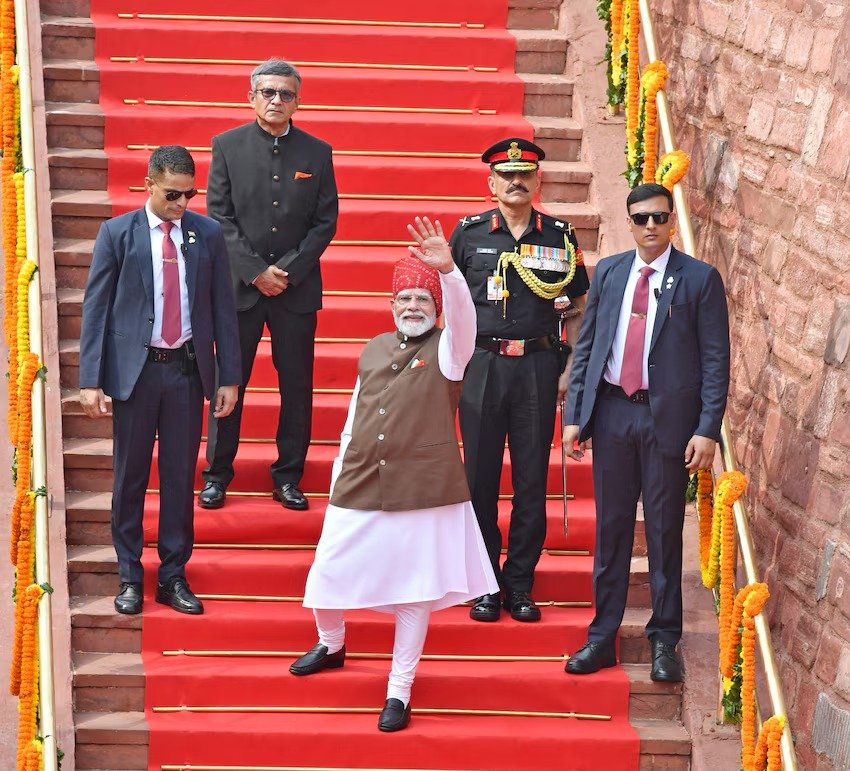
Addressing the nation from the ramparts of the historic Red Fort on India’s 80th Independence Day, Modi spoke at length about the country’s economic transformation, technological progress, national security, women’s participation in politics, youth empowerment and the need to strengthen India’s self-reliance.
The Prime Minister described the rendition of the National Song ‘Vande Mataram’ at the Red Fort as a historic moment, saying it had added a special significance to the Independence Day celebrations.
"It is a historic day. After Independence, this is the first time when 'Vande Mataram' has echoed from the ramparts of Red Fort. Today, the chant of 'Vande Mataram' resonates in every heart. Today, the Tricolour flies in every home and dwells in every mind," Modi said.
Big Dream of Viksit Bharat
Emphasising the importance of setting ambitious national goals, Modi said India had moved into a phase of unprecedented growth and confidence. He recalled that although the country had harboured big dreams after Independence, progress had not always matched its aspirations.
According to the Prime Minister, the situation has changed significantly, with India now moving forward with greater speed and confidence.
"After Independence, India had big dreams, but progress often fell short of the pace we aspired to achieve. Today, India is moving ahead with unprecedented speed and confidence. And now, no force can stop the resolve of 140 crore Indians," he said.
Modi reiterated that India’s biggest national ambition was to become a developed country by 2047, when it completes 100 years of independence. He said the transformation into a Viksit Bharat would require the contribution, participation and sustained efforts of every citizen.
He stressed that a nation’s willingness to dream big can influence how the world perceives it and said India’s determination to achieve developed-nation status would demonstrate its confidence and capabilities on the global stage.
From Fragile Five to Fast-Growing Economy
Reflecting on India’s economic journey, Modi said the country had undergone a major transformation over the past 12 years.
He recalled that India was once counted among the "Fragile Five" economies but had since emerged as one of the world’s fastest-growing major economies.
"Everyone over the past 12 years, with determination and dedication, has made every possible effort to take the country to new heights," he said, crediting citizens from different sections of society for contributing to the transformation.
The Prime Minister cited growth across several strategic and industrial sectors. Defence production, he said, had increased nearly four-fold, while Khadi and Village Industries production had risen nearly five-fold. Electronics manufacturing had expanded nearly seven-fold, modern railway coach production 21-fold and mobile phone manufacturing 33-fold.
India’s digital transformation had also accelerated sharply, with internet users nearly quadrupling, patents granted increasing four-fold and digital transactions rising around 100-fold.
Atmanirbhar Bharat at the Core
Modi said self-reliance would remain central to India’s future development strategy, stressing that the country could not afford excessive dependence on other nations for critical capabilities and resources.
"Becoming an 'Atmanirbhar Bharat' is crucial. That is why, over the past few years, our conviction has been that India should no longer live in dependence on other nations; we must become self-reliant," he said.
He called for strengthening domestic capabilities while protecting India’s national interests. The Prime Minister urged citizens and businesses to support Make in India, Swadeshi and Vocal for Local, saying India should build its own capacities while engaging with the global economy with confidence.
No Pause in Development Momentum
Warning against complacency, Modi said the country could not afford to slow down its development journey.
"One-fourth of the century has already elapsed, and the upcoming one-fourth is exceptionally crucial for us. We cannot afford to pause now. Our momentum must not slow down. Our trajectory is already set, and we are determined to achieve our objective," he said.
He described India as an increasingly respected global power and highlighted the country’s stable political mandate, democratic institutions, judiciary and Constitution as important foundations of its progress.
"Today, India is emerging in the eyes of the world as a widely accepted and respected nation," Modi said, adding that the world had begun to recognise the country’s intrinsic strengths.
‘Sapta Dhara’ for a Developed India
In a significant part of his address, Modi invoked the historical reference to Sapta Sindhu, or the Seven Rivers, to present his vision of a new "Sapta Dhara" of strength for building a developed India.
He said the country needed new currents of energy and capability to realise its long-term aspirations. The concept was presented as a broad framework for strengthening the foundations required to transform India into a developed nation.
The Prime Minister linked the larger vision of Viksit Bharat with economic strength, technological capabilities, social progress and national resolve.
Push for Greater Political Representation of Women
Modi also made a strong appeal for greater representation of women in politics, calling upon political parties across the spectrum to ensure that women receive their due share of representation in State Legislative Assemblies and the Lok Sabha.
Standing under the Tricolour, he urged political parties to recognise the capabilities of women and facilitate their greater participation in policymaking.
"Come forward and celebrate the strength and capability of our women. Step forward in honour of our women, and as swiftly as possible, ensure our mothers and sisters receive their due representation in the State Legislative Assemblies and the Lok Sabha so that they can actively contribute to shaping India's policies," he said.
Warning Against ‘Dimagi Naxalism’
National security and social harmony also featured prominently in the Prime Minister’s address. Modi warned against what he termed "dimagi Naxals" or individuals influenced by a Naxal mindset whom he accused of attempting to create violence, unrest and social discord.
He said India had made significant progress in tackling armed Naxalism in affected forest areas but cautioned that ideological extremism could continue to pose a challenge.
"We have succeeded in getting rid of armed Naxals in the jungles, but 'dimagi Naxals' are looking for opportunities to create violence, unrest," he said.
Modi called for identifying and isolating such forces while ensuring that young people remained connected to the mainstream.
Youth at the Centre of Future Growth
Youth empowerment was another major focus of the address. Modi announced that the government would provide artificial intelligence skills training to one crore young people over the coming year, with the aim of preparing India’s Gen Z population for emerging technologies and the global digital economy.
He also announced free online coaching for competitive examinations for young people from poor and middle-class families. The initiative, he said, would help widen access to opportunities and enable talented youngsters to pursue their aspirations regardless of their economic background.
Social Welfare and Governance Reforms
The Prime Minister also highlighted the expansion of basic amenities, saying tap-water connections were being provided at 15 times the previous annual pace, gas connections at six times the earlier rate, toilets for the poor at four times the pace and houses for underprivileged families at three times the previous rate.
He pointed to governance reforms as another major area of transformation, saying thousands of compliance requirements had been eliminated and hundreds of outdated laws repealed.
Modi argued that a modern economy required a modern governance framework and that obsolete regulations could not be allowed to hinder India’s aspirations in the 21st century.
A 76-Minute Address With a Long-Term Message
The Prime Minister’s 76-minute Independence Day address was his 13th from the Red Fort. The national flag was hoisted before the National Anthem and a 21-gun salute. The full rendition of ‘Vande Mataram’ added a distinctive element to this year’s celebrations.
Modi also expressed solidarity with families affected by floods and other natural disasters, assuring them of the nation’s support.
The address combined a celebration of India’s achievements with a forward-looking development agenda. From economic self-reliance and manufacturing to artificial intelligence, women’s political representation, youth empowerment and national security, Modi placed these priorities within the larger objective of building a Viksit Bharat by 2047.
The Prime Minister’s central message was that India had achieved significant progress but could not afford to slow down. With one-fourth of the 21st century already behind it, he said the coming decades would be decisive.
For Modi, the road to 2047 will depend on India’s ability to dream bigger, strengthen its domestic capabilities, empower its youth, expand opportunities for women and maintain the momentum of economic and social transformation. He called upon citizens to collectively turn that ambition into reality and establish India as a developed, self-reliant and globally respected nation.