India has taken a significant step towards strengthening its indigenous air-defence capabilities with the successful maiden flight-test of Project Kusha, a long-range Surface-to-Air Missile (SAM) system being developed by the Defence Research and Development Organisation (DRDO) in partnership with Indian industry.
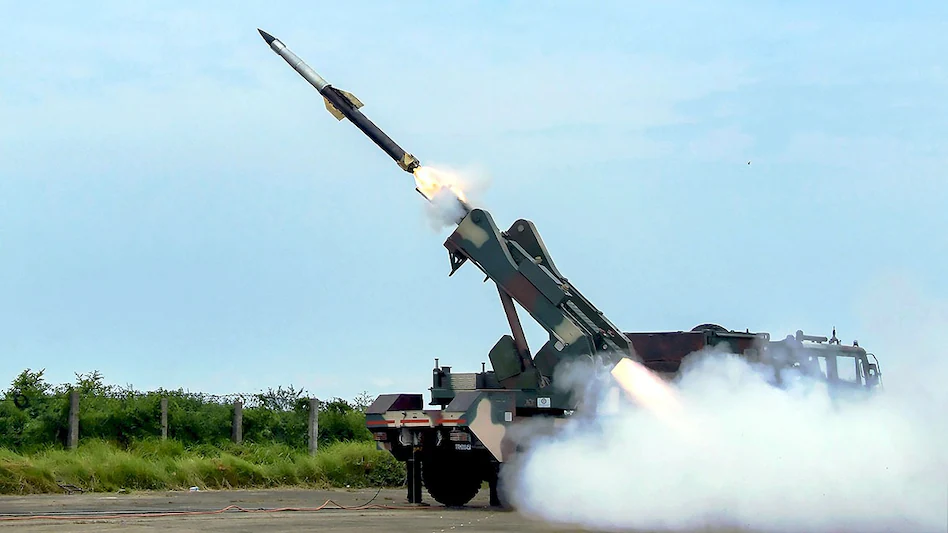
The test, conducted on July 23, 2026, from APJ Abdul Kalam Island off the Odisha coast, marked an important milestone in the development of a new generation of Indian air-defence technology. During the trial, an electronic target designed to simulate a high-speed, high-altitude aerial threat was successfully intercepted, according to the Ministry of Defence.
The successful test is significant not merely because a missile intercepted a target, but because Project Kusha is being developed as a complete long-range air-defence system. Its architecture is expected to bring together missiles, radars, command-and-control systems and other supporting technologies developed by various DRDO laboratories and Indian industrial partners.
The programme is therefore part of India's broader effort to build sophisticated defence systems domestically and reduce dependence on imported military equipment.
What is Project Kusha?
Project Kusha is an Indian programme aimed at developing a long-range Surface-to-Air Missile system capable of detecting and engaging aerial threats before they can reach protected areas.
The system is intended to counter a broad spectrum of threats, including fighter aircraft, missiles, unmanned aerial vehicles and large enemy aircraft.
Unlike a standalone missile, Kusha is envisaged as an integrated weapon system. Such a system requires several components to work together seamlessly. Missiles provide the interception capability, while radars detect and track targets. Command-and-control elements process information, assess threats and coordinate the engagement.
The broader architecture therefore involves radars, sensors, command-and-control systems, communications, launchers and interceptor missiles.
This integrated approach is crucial because modern aerial warfare is increasingly complex. A missile system cannot provide effective protection simply by operating independently. It has to receive accurate information about an approaching threat, establish its trajectory, determine whether it poses a danger and then launch an appropriate interceptor.
Project Kusha is being developed around this broader concept rather than as a single missile programme.
Maiden flight-test marks a crucial milestone
The July 23 test represents a major step in the journey of Project Kusha.
The maiden flight-test was conducted from APJ Abdul Kalam Island, with an electronic target simulating a high-speed and high-altitude aerial threat. The target was successfully intercepted, demonstrating the system's ability to complete a critical part of the engagement process under test conditions.
However, the successful maiden flight should be viewed as an important development milestone rather than the completion of the programme.
Advanced missile systems normally undergo multiple rounds of testing and evaluation before they are considered ready for operational deployment. Developers have to examine performance under different conditions, assess tracking and guidance, evaluate system integration and establish reliability.
Additional trials will therefore be necessary before Kusha can move from development towards eventual induction into the armed forces.
The first successful flight nevertheless demonstrates that the programme has progressed into an important testing phase and that several complex technologies are being brought together successfully.
What threats is Kusha expected to counter?
Modern air-defence systems have to deal with a rapidly changing threat environment. Fighter aircraft remain important, but they are no longer the only aerial threats that military planners have to consider.
Fighter aircraft
Advanced fighter aircraft can approach defended areas at high speed and employ a variety of weapons and tactics. A long-range surface-to-air missile system can create an additional layer of protection around strategically important locations.
The ability to detect and engage an aircraft at greater distance can potentially provide defenders with additional time to assess and respond to an incoming threat.
Cruise missiles
Cruise missiles present a different challenge because they can fly at relatively low altitudes and follow complex flight paths.
Successfully dealing with such threats requires sophisticated detection, tracking and engagement capabilities. A modern air-defence network therefore needs sensors capable of identifying aerial objects and weapons capable of responding to different types of threats.
Drones and UAVs
The rapid expansion of unmanned aerial vehicles has transformed the modern battlefield.
Drones can perform surveillance and reconnaissance missions and can also be used in attacks. Their increasing availability means that air-defence systems must be capable of identifying and responding to a wide variety of aerial objects rather than focusing exclusively on conventional aircraft.
Large aircraft
Large enemy aircraft, including surveillance and support platforms, can also be strategically important targets. The official description of Project Kusha includes large enemy aircraft among the threats the system is intended to neutralise.
How a modern air-defence system works
Understanding Kusha requires understanding how an integrated air-defence network functions.
The first stage is detection. Radars and sensors continuously monitor the surrounding airspace for potential threats.
The next stage is tracking. Once an aerial object is detected, the system determines its location, direction and movement and continuously updates that information.
This is followed by decision-making and command-and-control. The air-defence network assesses the nature of the threat and determines how it should be dealt with.
Finally, an interceptor missile can be launched to engage the selected target.
The process can therefore be broadly understood as:
Detection → Tracking → Assessment → Command and Control → Interception
The effectiveness of such a system depends not only on the missile itself but also on the accuracy and speed of the entire network.
That is why Project Kusha is important as an integrated programme involving missiles, radars, command-and-control systems and supporting technologies.
Is Kusha India's answer to the S-400?
Project Kusha has frequently been compared in defence discussions with the Russian S-400 long-range air-defence system.
Such a comparison can help explain the broad role envisaged for Kusha, since both are long-range air-defence systems designed to protect large areas from aerial threats. However, the two systems should not be treated as identical.
The S-400 is a Russian operational system with its own architecture and capabilities, while Kusha is an Indian programme being developed around India's requirements and indigenous technologies.
More importantly, Kusha is still undergoing development and testing.
Therefore, describing it as an operational replacement for the S-400 would be premature. Its ultimate capabilities will become clearer only after further trials, evaluation and eventual induction.
Reported range variants
There has been considerable interest in the potential range of Kusha's interceptor missiles. Several defence reports have described a multi-layered system involving three broad interceptor classes, commonly referred to as M1, M2 and M3.
Reported figures have placed their ranges at approximately 150 km, 250 km and 350 km, respectively.
However, these numbers need to be treated carefully.
The Ministry of Defence announcement concerning the July 23 maiden test did not publicly provide detailed range specifications for each interceptor variant. Therefore, the reported figures should be regarded as reported or projected specifications rather than technical specifications officially confirmed in the maiden-test announcement.
Further testing could provide greater clarity about the final configuration and capabilities of the system.
Why multiple interceptor layers matter
A modern air-defence network can benefit from multiple engagement layers.
A shorter-range interceptor can potentially deal with threats that approach the defended area, while longer-range weapons can engage suitable threats farther away.
The basic concept is straightforward: a long-range layer can provide an opportunity to detect and engage a threat early, while additional layers can provide protection if a threat moves closer to the defended area.
This layered approach reduces reliance on a single weapon system and allows different interceptors to perform different roles.
The final architecture of Project Kusha, however, will depend on how the system evolves through development, testing and induction.
Indigenous development is the bigger story
One of the most important aspects of Project Kusha is its contribution to India's defence self-reliance.
India has traditionally depended on foreign suppliers for several major defence systems. Developing a sophisticated long-range air-defence system domestically can help reduce that dependence while giving the country greater control over production, maintenance, upgrades, spare parts and future technological development.
Indigenous development can also make it easier to integrate a system with India's wider defence networks.
The Defence Ministry has described the Kusha programme as an important step towards reducing import dependence in this area. For a country of India's geographical size and strategic position, developing domestic long-range air-defence capabilities has considerable significance.
The objective extends beyond manufacturing one missile. The larger ambition is to create the technological and industrial ecosystem needed to design, develop, manufacture, maintain and upgrade sophisticated military systems within India.
Role of Indian industry
Modern air-defence systems involve a wide range of technologies and cannot normally be developed by a single organisation working in isolation.
According to the Ministry of Defence, various DRDO laboratories and Indian industry partners are participating in Project Kusha.
This cooperation is important because the system requires expertise across several fields.
Missiles require propulsion, guidance and control technologies. Radars require sophisticated electronics and signal-processing capabilities. Command-and-control systems depend on reliable communications, computing and software. Launchers and support equipment must also be manufactured and integrated with the broader system.
The development of Kusha can consequently strengthen India's wider defence manufacturing ecosystem while building expertise in areas such as radar technology, electronics, sensors, communications, missile technology and systems integration.
Long-range air defence in modern warfare
The nature of warfare has changed significantly. A country can face threats from aircraft, cruise missiles, drones, surveillance platforms and precision-guided weapons.
This makes air defence a networked and layered challenge.
A long-range system such as Kusha could potentially serve as an outer layer in such a network. Detecting an incoming threat early can give defenders additional time to evaluate the situation and respond.
However, no single missile system can provide absolute protection against every possible aerial attack.
Modern air defence depends on combinations of sensors, missiles, aircraft, electronic warfare capabilities, command networks and multiple defensive layers.
Kusha should therefore be viewed as one component of a much broader architecture rather than as a standalone solution.
Kusha's place in India's wider air-defence network
India already operates and is developing different air-defence systems designed for different ranges and roles.
The Akash family is one part of India's air-defence capabilities. India has also developed the Medium Range Surface-to-Air Missile (MRSAM) jointly with Israel Aerospace Industries for the Indian Air Force and Indian Army.
DRDO describes MRSAM as a mobile, all-weather, 360-degree medium-range surface-to-air missile system.
Project Kusha is intended to add a long-range layer to this broader architecture.
The principle is that different systems can perform different tasks. A strong air-defence network does not depend on a single missile or radar.
Instead, multiple systems can work together to create overlapping layers of protection.
What about ballistic and hypersonic threats?
Claims about Project Kusha's ability to intercept ballistic missiles or hypersonic weapons have generated considerable discussion.
However, these claims should be treated cautiously unless supported by official technical information.
The Ministry of Defence's announcement regarding the July 2026 maiden flight described Kusha as capable of neutralising a variety of aerial threats, including fighter aircraft, missiles, UAVs and large aircraft.
The announcement did not present Kusha as a dedicated ballistic-missile defence system.
Consequently, it would be premature to describe the programme as India's complete answer to ballistic missiles or hypersonic weapons without further official confirmation.
This distinction is important because defence capabilities can evolve considerably during development and testing.
Why the July 2026 test matters
The successful test demonstrated progress across multiple technological areas.
A missile interception trial involves much more than launching an interceptor. It requires the successful functioning and integration of missile technology, target detection, tracking, guidance, command and control and the overall engagement process.
The July 23 test therefore represented progress in several areas simultaneously.
For India's defence research establishment, this is important because the country is seeking to develop increasingly complex military technologies domestically.
Project Kusha fits into that larger effort, alongside indigenous programmes involving missiles, aircraft, drones, radars, electronic warfare and other defence technologies.
Kusha will not immediately replace the S-400
The successful test should not be interpreted as meaning that Kusha has already replaced or is immediately replacing the S-400.
The S-400 is an operational foreign-origin system, whereas Kusha remains under development and testing.
The strategic significance of Kusha lies in the long-term development of India's own capabilities.
If the programme successfully completes its trials, evaluation and induction, it could become an important part of India's future long-range air-defence architecture.
But operational status and actual replacement of an existing system are separate matters. Kusha would have to complete its development programme and be inducted into service before such conclusions could be drawn.
What happens after the maiden test?
The first flight-test is only one stage of the development process.
Further trials are expected to examine the system under different conditions and against different target scenarios. Developers need to assess tracking performance, missile guidance, reliability, system integration and operational procedures.
The armed forces must also evaluate the system before it can eventually be inducted.
The development process can therefore take considerable time even after a successful maiden flight.
This is particularly important for a sophisticated system such as Kusha, where the performance of individual missiles must be evaluated alongside the functioning of radars, command-and-control networks and other components.
The July test has established an important foundation, but the programme now enters a phase in which repeated testing and evaluation will be crucial.
A larger push for defence self-reliance
Project Kusha is part of India's wider effort to transform its defence manufacturing and technology base.
The objective is not simply to manufacture individual weapons inside the country. The larger goal is to develop an ecosystem capable of designing, testing, producing, maintaining and upgrading sophisticated defence technologies.
Such an ecosystem requires research institutions, engineering expertise, manufacturing capabilities, electronics companies, software developers and specialised industrial partners.
Kusha fits into this larger vision by bringing together missile technology, radar systems, sensors, command-and-control capabilities and industrial manufacturing.
If successfully developed, the programme could therefore have implications extending beyond air defence itself.
Could Kusha reshape India's air-defence strategy?
If successfully developed and inducted, Project Kusha could become an important component of India's layered air-defence architecture.
Its long-range role could provide another defensive layer around strategically important locations and improve India's ability to respond to a variety of aerial threats.
But expectations must remain realistic.
No air-defence system can guarantee that every incoming threat will always be intercepted. Modern warfare involves sophisticated combinations of aircraft, missiles, drones, electronic warfare, deception, sensors and other technologies.
The effectiveness of any national air-defence architecture therefore depends on how well its various components work together.
Kusha could become an important piece of this network, but it will not operate in isolation.
What is confirmed — and what remains to be established?
The information currently available establishes several important facts about Project Kusha.
It is a long-range Surface-to-Air Missile system being developed by DRDO with Indian industry partners. Its maiden flight-test was successfully conducted on July 23, 2026, from APJ Abdul Kalam Island off the Odisha coast.
The test involved an electronic target simulating a high-speed, high-altitude aerial threat, and the target was successfully intercepted.
The system is intended to counter a variety of aerial threats and is being developed as a broader weapon system involving missiles, radars and command-and-control elements.
At the same time, several details remain to be established publicly.
These include the final specifications of individual interceptor variants, their final operational ranges, the exact induction timeline, the number of systems eventually planned for induction and detailed performance against different categories of targets.
These distinctions are important because defence programmes can evolve during development. Specifications discussed during the development stage may change following testing and evaluation.
The strategic significance of Project Kusha
The significance of Kusha goes beyond the successful interception of a test target.
The programme represents India's effort to develop a sophisticated long-range air-defence capability using domestic research, engineering and industrial capacity.
If successfully completed, it could contribute to:
- Greater technological independence
- Reduced dependence on foreign imports
- Stronger domestic defence manufacturing
- Advanced expertise in missile and radar technologies
- A new long-range layer in India's air-defence network
The July 2026 maiden flight-test is therefore an important milestone, but it also marks the beginning of the next phase of the programme.
Conclusion
Project Kusha is emerging as one of India's important indigenous efforts to build a sophisticated long-range air-defence capability.
The successful maiden flight-test on July 23, 2026, demonstrated that the programme has reached a significant stage of development. Conducted from APJ Abdul Kalam Island off the Odisha coast, the trial successfully intercepted an electronic target designed to simulate a high-speed and high-altitude aerial threat.
The programme's importance lies in its broader architecture. Kusha is not simply a missile. It is being developed as an integrated system involving missiles, radars, command-and-control infrastructure and supporting technologies developed through India's defence research and industrial ecosystem.
Its intended ability to counter fighter aircraft, missiles, UAVs and large aircraft gives the programme a potentially important role in India's future layered air-defence network.
At the same time, expectations surrounding Kusha need to remain grounded in officially confirmed information. Reports about specific interceptor ranges and capabilities should not be treated as final until they are officially established through further testing and evaluation.
The road from a successful maiden flight to operational deployment remains substantial. Additional trials, technical assessments, system integration and user evaluation will be required before the system can eventually enter service.
Yet the direction is significant.
For India, the larger achievement is the development of the technological capability to design and build an advanced long-range air-defence system domestically. Such programmes can reduce dependence on foreign suppliers while strengthening India's ability to control the development, production, maintenance and future upgrading of critical defence technologies.
If Project Kusha successfully completes its development journey, it could become a major component of India's future air-defence architecture.
For now, the July 2026 test represents a clear milestone in India's movement towards a more indigenous, integrated and technologically advanced air-defence capability.
Sources
- Ministry of Defence / Press Information Bureau — DRDO's successful maiden flight-test of Kusha, 23 July 2026.
- DRDO — Official information on India's air-defence missile programmes.
- Ministry of Defence — Official updates on indigenous defence technology and air-defence development.
(The content of this article is sourced from a news agency and has not been edited by the Mavericknews30 team.)