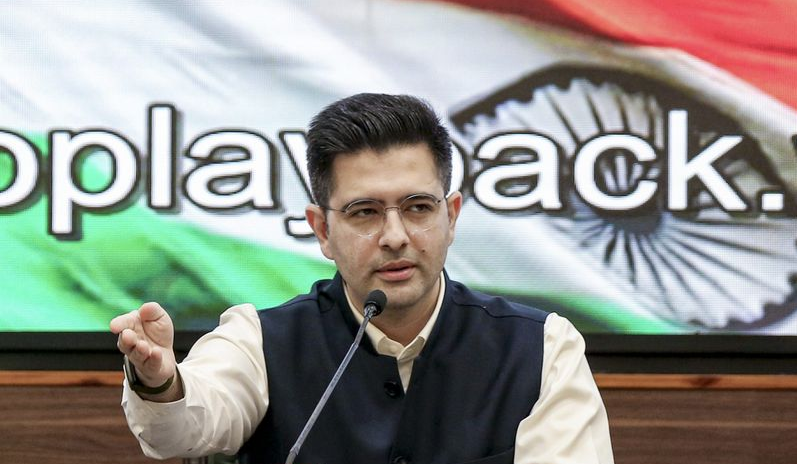
New Delhi, Sept 2026 : Rajya Sabha MP Raghav Chadha on Thursday accused the Aam Aadmi Party (AAP)-led Punjab government of deliberately marking his voter identification record in Mohali as “permanently shifted” in the draft electoral rolls prepared under the Election Commission’s Special Intensive Revision (SIR), alleging that the move violated safeguards intended to protect the names of public representatives.
Chadha, who was elected to the Rajya Sabha from Punjab as an AAP member in 2022, joined the Bharatiya Janata Party (BJP) in April this year along with six other AAP MPs. The MPs invoked the anti-defection law’s merger provision while switching political affiliation.
In a post on X, Chadha alleged that the Punjab government had extended what he described as its “politics of revenge” to the electoral revision process. He said he was a sitting Rajya Sabha member from Punjab and that his voter identification card was registered in Mohali. Despite this, he claimed his name had been classified as “shifted” in the draft electoral rolls.
“The AAP government in Punjab has now taken its politics of revenge to the Draft Electoral Rolls,” Chadha said, alleging that the classification was politically motivated.
At the same time, the BJP leader acknowledged that the electoral rolls currently under consideration are only draft rolls and not the final version. He pointed out that voters have an opportunity to raise objections and seek corrections during the ongoing Claims and Objections process.
“Thankfully, these are only the Draft Electoral Rolls, not the Final Electoral Rolls,” Chadha said, adding that corrections could be made during the process. He said the final electoral rolls are scheduled to be published in October 2026 and that he was already pursuing the remedies available under the SIR guidelines.
Chadha, however, maintained that the classification of his electoral record could not simply be dismissed as an administrative or clerical error. He described it as a “clear case of political vendetta” and questioned how the decision was made and verified.
He alleged that the official who marked his record as “shifted”, the officer who verified the classification and the official who processed it at a higher level were all associated with the Punjab government.
The Rajya Sabha member also questioned the structure of the electoral revision machinery in Punjab. According to Chadha, officials working at different stages of the process, from Booth Level Officers (BLOs) to the Chief Electoral Officer, are drawn from the state government administrative structure.
He said BLOs are generally junior state government employees, while Assistant Electoral Registration Officers (AEROs), Electoral Registration Officers (EROs) and District Election Officers (DEOs) involved in the revision exercise are also state government officials. Chadha further pointed out that the Chief Electoral Officer of Punjab is a Punjab-cadre IAS officer.
Based on this structure, Chadha alleged that state officials could face political pressure because transfers, postings and career-related decisions are controlled by the government. He claimed such circumstances could allow the ruling establishment to exert influence over officials performing electoral duties.
“These officers know AAP Government controls their transfers, postings and careers once their electoral duty ends,” Chadha alleged, claiming that this was how political pressure could be applied through the state administrative machinery.
The BJP leader further alleged that the action involving his electoral record was part of a wider pattern of retaliation against leaders who had left the AAP and joined the BJP.
Chadha claimed that after his departure from the AAP, the Punjab Police and administrative machinery had been used against political leaders who chose to leave the party. He alleged that other former AAP MPs who joined the BJP had also faced targeting by the Punjab government.
“This wrongful classification is only the latest act in that political vendetta,” he said.
A key part of Chadha’s argument relates to Paragraph 4(d) of the Election Commission of India’s Detailed Guidelines for SIR. He said the provision establishes a form of protection for certain public representatives and other prominent individuals whose names have previously been flagged in electoral databases.
According to the provision cited by Chadha, names of members of the judiciary, public representatives, holders of declared offices and personalities from fields such as arts, culture, journalism, sports and public service who were earlier flagged in the electoral database are to be included in the draft electoral rolls. This allows necessary documents to be collected during the Claims and Objections period.
Chadha argued that his status as a sitting Member of Parliament from Punjab meant that his name should have remained included in the draft electoral rolls even if his record had been flagged for verification.
“I am a sitting Member of Parliament from Punjab. If at all my name was flagged, Paragraph 4(d) required my inclusion in the draft electoral rolls,” he said, alleging that the provision had been deliberately violated in his case.
The controversy comes as the Election Commission’s electoral roll revision exercise continues, with the draft rolls still subject to claims, objections and corrections before publication of the final list.
Chadha said he would pursue the remedies available under the SIR guidelines to have his electoral record corrected. He also used the controversy to challenge what he described as the Punjab government’s attempt to use administrative processes for political purposes.
“AAP may run the Punjab Government, but Punjab’s Draft Electoral Rolls are not its private property,” Chadha said.
The allegations made by Chadha have not been independently established in the information available, and the claims regarding the involvement or political direction of individual government officials remain allegations.