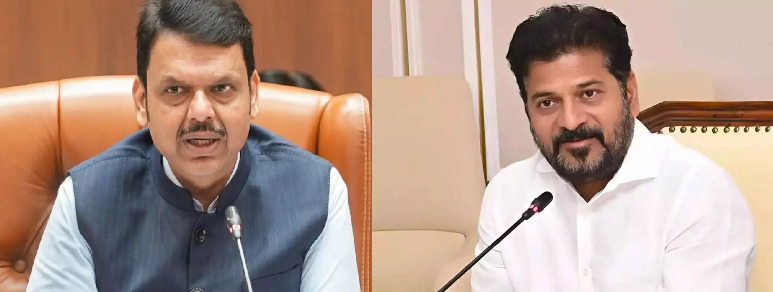
Hyderabad, October 2026 : Telangana Chief Minister A. Revanth Reddy will meet Maharashtra Chief Minister Devendra Fadnavis in Mumbai on Monday to seek approval for the construction of the proposed Tummidihatti Barrage across the Pranahita River. The discussions will focus on increasing the barrage’s height to 152 metres to improve irrigation and drinking water availability in northern Telangana.
A delegation led by Revanth Reddy was scheduled to leave for Maharashtra on Sunday evening. Following an overnight stay in Mumbai, the delegation will meet Fadnavis at the Sahyadri State Guest House at 11 a.m. on Monday.
According to the Telangana Chief Minister’s Office (CMO), the meeting will focus on the long-pending Tummidihatti irrigation project. Telangana Irrigation Minister Uttam Kumar Reddy and senior officials of the Irrigation Department will also participate in the discussions.
The Telangana government will seek Maharashtra’s consent to construct the barrage with a Full Reservoir Level (FRL) of 152 metres, instead of the previously agreed 148 metres. The proposed project is expected to strengthen irrigation infrastructure and help meet the drinking water requirements of several districts in northern Telangana.
The state government believes that increasing the barrage height to 152 metres would enable it to divert a larger volume of water from the Pranahita River, a tributary of the Godavari, thereby expanding irrigation facilities in the undivided Adilabad district and other water-stressed areas.
At a meeting held on October 23, Revanth Reddy directed irrigation officials to prepare detailed technical reports and supporting data to convince Maharashtra to approve the revised height. He informed the meeting that Fadnavis had expressed his willingness to hold discussions on the project.
Engineers briefed the Chief Minister on the potential quantities of water that could be diverted or lifted towards the Yellampally project under different scenarios, including a Tummidihatti Barrage FRL of 152 metres and 150 metres.
According to the officials, no villages in Maharashtra would be submerged following the construction of the barrage. However, the estimated submergence area would be around 2,300 acres at an FRL of 152 metres and less than 1,000 acres at 150 metres.
Revanth Reddy instructed officials to prepare precise estimates of the land likely to be submerged in Maharashtra and present the technical details to support Telangana’s demand for permission to divert the maximum possible quantity of water.
The Chief Minister also directed the Irrigation Department to furnish all information sought by the Central Water Commission (CWC), following a meeting between officials of Telangana and Maharashtra in New Delhi last month.
Emphasising the importance of the project, Revanth Reddy said the proposed barrage was intended to provide irrigation facilities to approximately two lakh acres in the backward regions of Adilabad, which include extensive forest areas and tribal communities.
He expressed hope that the project would benefit local communities, particularly those whose livelihoods depend on agriculture and natural resources.
The Chief Minister pointed out that Maharashtra had previously agreed to an FRL of 148 metres, but Telangana maintained that the lower height would not enable it to obtain the expected volume of water.
He asked officials to be fully prepared with technical assessments, water availability calculations and submergence details before the meeting with Fadnavis.
The proposed discussions are expected to be crucial for advancing the Tummidihatti Barrage project, with Telangana seeking Maharashtra’s cooperation to improve water utilisation, expand irrigation coverage and address the long-standing water needs of northern Telangana.