European Court Of Auditors Have Reviewed The European Budget 2028-2034; Rejects Several Amendments.

Luxembourg; April 2026: The European Court of Auditors (ECA) has just published “EU budget 2028-2034 – The ECA’s view: Many changes may not make it better”, an overview prepared under the responsibility of ECA President Tony Murphy.
The significant and manifold changes the European Commission has proposed for the EU’s long-term budget may ultimately not make funding and spending methods for implementing EU policies and programmes after 2028 better, according to the auditors. As certain parts of the proposed arrangements fundamentally change the way EU spending is planned, managed and scrutinised, the auditors warn of risks to sound financial management and call for stronger safeguards. In a document published today that summarises their concerns, the auditors reiterate warnings to EU policymakers as they embark on negotiating the outcome of the proposed budget of almost €2 trillion for the 2028-2034 period.
In its press release dated 28th April 2026 (ET), the European Court of Auditors have stated that:
- On 16 July 2025, the European Commission put forward its first set of legislative proposals for the 2028-2034 Multiannual Financial Framework (MFF), followed by a second set of sectoral proposals on 3 September 2025. Taken together, these legal proposals or draft laws set the strategic foundation for the European Union’s future financial planning and prioritisation during the next seven-year budget period. Once they have been agreed by EU lawmakers, they will govern the EU’s proposed €2 trillion 2028-2034 budget.
- From mid-January to mid-March 2026, we issued twelve individual opinions in response to requests from the European Parliament and/or the Council of the European Union. ECA has provided views on a wide array of areas of EU action, ranging from competitiveness, research and culture, to cohesion, agriculture, and international support. The ECA’s assessments of the proposals stem from our institution’s previous audit work and insight in EU policies and programmes.
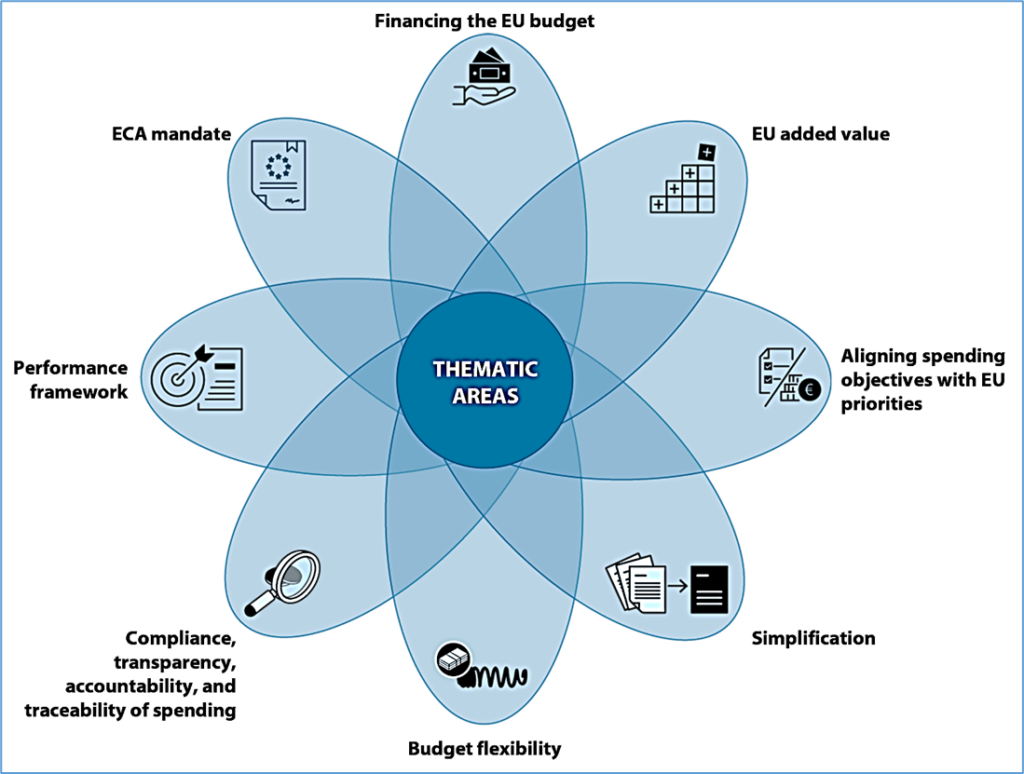
- In this overview document, the ECA outlines its position on the legislative package as a whole, bringing together the main messages from its individual opinions that centre around eight key thematic areas such as accountability, simplification and EU added value.
2028-2034 MFF architecture –
- The MFF constitutes the EU’s budgetary plan for a seven-year period, setting the maximum level of spending (commitment ceilings) for each major category of expenditure (heading). The proposed funding of almost €2 trillion at current prices (€1.8 trillion at 2025 prices) represents an increase of 59% at current prices (39% at 2025 prices), compared to the €1.2 trillion of the 2021-2027 MFF. When expressed as a percentage of EU gross national income (GNI), the MFF ceilings increase from 1.13% to a proposed 1.26% (1.15% excluding the Next Generation EU repayment).
- With the proposed 2028-2034 package, the Commission significantly changes the MFF architecture by reorganising the current MFF from seven to four main headings and by reducing the number of programmes from 52 to 162, which shows that we are dealing with a major budget overhaul.
- As well as a substantial increase in the budget and a reduced number of headings, the proposals provide for more major changes, which are summarised below:
Financing:
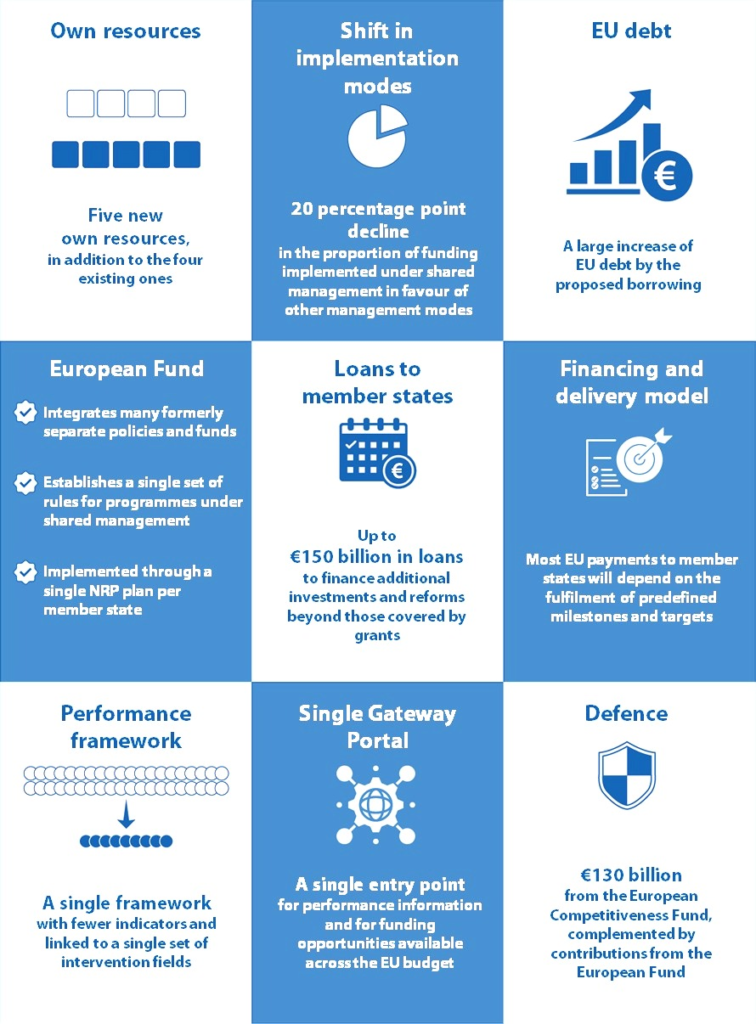
- Annual national contributions to finance the budget would increase by 81 % to €235 billion at current prices (48 % to €208 billion at 2025 prices).
- An increase in the number of own resources from four to nine, by introducing three new own resources (non-collected e-waste, tobacco excise duties, and a corporate resource for Europe) and keeping two that were previously proposed (Carbon border adjustment mechanism and the Emissions trading system). Adjustments to the existing own resources are also proposed. Taken together the changes would amount to an additional €66 billion annually at current prices (€58 billion at 2025 prices).
- An option introduced by the European Fund proposal for member states to finance the implementation of their NRP plans through loans from the EU for up to €150 billion, to be repaid by those member states at a later stage. An EU loan instrument, at such scale, and not in response to a crisis, is a significant novelty.
- A large increase of EU debt by the proposed borrowing, including mainly these €150 billion loans, the up to €100 billion additional support for Ukraine, along with the recently proposed €90 billion loan to Ukraine and the potential use of the severe crisis mechanism of up to €395 billion.
Spending priorities:
- A new sizeable European Fund worth €865 billion at current prices (€771 billion at 2025 prices) under the new heading will be established, incorporating various key EU policy areas (economic, social and territorial cohesion, agriculture and rural development, fisheries and maritime affairs, prosperity and security) into a single framework centered around a single national and regional partnership (NRP) plan for each member state.
- A substantial increase in funding, amounting to as much as €130 billion from the new European Competitiveness Fund, complemented by additional contributions from the European Fund, is designed to strengthen the EU’s defence industrial base and enhance defence capabilities.
Budget management and reporting:
- A marked decline (20 percentage points) in the proportion of funding that is implemented jointly by the Commission and member states under shared management. Shared management would be at 46% and direct/indirect at 54%.
- A shift from the current reimbursement of eligible expenditure incurred to a financing model not linked to costs, largely inspired by the Recovery and Resilience Facility (RRF), the EU’s COVID recovery fund. Most EU payments to member states will depend on the fulfilment of predefined milestones and targets for reforms and investments and will be based on ex ante cost estimates.
- More flexibility in the use of EU funds to address unexpected challenges or emergencies.
- An increased use of simplified cost options or financing not linked to costs. This funding mechanism is proposed for most funds.
- A single performance framework, with a significantly reduced number of indicators and a single set of intervention fields for monitoring the implementation of the programmes.
- A single entry point for performance information and for funding opportunities available across the EU budget (Single Gateway Portal), as well as a single ‘Annual Management Performance report’ and an implementation report for each programme to replace mid-term evaluations.
Main messages by ECA:
- The legislative proposals mark a significant change compared to previous long-term EU budgets or MFFs. A clear example is the brand-new European Fund, which merges funding for long-standing key policies such as cohesion and agriculture and addresses emerging priorities by facilitating the reallocation of resources to respond to new needs and unforeseen crises under a single national plan for each member state. While such integration is intended to enhance coherence, it also means combining policies which have different objectives, timeframes and delivery rationales. This could lead to greater complexity and require trade-offs between priorities.
- The European Fund largely replicates the RRF’s delivery model. Our audit work has repeatedly highlighted lessons to be learned from the RRF to enhance the performance orientation, accountability and transparency of similar instruments in future. Some of these issues have been addressed while other important ones remain unaddressed, most notably the need to focus on results rather than outputs and to provide a clear link between funding and results.
- For the first time since 1962, the common agricultural policy (CAP) will no longer have a separate, dedicated agricultural fund. The increased flexibility granted to member states allows them to tailor their plans to address specific challenges they may face. However, significant divergence among member states’ plans could weaken the alignment of CAP spending with EU priorities, distort competition and create an uneven playing field for farmers.
Team Maverick.






Shivakumar Says Congress United, Assures Women Will Get Cabinet Berth
Bengaluru, Aug 2026 : Karnataka Chief Minister D.K. Shivakumar on Monday sought to dismiss…
Shivakumar Says Congress United, Assures Women Will Get Cabinet Berth
Bengaluru, Aug 2026 : Karnataka Chief Minister D.K. Shivakumar on Monday sought to dismiss …