No Decision Yet on Raising Ethanol Blending Beyond 20%: Centre Highlights E20’s Safety and Economic Gains

New Delhi, July 2026 : The Union government on Thursday informed Parliament that it has not taken any decision to increase ethanol blending in petrol beyond the existing 20 per cent level, clarifying that any future move will be based on comprehensive scientific evaluation, technical studies and consultations with all stakeholders.
Replying to a question in the Lok Sabha, Minister of State for Petroleum and Natural Gas Suresh Gopi said the government remains committed to a science-based and consultative approach before considering higher ethanol blends. He stressed that any proposal to increase blending beyond E20 would involve extensive discussions with automobile manufacturers, oil marketing companies, research institutions and technical experts to ensure vehicle compatibility, fuel efficiency and consumer safety.
The Minister also clarified that the recent introduction of E85 fuel, which contains 85 per cent ethanol and 15 per cent petrol, should not be interpreted as an increase in the country’s standard ethanol blending programme. E85 has been introduced exclusively for specially designed and certified Flex Fuel Vehicles (FFVs) and is intended for a limited category of automobiles capable of operating on high-ethanol fuel.
Highlighting India’s ethanol blending journey, Gopi said ethanol has been used as a transportation fuel across the world for more than a century, with countries such as Brazil successfully operating vehicles on much higher ethanol blends for several decades. India’s Ethanol Blended Petrol (EBP) Programme, he noted, has followed a carefully planned and phased roadmap backed by scientific validation and extensive stakeholder consultation.
He said the programme has been implemented with active participation from institutions including NITI Aayog, the Society of Indian Automobile Manufacturers (SIAM), the Automotive Research Association of India (ARAI), Indian Oil Corporation Limited (IOCL), the Indian Institute of Petroleum (IIP), oil marketing companies and automobile manufacturers.
According to the government, extensive laboratory research, field validation and large-scale operational experience have demonstrated that E20 fuel is safe, efficient and environmentally beneficial when used in accordance with vehicle manufacturers’ specifications.
“The assessment is based not merely on laboratory testing but also on extensive nationwide implementation,” the Minister informed the House.
He pointed out that E15 petrol has been in widespread use across India for more than three-and-a-half years, while E19 and E20 blends have been available for over two-and-a-half years. During this period, more than 20 crore two-wheelers and over three crore petrol-powered passenger vehicles have operated on these fuel blends without any verified evidence of widespread engine failure or abnormal mechanical damage linked to ethanol blending.
The Minister said data collected from automobile manufacturers further reinforces confidence in the safety of E20 fuel. Vehicle manufacturers have continued to honour warranty commitments for vehicles using E20, indicating that the fuel has not resulted in abnormal corrosion, excessive wear or reduction in engine life.
Citing industry data, Gopi said one of India’s largest passenger vehicle manufacturers serviced approximately 2.84 crore vehicles during the 2025-26 financial year. This included nearly 1.5 crore older vehicles that were originally designed before E20 compatibility standards were introduced. Despite this, there were no reports of engine damage or unusual component wear attributable to ethanol-blended fuel.
Similarly, one of the country’s leading two-wheeler manufacturers reported that its extensive service records revealed no higher incidence of engine-related problems in vehicles running on E20 compared to those operating on earlier fuel blends.
He added that findings from the Inter-Ministerial Committee under NITI Aayog, along with studies conducted by IOCL, SIAM, ARAI and the Indian Institute of Petroleum, confirmed that E20 fuel does not create compatibility issues or cause abnormal wear and tear in engines.
Addressing concerns regarding fuel efficiency, the Minister acknowledged that mileage depends on multiple factors, including driving conditions, vehicle maintenance and driving behaviour. While some vehicles originally designed for E10 fuel may experience a marginal reduction in fuel economy of around three to five per cent, he said the overall performance advantages of E20 outweigh this difference.
According to studies conducted by SIAM and ARAI, E20 offers a higher octane rating, superior anti-knock properties, cleaner combustion and improved engine performance. The fuel also enhances acceleration and overall ride quality while helping reduce harmful carbon emissions.
Gopi explained that ethanol’s higher octane number supports the operation of modern high-compression engines, while its greater heat of vaporisation contributes to more efficient combustion, making it a cleaner alternative to conventional petrol.
The government also highlighted the broader economic and environmental benefits achieved through the Ethanol Blended Petrol Programme. According to official estimates, the initiative has significantly reduced India’s dependence on imported crude oil while strengthening rural incomes through increased demand for agricultural feedstock used in ethanol production.
“The Ethanol Blended Petrol Programme has resulted in savings of more than Rs 1.97 lakh crore in foreign exchange by reducing crude oil imports,” the Minister said.
He added that the programme has helped substitute nearly 316 lakh metric tonnes of crude oil, reduced approximately 952 lakh metric tonnes of carbon dioxide emissions and transferred more than Rs 1.66 lakh crore to farmers through ethanol procurement.
The government reiterated that while India remains committed to expanding the use of cleaner and renewable fuels, any future decision on increasing ethanol blending beyond the present 20 per cent level will be taken only after rigorous scientific assessment, technological validation and broad-based consultations to ensure that consumer interests, vehicle safety and environmental objectives remain fully protected.



Rahul Gandhi, INDIA Bloc Hold Candlelight Vigil at Gandhi Smriti Over NEET Paper Leak Row
New Delhi, July 2026 : The Opposition intensified its campaign over the alleged NEET exami…
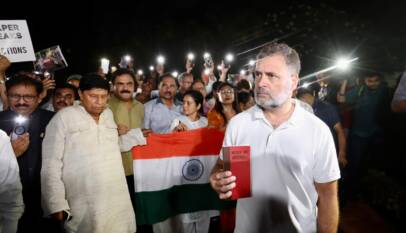
Rahul Gandhi, INDIA Bloc Hold Candlelight Vigil at Gandhi Smriti Over NEET Paper Leak Row
New Delhi, July 2026 : The Opposition intensified its campaign over the alleged NEET …