Tejas Programme Gets Major Boost as Uttam AESA Radar Nears Induction, Indigenous IRST Advances for Mk-2

New Delhi, July 2026 : India’s indigenous Tejas fighter aircraft programme has achieved a major technological milestone with the successful completion of extensive flight trials of the Uttam Active Electronically Scanned Array (AESA) radar for the Tejas Mk-1A, while the development of an indigenous dual-band Infrared Search and Track (IRST) system for the Tejas Mk-2 is progressing rapidly. Together, these advanced sensor systems are expected to significantly enhance the Indian Air Force’s air combat capabilities and reduce dependence on imported technologies.
The latest advancements represent a crucial step in strengthening India’s indigenous aerospace ecosystem under the Aatmanirbhar Bharat initiative. Equipped with next-generation radar and passive detection technologies, future variants of the Tejas are expected to offer superior situational awareness, improved survivability and greater combat effectiveness against modern fighter aircraft operating in increasingly contested airspaces.
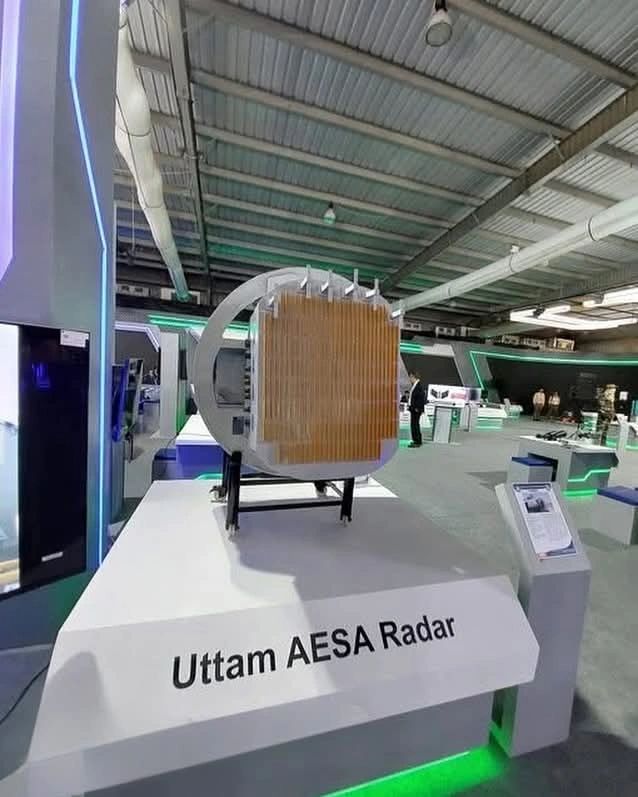
The Uttam AESA radar, developed by the Defence Research and Development Organisation’s (DRDO) Electronics and Radar Development Establishment (LRDE), has completed more than 125 successful flight trials on Tejas prototypes and flying test beds. Following the successful validation programme, the radar is scheduled to be integrated beginning with the 41st production aircraft under the Tejas Mk-1A programme, gradually replacing the imported Israeli EL/M-2052 radar.
The indigenous radar marks a significant achievement for India’s defence research establishment. During trials, Uttam reportedly demonstrated the capability to detect fighter-sized aircraft with radar cross-sections of approximately 10 square metres at ranges of up to 240 kilometres. The evaluation involved Pilotless Target Aircraft equipped with corner reflectors to simulate realistic combat targets, enabling engineers to assess the radar’s detection, tracking and targeting performance under operational conditions.
The AESA radar employs advanced Gallium Nitride (GaN) technology, providing higher power efficiency, improved target detection, simultaneous tracking of multiple airborne threats and enhanced resistance against electronic jamming. These capabilities are expected to provide Tejas pilots with a significant “first-look, first-shot” advantage in beyond-visual-range (BVR) engagements.
The Uttam radar has also been designed to integrate seamlessly with India’s indigenous Astra Mk-2 beyond-visual-range air-to-air missile. The Astra Mk-2 is expected to engage aerial targets at distances exceeding 160 to 200 kilometres, enabling Tejas Mk-1A pilots to neutralise hostile aircraft well before entering close combat. The combination of Uttam AESA radar and Astra Mk-2 missile is expected to substantially improve the aircraft’s lethality while allowing pilots to engage enemy fighters from safer stand-off ranges.
According to programme plans, Hindustan Aeronautics Limited (HAL) will progressively integrate the Uttam radar into future Tejas Mk-1A production. Most aircraft in the second batch of 97 Tejas Mk-1A fighters are expected to be equipped with the indigenous radar, significantly reducing reliance on imported mission-critical systems while enhancing India’s strategic self-reliance in defence technology.
Alongside the radar programme, DRDO is making rapid progress in developing a sophisticated dual-band Infrared Search and Track (IRST) system for the upcoming Tejas Mk-2. The passive sensor is inspired by advanced European systems such as the Eurofighter Typhoon’s PIRATE IRST and is intended to complement the aircraft’s radar by providing silent target detection capability.
Unlike conventional radar systems, which emit radio waves that can be detected by enemy warning receivers, IRST systems operate passively by detecting the heat signatures generated by aircraft engines, fuselages and weapon bays. This allows fighter pilots to identify and track adversary aircraft without revealing their own position, offering a critical tactical advantage during modern air combat.
The capability is considered particularly important as neighbouring countries continue to induct advanced combat aircraft equipped with low-observable features and sophisticated electronic warfare systems. Passive infrared detection can help counter stealth technologies by identifying thermal emissions that remain difficult to conceal.
The indigenous IRST programme has reportedly entered an advanced stage of development, with sensor validation activities already underway and preparations progressing for prototype integration. The dual-band architecture will enable the system to detect targets across multiple infrared wavelengths, improving accuracy, extending detection ranges and enhancing resistance to infrared countermeasures.
Once integrated into the Tejas Mk-2, the IRST will operate alongside the Uttam AESA radar and onboard electronic warfare suite, allowing the aircraft to fuse data from multiple sensors into a comprehensive tactical picture. Such sensor fusion will significantly improve pilot situational awareness, target tracking and engagement efficiency in both air superiority and defensive missions.
The parallel development of the Uttam AESA radar and indigenous IRST reflects India’s growing capability to design and manufacture advanced airborne sensors domestically. Beyond improving the operational effectiveness of the Tejas fleet, these technologies represent a strategic investment in India’s long-term defence preparedness.
As regional air forces continue to modernise with increasingly sophisticated fighters, airborne early warning systems and electronic warfare capabilities, the induction of indigenous radar and passive detection technologies will ensure that the Tejas remains a competitive and capable frontline fighter. The programme also reinforces India’s commitment to building a self-reliant defence industrial base, reducing dependence on foreign suppliers and positioning the country among the leading developers of advanced military aviation technologies.






HAL Begins Production of 12 Indigenous-Enhanced Su-30MKI Fighters for Indian Air Force
New Delhi, July 2026 : Hindustan Aeronautics Limited (HAL) has commenced the construction …
HAL Begins Production of 12 Indigenous-Enhanced Su-30MKI Fighters for Indian Air Force
New Delhi, July 2026 : Hindustan Aeronautics Limited (HAL) has commenced the construction of …