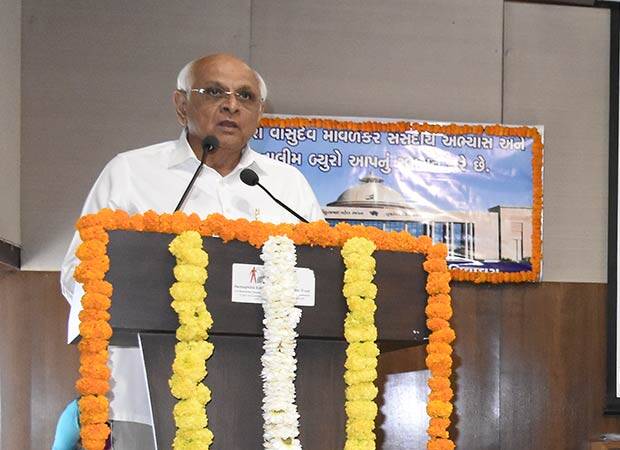
CM Calls on Sarpanches to Build Viksit Villages for a Developed Bharat

Sarpanches from over 260 villages representing various talukas across seven districts of North Gujarat participate
Chief Minister Shri Bhupendra Patel:-
• Prime Minister Shri Narendra Modi has emphasised rural development in the Union Budget, which is based on the spirit of duty
• Villages form the backbone of the nation’s development process
• Sarpanches, as village leaders, must perform their responsibilities with commitment, guided by the mantra of Sauno Saath, Sauno Vikas, Sauno Vishwas, Sauno Prayas, and mobilise rural people’s strength in the journey towards a Viksit Bharat
• No compromise will be allowed in the quality of public-interest works
• Grants must be utilised in a systematic and planned manner, ensuring 100 per cent achievement through the Prime Minister’s saturation approach
Speaker of the Legislative Assembly Shri Shankar Chaudhary
• It is the duty of Sarpanches to realise the Prime Minister’s vision of a Gram Sachivalaya (Village Secretariat) into reality and lead villages towards modernisation
• By understanding their rights and duties under the Panchayat Act, Sarpanches should work more proactively for the holistic development of villages
• Active public participation in Gram Sabhas is essential to strengthen the very foundation of democracy
Gandhinagar, February 2026: Chief Minister Shri Bhupendra Patel called upon Gram Panchayat Sarpanches to commit themselves to the task of developing villages for a Viksit Bharat by ensuring greater transparency, quality, and accountability at the rural level.
He stated that under the leadership of Prime Minister Shri Narendra Modi, this year’s Union Budget prioritises duties, specifically emphasising rural development.
Highlighting the vital role of villages in the nation’s progress, CM guided Sarpanches to responsibly fulfil their roles as village leaders, guided by the mantra of Sauno Saath, Sauno Vikas, Sauno Vishwas, Sauno Prayas, and to engage people in the journey towards a Viksit Bharat actively.
Chief Minister inaugurated the ‘Gram Shakti Training Programme’ at the Gujarat Legislative Assembly with reference to Ganesh Vasudev Mavalankar Parliamentary Studies and Training Bureau, in the presence of Speaker Shri Shankar Chaudhary and Ministers Shri Rushikesh Patel and Shri Kunvarji Bavaliya.
More than 260 Sarpanches from various talukas of Banaskantha, Vav–Tharad, Mehsana, Patan, Sabarkantha, and Aravalli districts of North Gujarat participated in the training programme. Elaborating on the idea that villages are the soul of India, the Chief Minister stated that when all villagers collectively engage in development activities, the village’s progress becomes evident and vibrant.
Encouraging Sarpanches to prepare well-planned lists of development works with enthusiasm and a sense of service, CM emphasised optimal utilisation of grants with 100 per cent targets through the Prime Minister’s saturation approach. He stated that the foremost responsibility of Sarpanches is to ensure that government schemes and facilities reach to every person in the village. The nation can truly progress only when its villages develop.
While stating that there would be no compromise on the quality of public-interest works, CM added that Sarpanches must actively involve youth in development initiatives and future planning, while leveraging technology to deliver services and facilities efficiently to citizens.
Assuring that the government stands firmly with them in all circumstances, the Chief Minister expressed his resolve that Sarpanches should work fearlessly and with dedication in public service, uniting everyone to achieve Viksit villages, leading to a Viksit Gujarat and Viksit Bharat.
Speaker of the Gujarat Legislative Assembly, Shri Shankar Chaudhary
Addressing the Sarpanches present at the ‘Gram Shakti Training Programme’, Speaker Shri Shankar Chaudhary stated that the Prime Minister’s vision of the Gram Sachivalaya (Village Secretariat) offers a new direction for rural development. He emphasised that the key responsibility of implementing this vision at the grassroots level and making villages self-reliant rests with the Sarpanches.
Highlighting the Chief Minister’s effective leadership, the Speaker stated that the training programme was realised due to the Chief Minister’s vision. He reaffirmed the state government’s commitment to extending modern facilities to rural citizens.
Encouraging the Sarpanches, the Speaker added that development is not limited to bricks-and-cement infrastructure; it is driven by meaningful ‘conversation’. Often, gaps in communication between the Gram Panchayat and the Gram Sabha lead to conflict. Involving villagers even in minor works and by interacting with them will naturally reduce conflicts, leading to development through public participation.
Stressing the importance of Panchayati Raj, he said that true public service lies in understanding and fulfilling the rights and duties prescribed in the Panchayat Act for comprehensive village development. While ideological differences from Panchayat to Parliament are natural in a democracy, village welfare should remain paramount, and constructive ideas from the opposition should also be accepted through conversation.
Panchayat is the cornerstone of democracy. Only when this foundation is strong can the Prime Minister’s vision of a ‘Viksit Bharat’ be realised. The Speaker urged all Sarpanches to make villages Atmanirbhar and modern, and to contribute to nation-building through a Viksit Gujarat.
On this occasion, Panchayat and Rural Housing Minister Shri Rushikesh Patel stated that Sarpanches carry the significant responsibility of shaping an ‘ideal’ village by providing urban-like facilities and fostering an urban outlook among rural citizens. He recalled that upon becoming Prime Minister, Shri Narendra Modi empowered Sarpanches by allowing them to utilise 70 per cent of Finance Commission grants, enabling the preparation of Village Development Plans and the delivery of facilities comparable to those in cities. In consultation with villagers, Sarpanches can decide priorities such as roads, water supply, electricity, and drainage, ensuring development is aligned with village needs.
Shri Rushikesh Patel further added that under the guidance of Chief Minister Shri Bhupendra Patel, all villages in Gujarat have been connected by at least two roads under the ‘Mukhya Mantri Gram Sadak Yojana’. He noted that the Gram Shakti Training Programme would guide village administration. Emphasising the pivotal role of the Sarpanch, he urged them to ensure that the benefits of various state schemes reach senior citizens, widowed women, and villagers still awaiting government assistance.
Rural Development Minister Shri Kunvarji Bavaliya stated that under the guidance of Prime Minister Shri Narendra Modi and the leadership of Chief Minister Shri Bhupendra Patel, state government initiatives have enabled villages to access facilities on par with cities. Funds from central and state schemes are directly transferred to Gram Panchayat accounts, leading to proper and meaningful utilisation of these funds, which enable the transformation of villages into Viksit villages.
Expressing gratitude to the Chief Minister, the Minister highlighted that assistance under the Pradhan Mantri Awas Yojana has been increased from ₹1.20 lakh by an additional ₹50,000, enabling beneficiaries to receive up to ₹1.70 lakh for house construction. Furthermore, ₹5,000 assistance is provided to construct toilet facilities under the MGNREGA scheme. He urged Sarpanches to ensure that every villager receives a permanent house and that the benefits of welfare schemes reach everyone.
Secretary of the Gujarat Legislative Assembly Shri Chetan Pandya delivered the welcome address and presented the outline of the programme, while Chief Whip of the Assembly Shri Balakrishna Shukla gave the vote of thanks.
During the training programme, experts provided Sarpanches with in-depth insights on the role of Panchayats in parliamentary democracy, the G-RAMJI Gram Vikas Yojana development scheme, Panchayat accounting rules, and the rights and duties of Sarpanches in Gram Sabhas.
On this occasion, Development Commissioner Shri Hitesh Koya, Joint Secretary of the Assembly Shri Rita Mehta, Deputy Development Officers, and Sarpanches were present.
Source: Information Department, Gujarat

Governor pays obeisance at Baba Lal Ji Dhianpur Dham
On the eve of Guru Purnima, Governor Kavinder Gupta along with Lady Governor Bindu Gupta t…
Governor pays obeisance at Baba Lal Ji Dhianpur Dham
On the eve of Guru Purnima, Governor Kavinder Gupta along with Lady Governor Bindu …