Sonia Gandhi Slams Government Silence on Killing of Iran’s Supreme Leader, Calls It Abdication of India’s Moral and Strategic Responsibility

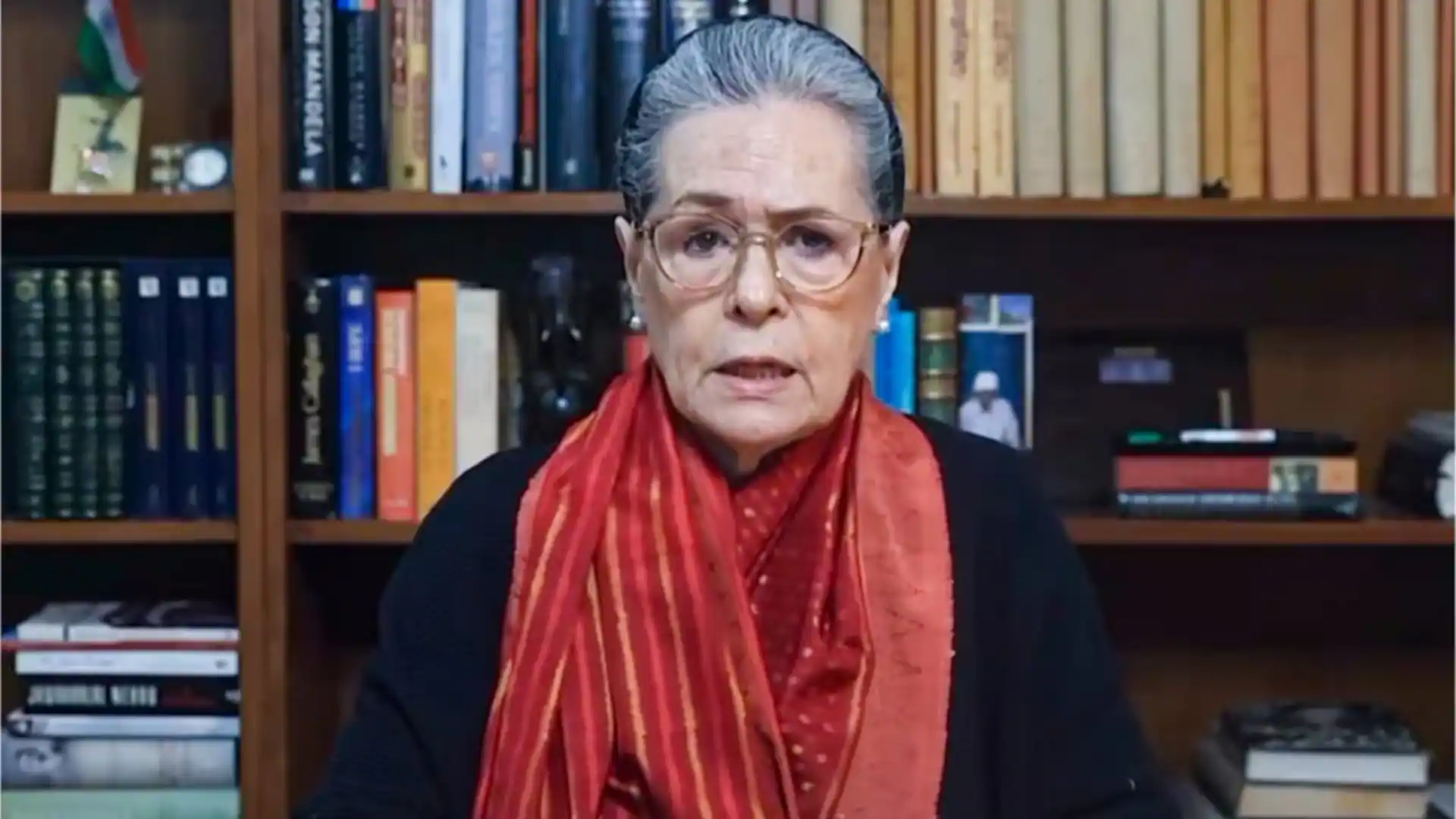
New Delhi, March 2026 : Congress Parliamentary Party (CPP) Chairperson Sonia Gandhi has sharply criticised the Union government for maintaining silence over the assassination of Iran’s Supreme Leader, Ayatollah Ali Khamenei, during joint US–Israel airstrikes, arguing that New Delhi’s lack of a clear response undermines both international law and India’s long-standing foreign policy principles.
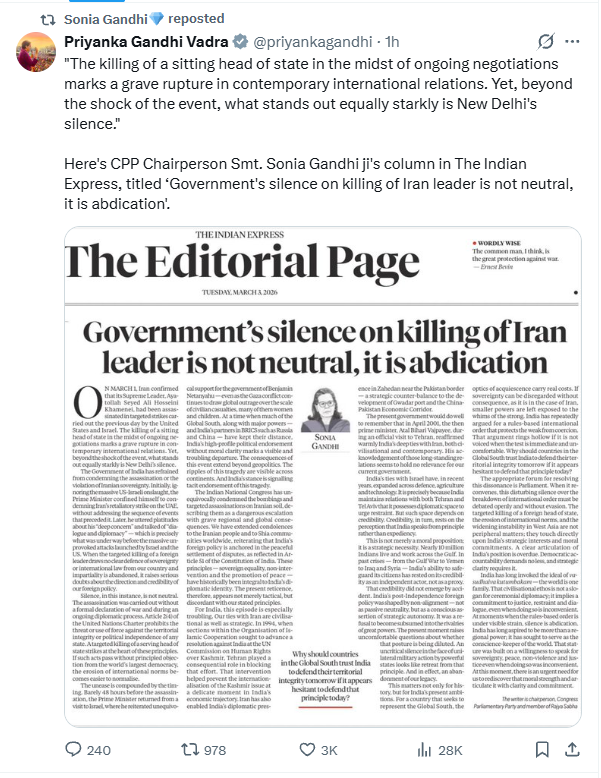
In an opinion piece published in The Indian Express, titled “Government’s silence on killing of Iran leader is not neutral, it is abdication”, Gandhi described the killing of a sitting head of state amid ongoing diplomatic negotiations as a profound rupture in contemporary international relations. She asserted that what was equally disturbing was India’s failure to articulate a principled response.
“The killing of a sitting head of state in the midst of ongoing negotiations marks a grave rupture in contemporary international relations. Yet, beyond the shock of the event, what stands out equally starkly is New Delhi’s silence,” Gandhi wrote, adding that the government had “refrained from condemning the assassination or the violation of Iranian sovereignty.”
Referring to recent remarks by Narendra Modi, Gandhi said the Prime Minister initially chose to condemn Iran’s retaliatory strike on the UAE without addressing the sequence of events that preceded it, namely the large-scale US–Israeli assault on Iranian targets. She argued that later statements expressing “deep concern” and calling for “dialogue and diplomacy” rang hollow because diplomatic engagement was already underway before the attacks took place.
“When the targeted killing of a foreign leader draws no clear defence of sovereignty or international law from our country, and impartiality is abandoned, it raises serious doubts about the direction and credibility of our foreign policy,” she wrote.
Gandhi stressed that silence in this case could not be interpreted as neutrality. She pointed out that the assassination occurred without a formal declaration of war and during an active diplomatic process, making it a direct challenge to the rules-based international order. Citing Article 2(4) of the United Nations Charter, she underlined that the threat or use of force against the territorial integrity or political independence of any state is explicitly prohibited.
“A targeted killing of a serving head of state strikes at the heart of these principles,” she said, warning that if such actions pass without principled objection from the world’s largest democracy, the erosion of international norms would become easier to normalise.
The Congress leader also criticised what she described as the Prime Minister’s “unequivocal support” for the Israeli government led by Benjamin Netanyahu, particularly in the context of the Gaza conflict. She argued that India’s high-profile political endorsement of Israel, without adequate moral clarity, represented a troubling departure from the country’s traditional balanced approach to West Asia.
Reiterating the Congress party’s stand, Gandhi described the assassination of Iran’s Supreme Leader as a “dangerous escalation with grave regional and global consequences.” She cautioned that such actions risk pushing an already volatile region into deeper instability, with direct implications for India’s strategic and economic interests.
Gandhi also recalled Iran’s historical diplomatic support for India. She noted that in 1994, when sections within the Organisation of Islamic Cooperation sought to advance a resolution against India at the UN Commission on Human Rights over Kashmir, Tehran played a crucial role in blocking the move. This, she said, demonstrated Iran’s willingness to support India on sensitive international issues.
She further highlighted Iran’s role in enabling India’s diplomatic presence in Zahedan, close to the Pakistan border, which she described as a strategic counter-balance to the Gwadar port and the China–Pakistan Economic Corridor. Such cooperation, she argued, underscored the depth and complexity of India–Iran relations, which should not be disregarded in moments of crisis.
Looking back at history, Gandhi recalled the 2001 visit of former Prime Minister Atal Bihari Vajpayee to Tehran, during which he reaffirmed India’s “deep ties” with Iran. She lamented that this acknowledgement of long-standing relations appeared to hold little relevance for the current government.
While acknowledging that India’s ties with Israel have expanded significantly in recent years across defence, agriculture and technology, Gandhi argued that it was precisely because India maintains relations with both Tehran and Tel Aviv that it possesses the diplomatic space to urge restraint. However, she warned that such space depends on credibility, which in turn rests on the perception that India speaks from principle rather than expediency.
Expressing concern for Indian citizens living and working in Gulf countries affected by the conflict, Gandhi said India’s ability to safeguard its people abroad has historically rested on its credibility as an independent actor, not as a proxy aligned with one side.
“The targeted killing of a foreign head of state, the erosion of international norms, and the widening instability in West Asia are not peripheral matters; they touch directly upon India’s strategic interests and moral commitments,” she wrote, adding that a clear articulation of India’s position was long overdue.
Invoking India’s civilisational ethos of Vasudhaiva Kutumbakam—the world is one family—Gandhi concluded that this principle is not merely a ceremonial slogan but a commitment to justice, restraint and dialogue, even when such positions are inconvenient. “At moments when the rules-based order is under visible strain, silence is abdication,” she said, urging India to rediscover and articulate its moral strength with clarity and conviction.
(The content of this article is sourced from a news agency and has not been edited by the Mavericknews30 team.)

Pakistan Appoint Mike Smith as Test Batting Coach Amid Batting Crisis
Mumbai, Aug 2026 : Pakistan have appointed former South African first-class cricketer and …
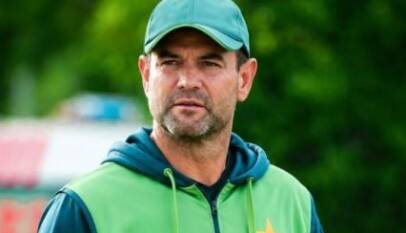
Pakistan Appoint Mike Smith as Test Batting Coach Amid Batting Crisis
Mumbai, Aug 2026 : Pakistan have appointed former South African first-class cricketer and Level …