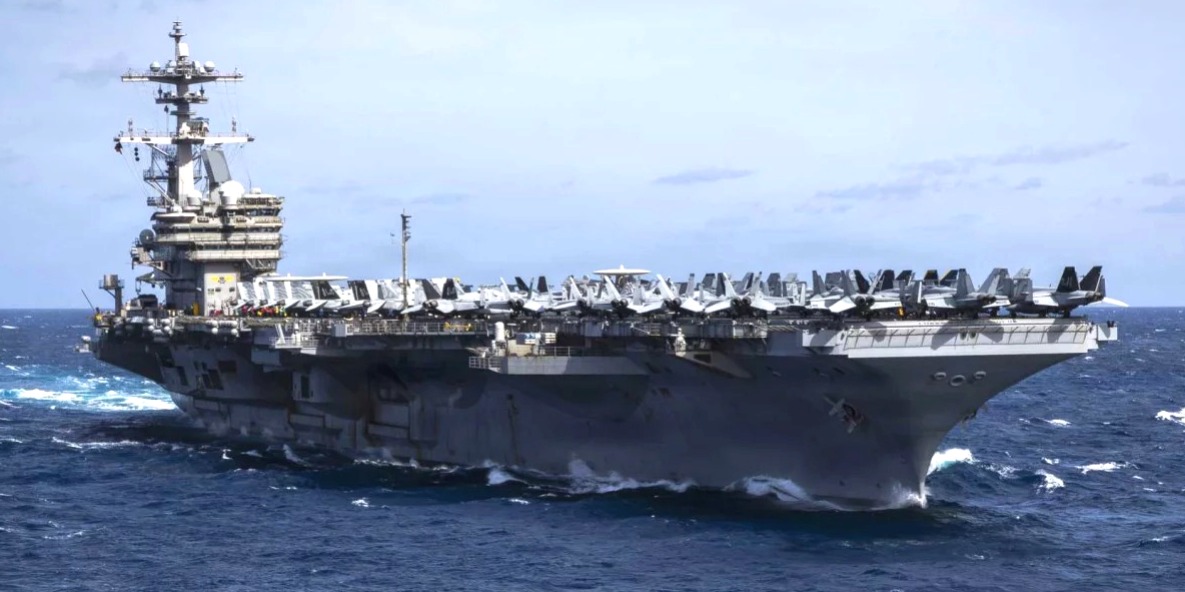
US Navy Prepares 03rd Carrier Strike Group Deployment With USS George H.W. Bush Near Iran.

Washington DC; March 2026: The US Navy is preparing to deploy the USS George H.W. Bush Carrier Strike Group to the Middle East in a move that could raise the number of American carrier strike groups operating in the region to three, according to US defence officials. The deployment would significantly increase the US Navy’s ability to conduct sustained air strikes, maritime security patrols, and deterrence operations near Iran while strengthening protection for commercial shipping lanes in the Persian Gulf and surrounding waters. Carrier strike groups typically include a Nimitz-class aircraft carrier, guided missile destroyers, and a cruiser, providing a mobile air base capable of launching dozens of sorties daily and supporting regional security missions.
According to the Department of War (DOW) USS George H.W. Bush (CVN-77) has finished its pre-deployment workups off Cape Hatteras on the US East Coast. The carrier is expected to cross the Atlantic and operate with its strike group in the eastern Mediterranean, reinforcing the US naval presence across the Mediterranean, the Red Sea, and the approaches to the Persian Gulf.
The potential deployment follows the USS Gerald R. Ford (CVN-78) crossing the Suez Canal. The ship now operates in the Red Sea. The presence of several US carrier strike groups shows a major increase in American military posture. Tensions with Iran are escalating, and maritime security is deteriorating along several strategic waterways.
The USS George H.W. Bush is the tenth and final Nimitz-class aircraft carrier built for the US Navy. It displaces more than 100,000 tons and is powered by two nuclear reactors. The ship can operate for long periods without refuelling. It can also sustain high-tempo flight operations far from US territory. As a mobile air base, the carrier can generate dozens of combat sorties per day for strike missions, intelligence, electronic warfare, and air defence.
Carrier Air Wing Seven is embarked aboard the carrier. This wing usually includes F/A-18E/F Super Hornets, EA-18G Growlers, E-2D Advanced Hawkeyes, and MH-60 Seahawk helicopters. Together, these aircraft provide a wide spectrum of capabilities. They support precision strike, suppression of enemy air defences, maritime surveillance, and anti-submarine warfare.
The carrier serves as the centre-piece of a broader Carrier Strike Group, typically comprising several Arleigh Burke-class guided-missile destroyers and, potentially, a Ticonderoga-class cruiser equipped with the Aegis combat system. These warships carry vertical launch systems capable of firing Tomahawk land-attack cruise missiles, Standard Missile family interceptors for air and ballistic missile defence, and anti-submarine warfare weapons. In a high-intensity conflict scenario, these vessels could conduct coordinated long-range strikes against Iranian military infrastructure, missile launch sites, naval bases, or proxy-controlled areas such as Houthi positions in Yemen.
The deployment comes amid growing instability across several maritime chokepoints in the Middle East. In the Red Sea, Houthi forces in Yemen have repeatedly launched missiles and drones targeting international shipping and vessels linked to Israel, forcing commercial shipping companies to divert traffic away from the region. US naval forces have already conducted multiple intercept operations and retaliatory strikes in response to these threats.
Tensions are also increasing in the Strait of Hormuz. This corridor is one of the world’s most critical maritime routes. About 20% of the global oil supply passes through it each year. Maverick News 30 have reported that maritime transit in the strait has dropped sharply since the confrontation with Iran began. This highlights growing disruption in global energy and trade.
To help stabilise maritime traffic, the US has announced a $1 billion reinsurance program. This aims to lower financial risks for shipping companies operating in the region. US Energy Secretary Chris Wright also said the US Navy could begin escorting commercial vessels through the Strait of Hormuz when security conditions allow. This would echo escort missions carried out during the 1980s Tanker War.
From a strategic perspective, the addition of the USS George H.W. Bush Carrier Strike Group would significantly increase the United States ability to sustain continuous air operations across multiple territories in the Middle East. Carrier-based aircraft can rapidly shift between missions ranging from maritime security and convoy escort to precision strikes against hostile forces, providing commanders with flexible options without relying heavily on regional air bases.
If the deployment occurs as expected, the US could soon have one of the largest concentrations of naval aviation power in the Middle East in decades. Carrier strike groups would operate across the Mediterranean, the Red Sea, and waters near the Persian Gulf. This presence would enable US forces to deter adversarial activities and rapidly respond to emerging threats in some of the world’s most sensitive maritime corridors.
Team Maverick.






Pakistan Appoint Mike Smith as Test Batting Coach Amid Batting Crisis
Mumbai, Aug 2026 : Pakistan have appointed former South African first-class cricketer and …

Pakistan Appoint Mike Smith as Test Batting Coach Amid Batting Crisis
Mumbai, Aug 2026 : Pakistan have appointed former South African first-class cricketer and Level …