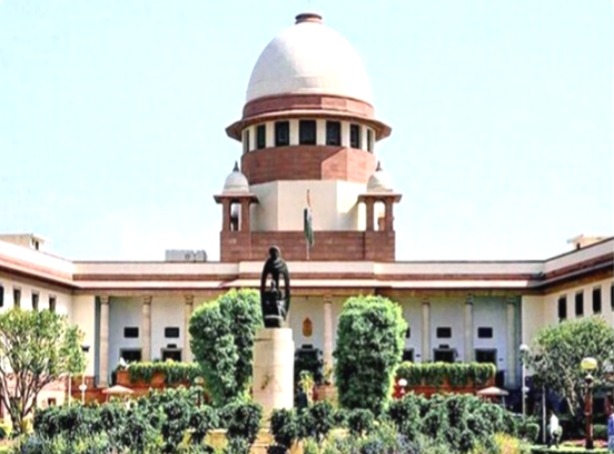
Supreme Court Rules Converted Christians Cannot Claim Scheduled Caste Status

New Delhi, March 2026 : The Supreme Court of India on Tuesday upheld a ruling of the Andhra Pradesh High Court, affirming that individuals who convert to Christianity and continue to practice the faith cannot claim the status of a Scheduled Caste under Indian law.
A Bench comprising Justices Prashant Kumar Mishra and N. V. Anjaria ruled that the constitutional provisions governing Scheduled Caste status are clear and leave no room for ambiguity. The court stated that only individuals professing Hinduism, Sikhism, or Buddhism are eligible to be recognised as members of Scheduled Castes.
Referring to the Constitution (Scheduled Castes) Order, 1950, the Bench emphasised that the restriction is “absolute” and does not allow for exceptions. It further clarified that conversion to any religion outside the specified categories results in the immediate and complete loss of Scheduled Caste status.
In its detailed observations, the court noted that a person cannot simultaneously follow another religion while claiming benefits associated with Scheduled Castes. The ruling highlighted that in the present case, the appellant had not only converted to Christianity but had also actively practiced the faith for several years. Evidence showed that he had been working as a pastor for over a decade and regularly conducted Sunday prayers, clearly establishing his religious identity.
The court pointed out that there was no claim of reconversion to the original religion or reintegration into the traditional caste community. On the contrary, the facts indicated a continued and consistent adherence to Christianity, leaving no doubt about the individual’s religious affiliation.
The Supreme Court’s decision reinforces the earlier ruling of the Andhra Pradesh High Court, which had, in April 2025, held that a person who had converted to Christianity could not invoke legal protections available to Scheduled Castes under the Scheduled Castes and Scheduled Tribes (Prevention of Atrocities) Act. The High Court had also observed that the caste system, as understood within Hindu social structure, does not apply to Christianity.
The apex court’s verdict underscores the legal position that Scheduled Caste status is intrinsically linked to specific religious identities as defined by law. It reiterated that constitutional provisions must be interpreted strictly, particularly when they concern eligibility for affirmative action and legal protections.
This ruling is expected to have wider implications in cases involving claims of caste-based benefits following religious conversion. By reaffirming the constitutional framework, the court has clarified that religious identity plays a निर्णायक role in determining eligibility for Scheduled Caste recognition under existing laws.
(The content of this article is sourced from a news agency and has not been edited by the Mavericknews30 team.)






Trump Undergoes Routine Medical and Dental Check-Up at Walter Reed Ahead of 80th Birthday
Washington, May 2026 : US President Donald Trump underwent a routine annual medical and de…

Trump Undergoes Routine Medical and Dental Check-Up at Walter Reed Ahead of 80th Birthday
Washington, May 2026 : US President Donald Trump underwent a routine annual medical and …