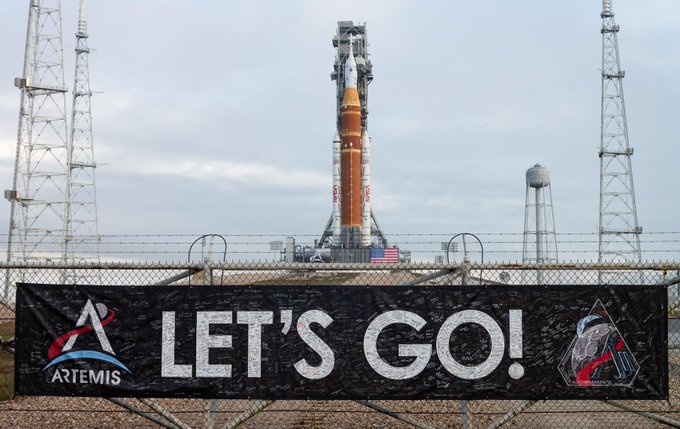
NASA Set to Launch Artemis II, First Crewed Moon Mission Since Apollo Era

New Delhi, March 2026 : The NASA has completed final preparations for the highly anticipated launch of Artemis II, which is scheduled to lift off as early as April 1 from the Kennedy Space Center.
The mission marks a historic milestone as the first crewed flight under NASA’s Artemis programme and the first time humans will travel beyond low-Earth orbit since the Apollo era. Artemis II will carry four astronauts on an approximately 10-day journey around the Moon, paving the way for future deep-space exploration.
The crew includes NASA astronauts Reid Wiseman, Victor Glover and Christina Koch, along with Canadian Space Agency astronaut Jeremy Hansen. Their mission will test the capabilities of the spacecraft and systems designed for future lunar and interplanetary travel.
Artemis II will be launched aboard NASA’s powerful Space Launch System rocket and will utilise the Orion spacecraft, which will carry astronauts with fully functional life-support systems for the first time. The mission is designed to evaluate critical technologies required for long-duration human spaceflight.
According to NASA, weather conditions for launch day appear largely favourable, with an 80 per cent chance of suitable conditions. However, potential challenges such as cloud cover and high winds remain under close observation.
Once launched, the spacecraft will first enter high Earth orbit before heading towards the Moon using a “free-return trajectory.” This path will take the crew around the far side of the Moon and back to Earth without requiring additional propulsion for the return journey, ensuring safety and efficiency.
During the mission, the astronauts are expected to surpass the record for the farthest distance travelled by humans from Earth, a milestone last achieved during the Apollo 13 mission.
Artemis II will also test several advanced systems, including emergency protocols, radiation protection measures, and cutting-edge communication technologies such as laser-based data transmission.
NASA has emphasised that this mission is a crucial step toward its long-term goals of establishing a sustained human presence on the Moon and eventually sending astronauts to Mars. The space agency will provide continuous coverage of the mission through live streams and regular updates.
As anticipation builds worldwide, Artemis II represents a new chapter in human space exploration, reviving ambitions that extend far beyond Earth’s orbit.







Fuel Prices Rise Across Major Indian Cities Amid Global Crude Oil Surge
New Delhi, May 2026 Petrol and diesel prices witnessed a sharp increase across major India…

Fuel Prices Rise Across Major Indian Cities Amid Global Crude Oil Surge
New Delhi, May 2026 Petrol and diesel prices witnessed a sharp increase across major …