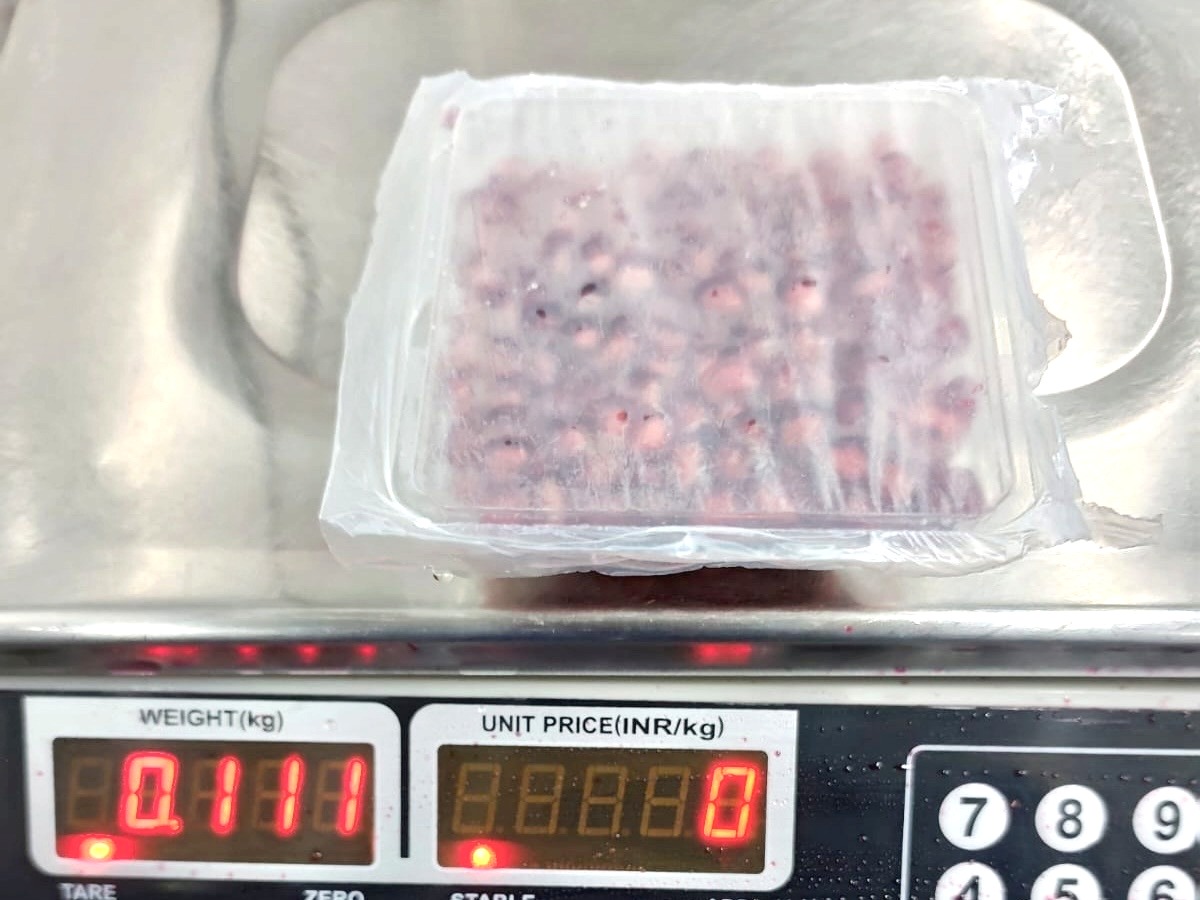
India’s New Cube Based Pack Eliminates Empty Air Dampening Fresh Produce Logistics.

Palghar, Maharashtra; May 2026: India’s fresh produce exporters are under intensifying pressure to move more product at lower cost, through crowded cold chains, using less plastic without risking shelf-life or presentation.
“Conventional produce clamshells and trays often waste space in cartons and pallets, so exporters end up paying to ship ’empty air’ along with the fruit” says Mitanshu Choudhary, Founder and Managing Partner of Ecopak, Q-Bic’s first licensee partner in the country. “That is the backdrop against which Ecopak and Norwegian-developed Q-Bic are piloting the cube-based pack in India. Trials show double the product per box with nearly half the packaging material weight”. Mitanshu added.
Ecopak’s link to Q-Bic was made through Innovation Norway, which Mitanshu credits with ‘building the trust bridge’ between the companies. “We realised very quickly that the problem is not only plastic use; it is structural inefficiency. Today, packs are rarely optimised for carton fill, pallet utilisation or reefer loading”.
For India, which is a major producer and exporter but also a highly cost-sensitive, innovation-ready market, local manufacturing of cube-based packs offers shorter lead times, more flexible customisation, and more reliable supply. It also opens the door for India to supply nearby export regions in West Asia, Southeast Asia, and parts of Africa and Latin America that are looking for more efficient, sustainable food packaging.
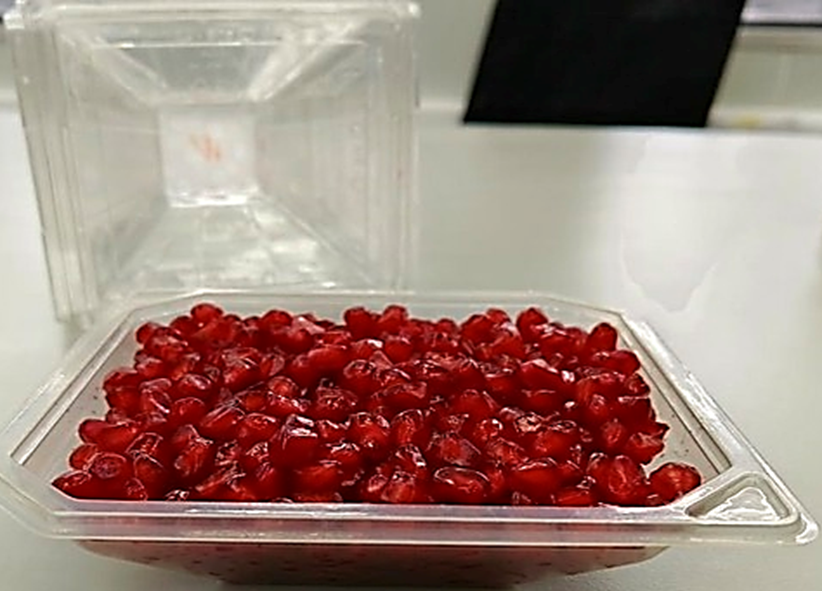
[[125g pomegranate arils packed in 6g Q-Bic trays versus conventional 11g trays]]
Through pomegranate aril trials, Mitanshu highlights the current stakes. “In the current practice, a polystyrene box carries around 90 trays of 125 g arils, equal to 11.25 kg net product. With the Q-Bic cube-based arrangement, using a 114 mm cube size, each cube can hold 06 trays. The box layout allows 3 × 5 cubes per layer with two layers, which means 3 × 5 × 2 × 6 trays, or 180 trays per box. At 125 g per tray, this gives 180 trays × 125 g, or 22.5 kg net arils per box. So, compared to the current format, the Q-Bic arrangement can potentially carry 180 trays instead of 90 trays, effectively doubling the product load from 11.25 kg to 22.5 kg per polystyrene box. On current lane assumptions, that density also translates into an estimated 25% reduction in air-freight costs when weight and volume are combined”.
Another important outcome is the reduction in tray packaging weight. “The current tray weighs around 11 grams, while the Q-Bic tray is designed at approximately 06 grams, reducing packaging weight per tray by about 45%. On a product-weight basis, packaging consumption reduces from around 88 grams per kg of arils in the current format to about 48 grams per kg in the Q-Bic format.”
Cooling is a critical test for such high-density packing. Mitanshu has emphasised that to avoid trading volume for temperature control, Ecopak has devised a configuration where gel-ice packs sit at the core of the cube arrangement rather than on top or in loose voids. The idea is to maintain temperature where it matters, at the centre of the box, without sacrificing density or adding extra space.
For export programmes where reefer space, freight cost, and temperature control are all under scrutiny, he believes these gains in density and targeted cooling can support stronger economics and lower environmental impact. Ongoing shelf-life work is focused on how the new format supports product stability, tray strength, and presentation at semi-commercial and commercial scales with Indian packers and retailers.
Beyond arils, Ecopak is evaluating cube-based formats across a range of high-value, logistics-intensive categories like blueberries, cherries, grapes, fresh-cut fruits, coconut chunks, snack packs, dry fruits and nuts, and selected ready-to-eat and food-service products. Many of these categories, Mitanshu notes, struggle with the same issues of protecting delicate or temperature-sensitive products while making better use of carton space and cold-chain capacity.
Depending on the application, early modelling suggests that cube-based formats could reduce primary packaging material by around 20–25% and secondary packaging by up to 50–60%, while raising pallet density and, in many cases, reducing pallet counts for the same shipped volume. On trials so far, we see an average 40–50% reduction in pallets needed to move the same number of consumer packs. For retailers, he points out, that also translates into more stable stacking and clearer product visibility on the shelf.
Commercial rollout in India is set to be phased, starting with specific customer-led applications where the value has already been demonstrated in trials. The Q-Bic production model uses local manufacturing, including Ecopak’s own facilities and partner sites, to support both bespoke projects and scalable supply. Material choices will be application-led, ranging from recyclable polymers to compostable or bio-based options where suitable, with food-contact safety and export-market compliance built into the specification.
For the first time in India, Ecopak, in partnership with Q-Bic, is launching a PLA-based compostable packaging solution for fresh pomegranate arils. The pack combines a PLA Q-Bic tray with a PLA compostable sealing film, creating a fully bio-based alternative to conventional plastic formats. Designed for fresh-cut fruit, it offers product visibility, hygiene, strong sealing, improved stacking, and better cold-chain logistics, marking an important step toward scalable compostable packaging for India’s fresh produce, retail, and export markets.
As Mitanshu sums it up, “If we can move significantly more product per pallet, even up to 2.5 times in the best cases, cut the amount of packaging around each kilogram of fruit, and still protect quality, then packaging innovation is clearly improving the economics of moving fresh produce through the chain”.
Team Maverick.



India Post Invites Citizens to Design Official Mascot, Announces Rs 2 Lakh Prize Pool
New Delhi, July 2026 : The Department of Posts has launched the ‘India Post Mascot D…

India Post Invites Citizens to Design Official Mascot, Announces Rs 2 Lakh Prize Pool
New Delhi, July 2026 : The Department of Posts has launched the ‘India Post …