Russia’s Nuclear Battlecruiser Admiral Nakhimov; 2X Of China’s Most Capable Destroyer, 3X The Principal Surface Combatant Of The US Navy.

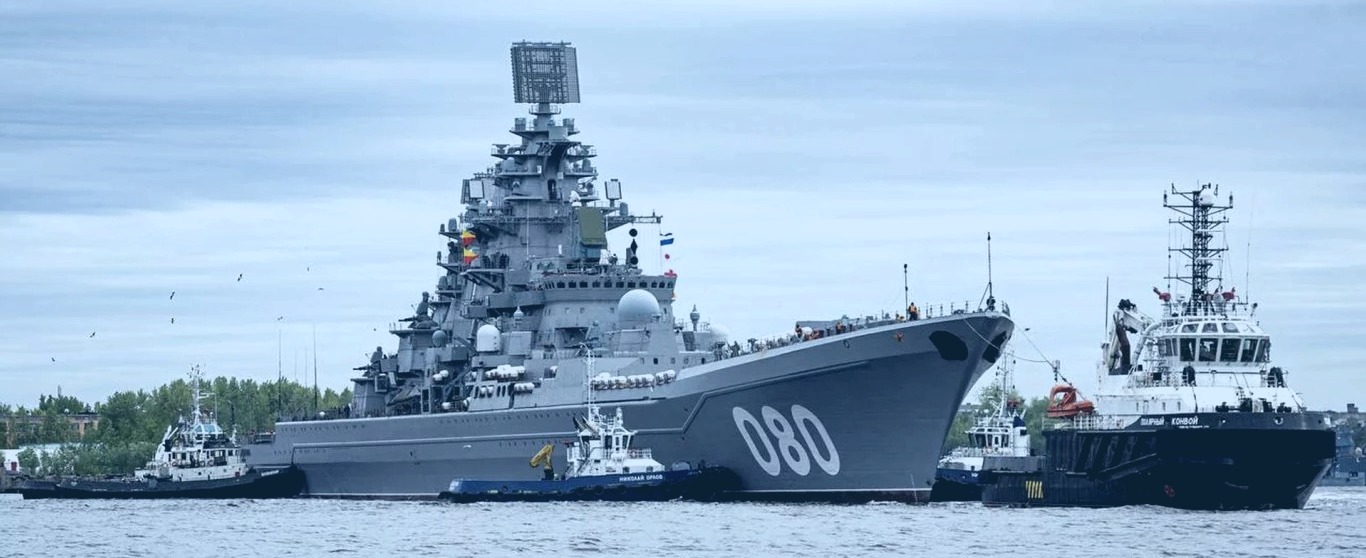
Moscow; June 2026: Russia’s nuclear-powered battlecruiser Admiral Nakhimov has entered its final sea trials after leaving Sevmash on May 31st, marking the return of one of the most heavily armed surface warships in the world after nearly three decades in overhaul, according to a June 1, 2026 announcement by the Russian Ministry of Transport.
Its reactivation strengthens Russia’s ability to defend strategic Arctic waters and protect the Northern Fleet’s ballistic missile submarine bastions, a mission central to Moscow’s nuclear deterrent posture.
The rebuilt cruiser replaces its Cold War-era weapons suite with 80 universal vertical launch cells capable of firing Kalibr, Oniks, and Zircon missiles, supported by a heavily upgraded air defence network and modern combat systems. While the ship delivers exceptional missile capacity and endurance for Arctic operations, its military value depends on effective targeting networks and it concentrates a significant share of Russian naval firepower on a single, high-value platform.
On June 1, 2026, the Russian Ministry of Transport announced that the nuclear-powered battlecruiser Admiral Nakhimov had entered the final phase of sea trials after departing Sevmash on May 31st, moving a modernisation effort that began before many of the sailors who will eventually serve aboard the ship were born. The Kirov-class vessel, commissioned as Kalinin on December 30, 1988, effectively disappeared from operational service after entering refit preparations in 1997 and arriving at Sevmash in 1999. By the time the ship completes trials and formally returns to service, nearly 27 years will have elapsed between its arrival at the shipyard and operational reactivation, which exceeds the period during which the cruiser operated in frontline service as a Soviet Navy ship.
The return of Admiral Nakhimov also highlights the extent to which Russia’s large surface combatant force has contracted since the Soviet period. Of the 04 Project 1144 Orlan-class nuclear cruisers originally built, 02 have been scrapped, 01 may be retired without modernisation, and only the Admiral Nakhimov is completing a full reconstruction. The result is that one of the largest naval modernisation programs undertaken by post-Soviet Russia has produced a single operational cruiser rather than a class of ships, raising questions regarding opportunity costs, fleet priorities, and whether the modernisation program justifies the resources consumed over nearly three decades.
What emerged from Sevmash is fundamentally different from the nuclear cruiser that entered the yard at the end of the 1990s. The original Soviet combat system was largely removed: the 20 P-700 Granit anti-ship missiles that defined the ship’s Cold War strike role disappeared entirely, replaced by 10 UKSK launch modules containing 80 universal vertical launch cells, which can employ Kalibr land-attack missiles, P-800 Oniks anti-ship missiles, 3M22 Zircon hypersonic missiles, and Otvet anti-submarine weapons. The air defence architecture was rebuilt around the Fort-M system, supplemented by 06 Pantsir-M close-range defence systems, new fire control systems, and new radar equipment.
The Admiral Nakhimov has also received new communications infrastructure, digital battle management architecture, power distribution networks, electronic warfare equipment, and internal control systems. The propulsion plant underwent a similarly extensive reconstruction, as 01 KN-3 nuclear reactor was restarted in December 2024 and the second in February 2025, restoring the ship’s nuclear propulsion for the first time in decades. In practical terms, the modernisation preserved the hull, propulsion arrangement, and general dimensions of a late-Soviet cruiser while modernising much of the equipment that determines combat effectiveness, to adapt to threat perceptions of the 2020s rather than those of the late 1980s.
The military value of Admiral Nakhimov is concentrated overwhelmingly in missile capacity. Current estimates indicate a total of 176 major launch cells, including 80 strike missile cells and 96 long-range air-defence cells. Few surface combatants currently in service approach those numbers, as it represents 57% more cells than China’s Type 055, 83% more than a US Navy Arleigh Burke Flight III, and 120% more than a Zumwalt-class destroyer. In short, the Admiral Nakhimov brings the equivalent firepower of several smaller combatants together on a single 28,000-ton hull. However, the United States fields 77 Arleigh Burke destroyers, while China continues serial production of the Type 055 alongside other destroyer classes.
Russia’s Kalibr, Oniks, and Zircon already exist aboard frigates, submarines, and coastal formations. Like the future Trump-class battleship, the significance of the Admiral Nakhimov primarily lies in carrying the largest quantity of weapons possible on a single vessel. Still, the strategic rationale for the ship may become clearer when examined through Russia’s Northern Fleet requirements rather than through comparisons with U.S. carrier strike groups. Russia’s most important naval mission remains the protection of its sea-based nuclear deterrent, as Borei and Delta IV ballistic missile submarines operating from the Kola Peninsula are expected to move into protected operating areas in the Barents Sea and Kara Sea during periods of tension or conflict.
Those waters form the core of Russia’s bastion-defence concept, and the Admiral Nakhimov’s characteristics align closely with that specific mission. Nuclear propulsion provides effectively unlimited range and permits extended operations in Arctic waters without dependence on fuel logistics. The vessel can sustain long deployments in regions where support infrastructure is sparse and weather conditions are demanding. Its 96 long-range air-defence cells provide substantial engagement capacity against aircraft, cruise missiles, and other threats approaching fleet operating areas, such as Ukrainian drones. Its strike battery provides options against surface ships, coastal targets, and supporting infrastructure.
The ship, therefore, contributes directly to the protection of submarine operating zones. Evaluated from that perspective, Admiral Nakhimov is less relevant as an instrument of global naval presence than as a fleet-defence asset designed to strengthen the Northern Fleet’s ability to secure strategically important waters near Russia’s ballistic missile submarine force. However, Admiral Gorshkov-class frigates already deploy Kalibr, Oniks, and Zircon missiles, while Yasen-M nuclear submarines can carry many of the same weapons while benefiting from dramatically lower detectability. 176 cells aboard one nuclear battlecruiser generate impressive missile figures, but they do not create a capability unavailable elsewhere.
The principal change lies in magazine depth. A Project 22350 frigate typically carries 16 UKSK cells, while the Admiral Nakhimov carries 80. Consequently, 01 cruiser possesses the strike-cell equivalent of 05 Project 22350 frigates. The same principle applies to air defence. The ship’s 96 long-range air defence cells represent one of the largest missile inventories available to any Russian surface combatant. Yet missile inventories alone do not determine combat effectiveness, as long-range weapons require target acquisition. A Zircon missile capable of engaging a target hundreds of kilometres away remains dependent on a sensor and command network capable of locating that target, tracking it, identifying it, and transmitting accurate coordinates.
The ship’s effectiveness, therefore, depends heavily on external reconnaissance assets, including satellites, maritime patrol aircraft, submarines, and other fleet sensors. The larger the missile inventory becomes, the more important the supporting targeting network becomes. Survivability remains one of the most significant questions surrounding the vessel. The sinking of Moskva in April 2022 demonstrated that Russia’s large missile cruisers remain vulnerable despite carrying substantial air defence systems. On paper, the Admiral Nakhimov possesses far stronger defensive capabilities than the Moskva.
The installation of six Pantsir-M systems significantly expands close-range defensive capacity, while the 96-cell Fort-M battery provides a larger engagement inventory than that available aboard the sunken Black Sea Fleet flagship. Modern radar systems, digital fire control architecture, and updated combat management systems improve coordination between sensors and weapons. Nevertheless, the Nakhimov modernisation could not alter the ship’s fundamental physical characteristics. Admiral Nakhimov remains a 251- metre nuclear battlecruiser displacing approximately 28,000 tons, meaning its radar and infrared signatures remain substantial. Unlike many contemporary warship designs, it was not constructed around low-observable principles.
The concentration of capability aboard a single hull also creates a strategic vulnerability. Losing one Project 22350 frigate removes sixteen strike cells. Losing Admiral Nakhimov removes 80 strike cells and 96 long-range air defence cells simultaneously. The ship, therefore, represents both a major concentration of naval power and a major concentration of risk. Any assessment of its military value must consider both factors simultaneously. Comparisons with contemporary US and Chinese warships reveal competing approaches to naval force development. Admiral Nakhimov displaces approximately 28,000 tons. A Type 055 destroyer displaces roughly 13,000 tons. An Arleigh Burke Flight III displaces approximately 9,700 tons.
In displacement terms, Admiral Nakhimov is more than twice the size of China’s most capable destroyer, and nearly three times larger than the principal surface combatant of the US Navy. Yet a larger size does not automatically generate greater military effectiveness. American and Chinese naval development increasingly emphasizes sensor integration, fleet networking, distributed firepower, and large numbers of interoperable combatants, except for the $700 billion Trump-class project. The USSR/Russia’s approach to the Kirov-class concentrated capability into a limited number of capital ships. The cruiser prioritises magazine depth. Western and Chinese fleets increasingly prioritise force distribution.
The distinction matters because distributed fleets absorb losses differently. Losing one destroyer from a fleet of dozens affects overall capability far less than losing a unique cruiser carrying a disproportionately large share of available missile inventory. The Admiral Nakhimov and the Trump-class battleship, therefore, illustrate a force-structure philosophy that differs substantially from the direction actually pursued by naval powers. The economics of the Nakhimov’s modernisation are difficult to separate from any discussion of its military effectiveness. The modernisation contract signed in 2013 reportedly carried a value of approximately 50 billion rubles (roughly $667 million) and anticipated a return to service in 2018.
The ship instead entered final sea trials in 2026, while cost estimates eventually approached 200 billion rubles ($2.67 billion). The program, therefore, experienced both major cost growth and significant schedule delays. Those figures acquire greater significance when measured against alternative procurement possibilities. A Project 22350 frigate carries 16 UKSK strike cells. 05 such frigates collectively carry 80 strike cells, equivalent to Admiral Nakhimov’s strike battery, while simultaneously providing 05 separate hulls, 05 separate radar systems, 05 separate operating areas, and greater geographic flexibility. The modernisation, therefore, reflects a deliberate choice to preserve a large Soviet-era cruiser rather than expand the number of modern surface combatants.
Supporters of that approach can point to the ship’s large missile inventory, endurance, and command capabilities. Critics can point to fleet shortages, prolonged delays, and the opportunity cost of concentrating resources on one vessel. The project also provides a revealing indicator of Russia’s shipbuilding capacity. No cruiser-sized surface combatant has been laid down in post-Soviet Russia. No direct successor to Project 1144 exists. No replacement for the Kirov-class has entered construction. The aircraft carrier Admiral Kuznetsov remains trapped in a prolonged and uncertain refit cycle.
Meanwhile, increasing attention has focused on the future of the other nuclear battlecruiser, the Pyotr Velikiy. Rather than receiving a modernisation equivalent to Admiral Nakhimov’s, the ship may ultimately be retired. These developments suggest a broader pattern. Russia retains the ability to preserve and reconstruct selected Soviet-era capital ships, maybe for prestige, but it has not demonstrated an ability to replace them with new vessels of comparable size and capability. Admiral Nakhimov itself illustrates this reality. Almost three decades were required to rebuild one cruiser, which helps explain why Russia’s future fleet increasingly centres on submarines, frigates, corvettes, and missile systems rather than on new cruisers.
As Admiral Nakhimov approaches operational service, it is likely to become the most heavily armed surface combatant in the Russian Navy and one of the largest operational warships in the world outside aircraft carriers. Its return strengthens Northern Fleet air defence capacity, expands long-range strike inventory, and provides a nuclear-powered vessel optimized for extended Arctic operations. At the same time, the ship does not change the broader balance between NATO and Russian naval forces. It remains a single unit. It cannot be reproduced quickly. It does not solve shortages in surface combatant numbers.
It cannot compensate for the absence of new cruiser construction. Instead, Admiral Nakhimov should be viewed as a specialized asset that may enhance specific missions associated with Arctic operations, bastion defence, and fleet protection, if Ukrainian drones or missiles do not pay a visit. The modernisation certainly demonstrates that Russia can restore selected Soviet-era capital ships to a high level of combat capability. But it simultaneously demonstrates the financial burden, industrial effort, schedule risk, and force structure limitations associated with relying on those ships as major elements of future naval power.
Team Maverick.








Vice-President releases book “RSS @100: A Century of Service, Unity & Sacrifice”
RSS has strengthened the ideals of service, unity and national consciousness over the past…

Vice-President releases book “RSS @100: A Century of Service, Unity & Sacrifice”
RSS has strengthened the ideals of service, unity and national consciousness over the past …