Iran-US Peace Negotiations; The Sea Mines Are The Fulcrum Balancing Principle.

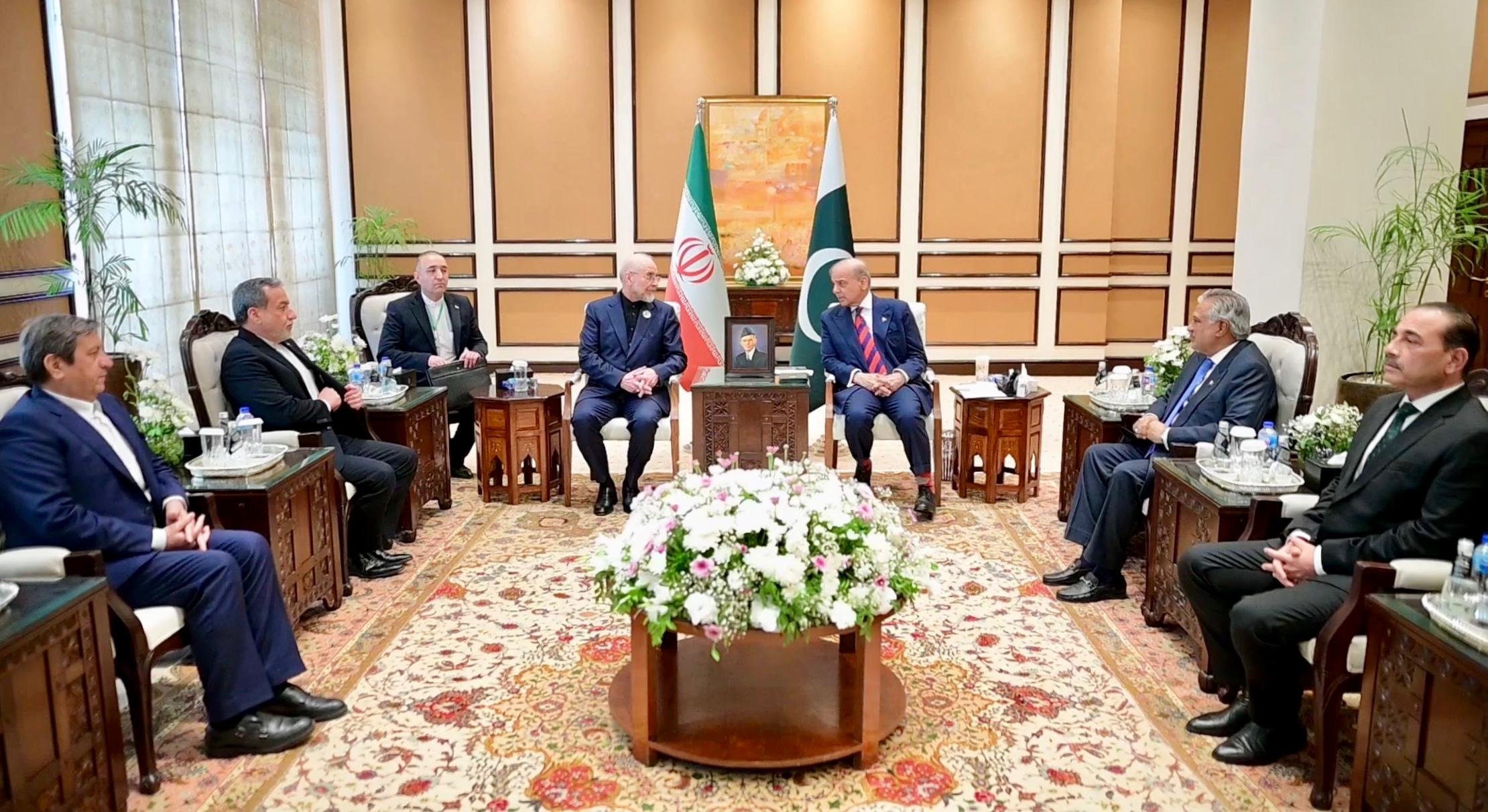
Islamabad; April 2026: The 71 member Iranian negotiating team headed by Iranian Parliament Speaker Mohammad Bagher Ghalibaf and Foreign Affairs Minister Abbas Araghchi, underscores Iran’s wide-ranging negotiating intentions at Islamabad since yesterday (11th April 2026 – the first day of negotiations). The fusion of diplomats, parliamentarians, Islamic Revolutionary Guards Corps (IRGC) -adjacent figures, and high-level economic technocrats, has exhibited Iran is pressing a long list of demands across a range of issue areas. The inclusion of the Central Bank Governor Abdolnaser Hemmati and economic specialists points to a focus on sanctions architecture, frozen assets, and alternative financial mechanisms, suggesting preparation for prolonged economic and strategic bargaining rather than confidence-building compromise.
Although considered by many anti-Iranian’s to be an internal divisions and deep mutual distrust among regime power centers, rather than a unified negotiating strategy, looking into the size of the team, particularly reported infighting between the regime factions before the negotiations, when Ghalibaf and Araghchi reportedly clashed with IRGC Commander Major General Ahmad Vahidi over Vahidi’s effort to insert longtime IRGC affiliate and Supreme National Security Council Secretary Mohammad Bagher Zolghadr into the talks, despite Zolghadr’s lack of experience with diplomatic negotiations. But if looked upon from the present geopolitical perspective, it is highly commendable such an act of the Iranian Team which didn’t want to let loose the negotiation opportunity to clinch a win-win deal for Iran. The presence of overlapping political, security, and economic representatives suggests that there is a need for constant internal monitoring, while facing the robust US negotiators of recent times.
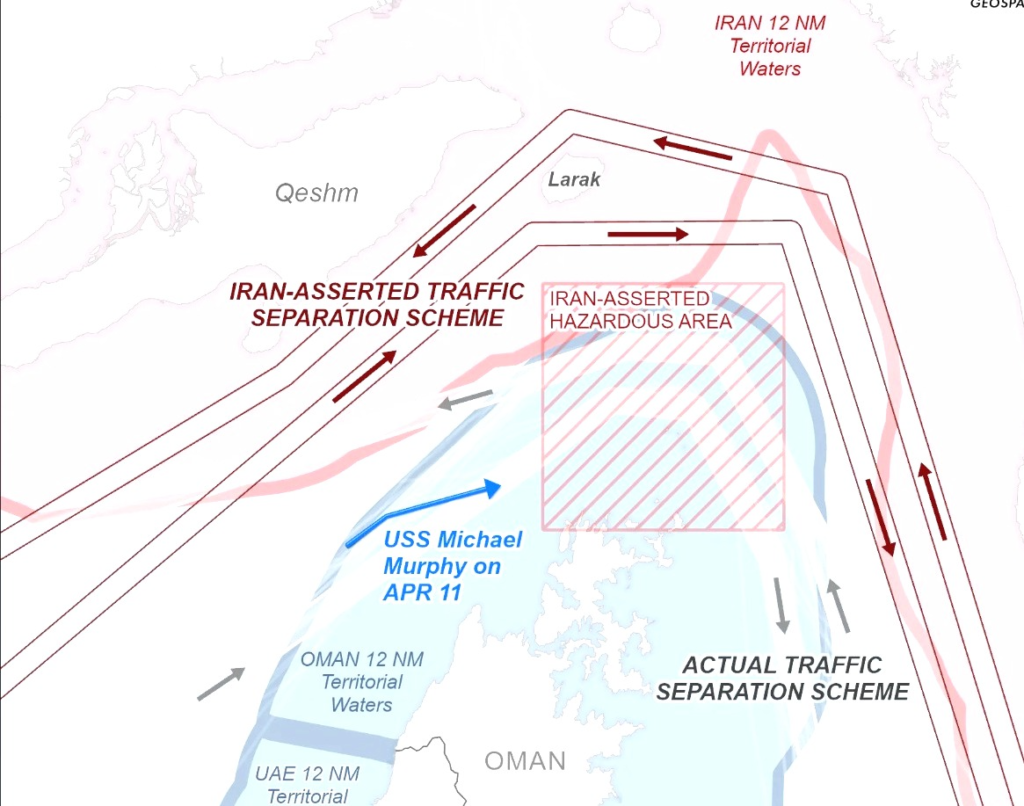
Iran is using the existence of an unknown number of naval mines it laid in the Strait of Hormuz to force ships to use Iranian territorial waters to traverse the Strait, which enables Iran to shakedown these ships for fees while the ships are in Iranian territorial waters. Iran likely designed its threatening behavior and its shakedowns to disrupt the global economy, which Iran calculates will enable it to extract concessions from the United States. Iran warned merchant ships that mines could exist in a “hazardous area” that covers 1,394 sq km of the Strait, including the normal traffic separation scheme (shipping lanes) that ships use to transit the Strait. Ships seeking to avoid the Iranian-declared hazardous area must transit Iranian territorial waters. Iran then shakes down these merchant ships by extracting “protection fees”. These “protection” fees protect ships from Iranian attacks. This protection racket is illegal under maritime law. No state bordering a strait is permitted to restrict traffic or extract fees under the United Nations Convention on the Law of the Sea. US officials has briefed media reporters on 11th April that Iran laid its mines, of which there are reportedly fewer than a dozen, according to a previous March 23 report, stating “haphazardly”, which has prevented Iran from locating or removing them. These mines may or may not be in the 1,394 sq km “hazardous area”.
The threat of mines also enables Iran to keep the price of oil and shipping insurance as high as possible for as long as possible without conducting attacks that would cause the ceasefire to collapse. Iran may calculate that the high price of oil and shipping insurance would cause the United States to cave on some of Iran’s demands.
The United States is attempting to undermine Iran’s ability to use the threat of mines in the “hazardous area” by using US Navy destroyers to prove that the normal traffic separation scheme is safe and viable for traffic. Iran can only use the threat of mines to keep these costs high if the fear of mines persists. US President Donald Trump said on April 11 that the United States is “starting the process of clearing out” the strait. Arleigh Burke-Class destroyers USS Frank E. Peterson and USS Michael Murphy transited the Strait to clear the Strait of naval mines. US CENTCOM commander Admiral Brad Cooper said that the US Navy will share the route of safe passage with civilian shipping as soon as possible. Such a move would undermine Iran’s threats and badly damage its leverage in negotiations. The Qatari Transport Ministry announced later on April 11 that it will resume operations “for all types of maritime vessels and ships” between 06:00 Hours and 18:00 Hours local time on April 12th.
In the meantime, the current ceasefire will provide Iran an opportunity to reorganise its missile force and recover from the temporary disruption wrought to the missile force during constant US and Israeli operations. Consistent US and Israeli operations over Iran had suppressed Iran’s missile force by preventing Iran from digging out launchers, disrupting command-and-control, and creating pervasive fear in military units that made them unwilling or unable to conduct attacks. Such effects are temporary, however, and the ceasefire provides Iran with an opportunity to reorganise itself for more coordinated missile attacks. This is especially notable because Iran still retains roughly 1,000 of the 2,500 medium-range ballistic missiles it had before the war and well under 50% of its one-way attack drones.
The US-Israeli air campaign has nonetheless severely degraded elements of Iran’s ballistic missile program, which is a system of systems that relies on many complicated and bespoke components to function. These components cannot be easily replaced. The air campaign targeted the critical capabilities of Iran’s ballistic missile program to prevent the missile forces from executing their campaign design. The US-Israeli campaign, for example, targeted Iranian missile fuel production, missile guidance systems, steel production that could be used for ballistic missiles, ball bearing factories (which are key for inertial guidance systems on Iranian missiles), and other key components. Such assets are not easily replaced, and when and if Iran expends its remaining missiles, it will struggle to replace them rapidly. This will play into Iranian strike package decisions if the war resumes.
Suvro Sanyal – Team Maverick.







Shivakumar Says Congress United, Assures Women Will Get Cabinet Berth
Bengaluru, Aug 2026 : Karnataka Chief Minister D.K. Shivakumar on Monday sought to dismiss…

Shivakumar Says Congress United, Assures Women Will Get Cabinet Berth
Bengaluru, Aug 2026 : Karnataka Chief Minister D.K. Shivakumar on Monday sought to dismiss …