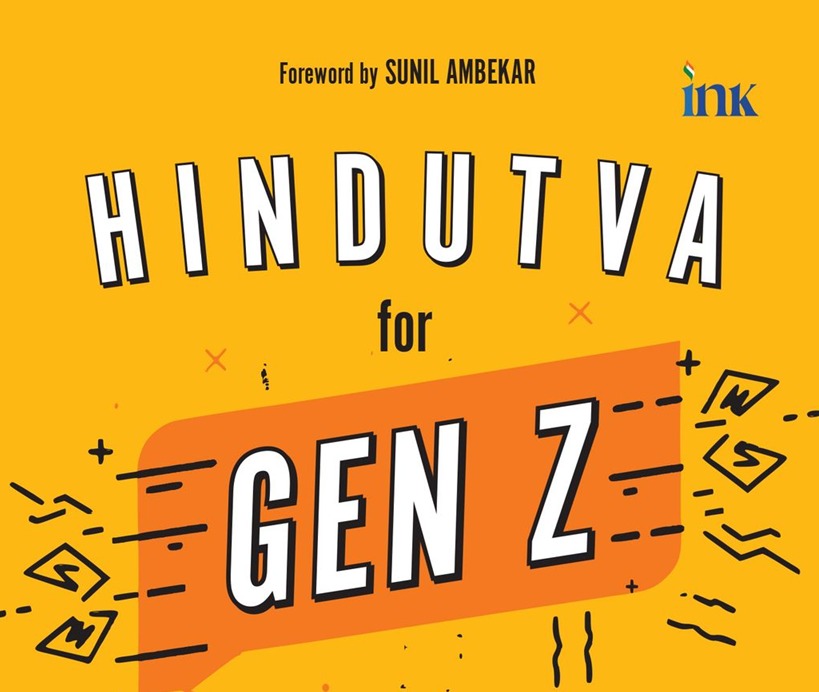
Hindutva for Gen Z: The Book That Does What Classrooms and Newsrooms Refused To

May 2026 : There is a generation of young Indians that has grown up with Hindutva as a dinner-table slur. A generation that was handed Wikipedia summaries, WhatsApp forwards, and primetime panel wars as substitutes for genuine civilisational education. A generation that knows everything about what Hindutva is alleged to be, and next to nothing about what it actually is. Yuvraj Pokharna’s Hindutva for Gen Z, published by BluOne Ink with a foreword by RSS National Spokesperson Sunil Ambekar, arrives as perhaps the most necessary corrective of the decade.
The book’s central wager is an audacious one: that the most contested idea in contemporary Indian politics can be explained without polemic, without jargon, and without condescension to the very generation it is addressed to. Pokharna makes good on that wager. What he has written is not a manifesto, not a hagiography of any political formation, and certainly not the kind of theological tract that its critics, who have not read it, will inevitably accuse it of being. It is, at its core, an act of honest intellectual restitution.
Pokharna draws an early and important distinction that the book builds upon with patience: the difference between ‘tatva’, the essence of a principle, and ‘ism’, the closed architecture of a rigid belief system. Hindutva, he argues, is not an ism, not a doctrine sealed in amber and handed down as dogma. It is a living, breathing cultural identity, the civilisational DNA of Bharat that predates any political party and will outlast every electoral cycle. This is not a novel argument in scholarly circles, but Pokharna’s achievement is in making it accessible, immediate, and urgent for a reader scrolling Instagram between lectures.
The author himself is no armchair theorist descending into Hinduism from a position of inherited certainty. His intellectual journey, from avowed atheist to agnostic to what he calls an ardent bhakt, gives the book a quality that purely academic treatments almost never possess: honesty about the process. He does not write as a preacher. He writes as someone who had questions, went looking for answers, and decided to document what he found before the next generation is left as adrift as he once was.
The timing of the book could not be more deliberate. Gen Z in India inhabits a peculiar paradox. It is the most connected generation in the country’s history, yet it remains deeply disconnected from the civilisational moorings that gave this land its distinctive genius. Its understanding of Hindutva has been outsourced almost entirely to foreign academic frameworks that measure Indic thought against Abrahamic templates, finding it wanting because it refuses to fit. Pokharna names this distortion and dismantles it chapter by chapter, weaving in historical context, modern debates, and civilisational philosophy with the kind of fluency that a columnist sharpened across years of deadline-driven writing naturally develops.
The foreword by Sunil Ambekar is not ornamental. It signals that this book sits at the precise intersection where grassroots civilisational work and intellectual articulation must meet if Hindutva is to be understood on its own terms by those who will inherit the idea.
What separates Hindutva for Gen Z from the pile of similar-sounding titles is its audience fidelity. Pokharna never talks down to his reader, never assumes prior reverence, and never asks the Gen Z reader to take anything on faith alone. He asks only that they read before they conclude, that they understand before they judge. In a media environment where the loudest voice usually wins, that is an almost quixotic demand. But Pokharna makes it with conviction, and more importantly, with evidence.

This is a book that deserves not just to be read, but to be discussed in college common rooms, debated in youth forums, and kept on the desk of every young Indian trying to understand who they are and where they came from. At a moment when the civilisational conversation in India is louder and more consequential than at any point since independence, Hindutva for Gen Z is the primer that should have existed ten years ago. Yuvraj Pokharna has written it now. That is better than never.
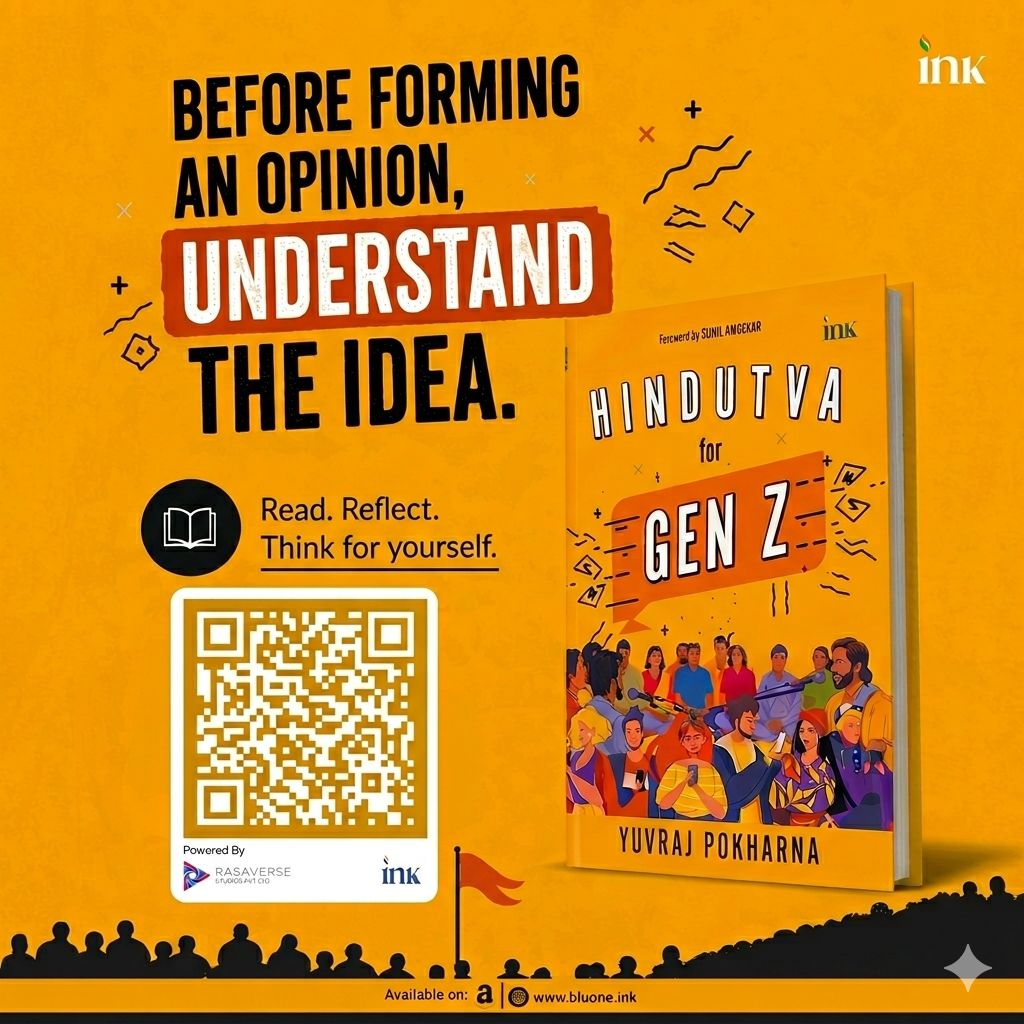
Hindutva for Gen Z by Yuvraj Pokharna is published by BluOne Ink and available on Amazon.
“Hindutva for Gen Z” has been written with the objective of helping the Gen Z better understand the terminology, narratives, and cultural conversations that are increasingly shaping public discourse across digital and mainstream media. The book aims to encourage informed thinking and independent decision-making among young readers by providing context around topics that are actively discussed in contemporary society. Written from a vantage point of an activist cum columnist, the primary target audience is the uninitiated Gen Z.
Team Maverick





Adani One Rewards Crosses 5 Million Members in Under a Year, Plans Premium Tier Benefits
Mumbai, July 2026 : Adani Airport Holdings Limited (AAHL) has announced that its digital c…

Adani One Rewards Crosses 5 Million Members in Under a Year, Plans Premium Tier Benefits
Mumbai, July 2026 : Adani Airport Holdings Limited (AAHL) has announced that its digital …