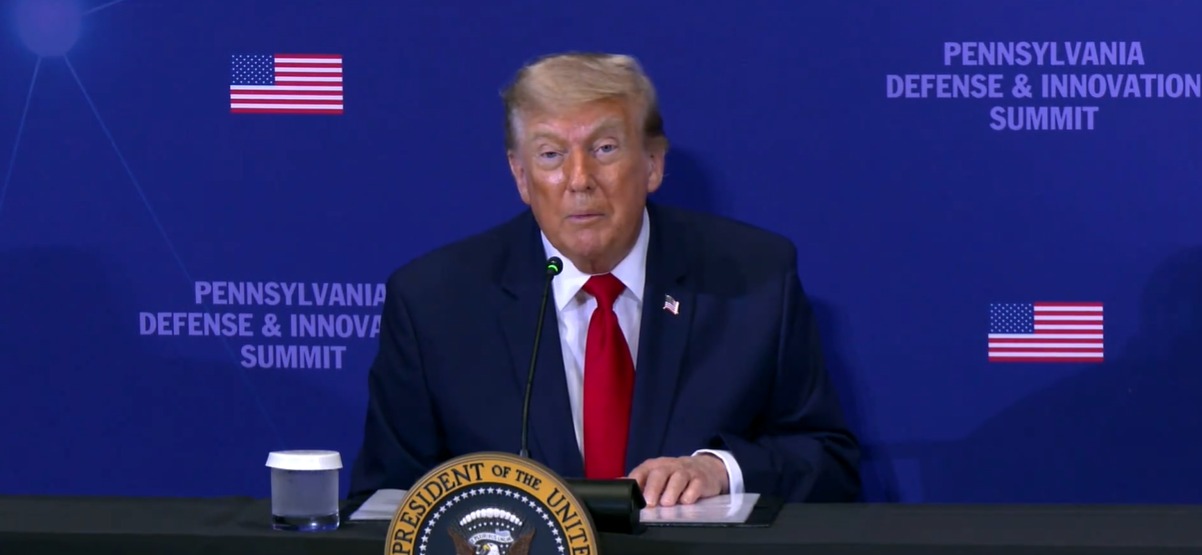
Trump Unveils AI-Driven Vision for Future US Military

Washington, July 2026 : US President Donald Trump has outlined an ambitious vision to transform the American military by placing artificial intelligence (AI), robotics, autonomous systems and other cutting-edge technologies at the heart of the country’s defence strategy. The move, he said, is aimed at ensuring the United States retains its military superiority in an era of rapidly evolving global security threats.
Speaking at the Pennsylvania Defense and Innovation Summit on Wednesday (local time), Trump stressed that the future of warfare would be shaped not only by conventional military strength but also by technological innovation. He said the administration is working closely with technology companies, investors and defence manufacturers to speed up the development and deployment of next-generation military capabilities.
“The talent and innovation in this room will keep America safe for many years to come,” Trump said while addressing senior executives from the defence and technology sectors. “They are very advanced, the most advanced equipment anywhere in the world.”
The summit brought together leading defence contractors, artificial intelligence firms, robotics companies, venture capitalists and private equity investors, highlighting the administration’s strategy of fostering closer collaboration between the Pentagon and the private sector.
US Defence Secretary Pete Hegseth said the Pentagon was undertaking sweeping reforms to replace its traditional procurement system, which has often been criticised for lengthy bureaucratic delays, with a faster and more competitive model focused on innovation.
“Our bureaucracy was built to keep most of you out, and we’ve been waging a war of attrition against the Pentagon bureaucracy to open up the aperture and make sure competition and speed and innovation and commercial options have a seat at the table,” Hegseth said.
He argued that the United States had reached a decisive moment in military technology, where staying ahead in emerging fields would determine future strategic dominance.
“AI and frontier models, autonomy, quantum space, hypersonics—you name it. If you’re ahead now and you get ahead of the game, you’re going to be way ahead. If you fall behind now, you fall even further behind,” he added.
Several companies attending the summit announced major investments designed to strengthen America’s defence manufacturing and technology ecosystem.
Voyager Technologies revealed plans to invest hundreds of millions of dollars to establish Pittsburgh as a global hub for robotics and space technologies. The company said the initiative would support research, advanced manufacturing and workforce development in emerging defence sectors.
Artificial intelligence software firm AIR announced a $450 million expansion of its operations in Pittsburgh, further boosting the city’s growing reputation as a centre for AI innovation.
Meanwhile, Carnegie Robotics said it expects to manufacture hundreds of millions of dollars’ worth of autonomous military technologies for the US Army, including advanced robotic systems and autonomous vehicles designed for future battlefield operations.
Private investors also expressed confidence in the administration’s defence innovation agenda.
Investor Antonio Gracias said reforms within the Department of Defense had fundamentally altered the environment for emerging defence technology companies, allowing them to innovate more rapidly.
“We are literally seeing an environment in change at the DOD that is allowing these companies to accelerate and unleash American entrepreneurship in the defence area,” Gracias said.
Thomas Tull, Co-Chairman of TWG Global, said his company had already invested billions of dollars in defence technology and expected that momentum to continue under the administration’s policy framework.
“We’ve invested billions of dollars in defence tech because we know that we need it,” Tull said. “Without the change that you’re causing, these things aren’t possible.”
Hegseth emphasised that the administration wants innovative startups and technology firms to compete on equal footing with traditional defence contractors instead of navigating years of complex procurement procedures.
“You shouldn’t have to sue your way into the Department of War, which is what companies in the past have had to do in order to compete,” he remarked.
The Trump administration has argued that artificial intelligence, autonomous systems, advanced robotics, quantum computing and hypersonic technologies will define the next generation of military capabilities. Pentagon officials are increasingly expanding partnerships with commercial technology firms to accelerate the adoption of these innovations across the US armed forces, with the goal of maintaining America’s technological and strategic edge in an increasingly competitive global security landscape.





Govt. to formulate policy to provide relief in encroachment cases involving poor and landless families: CM
Chief Minister Thakur Sukhvinder Singh Sukhu today laid the foundation stone of the new Mu…

Govt. to formulate policy to provide relief in encroachment cases involving poor and landless families: CM
Chief Minister Thakur Sukhvinder Singh Sukhu today laid the foundation stone of the new …