India Exports Akash Missile Systems to Tajikistan and Turkmenistan, Strengthening Defence Footprint in Central Asia

New Delhi, July 2026 : India has reportedly exported its indigenous Akash surface-to-air missile (SAM) systems to Tajikistan and Turkmenistan, marking another significant milestone in the country’s expanding defence export programme. The development underscores New Delhi’s growing stature as a global supplier of advanced military technology while deepening its strategic engagement with the Central Asian region.
The exports were confirmed by former Defence Research and Development Organisation (DRDO) Chairman Dr Samir V. Kamat, who described the move as a major achievement for India’s defence manufacturing sector and a reflection of the country’s increasing role in strengthening regional security architecture.
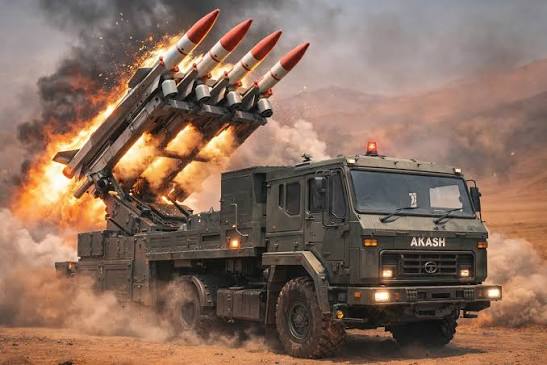
Developed by the DRDO and manufactured by Bharat Dynamics Limited (BDL), the Akash missile system is one of India’s flagship indigenous air defence platforms. Designed as a medium-range surface-to-air missile system, Akash is capable of intercepting a wide range of aerial threats, including fighter aircraft, helicopters, drones and cruise missiles.
The system has an operational range of approximately 25 kilometres and can engage multiple targets simultaneously through an integrated network of advanced radar, command and control systems. Its combination of indigenous technology, operational effectiveness and relatively lower cost has made it an attractive option for countries seeking reliable air defence capabilities without relying exclusively on Western or Russian military equipment.
The reported exports to Tajikistan and Turkmenistan carry considerable geopolitical significance. Both nations are located in Central Asia, a region where Russian defence equipment has traditionally dominated military inventories. Their decision to procure Indian missile systems reflects a gradual diversification of defence procurement and growing confidence in India’s indigenous military technology.
For Tajikistan, which shares a long border with Afghanistan and hosts a Russian military base, strengthening air defence has become increasingly important amid evolving regional security challenges. Turkmenistan, strategically located along the Caspian Sea, has also been modernising its armed forces to address emerging aerial threats and safeguard critical infrastructure.
The latest exports further reinforce India’s growing presence in Central Asia, complementing its broader diplomatic, economic and energy partnerships in the region.
India’s defence exports have witnessed remarkable growth in recent years, reflecting the government’s focus on transforming the country into a major global defence manufacturing hub. During the 2025-26 financial year, India’s defence exports crossed ₹38,000 crore, setting a new record and moving closer to the government’s long-term export targets.
The Akash missile system has emerged as one of the country’s most successful export products alongside other indigenous platforms such as the BrahMos supersonic cruise missile, Pinaka multi-barrel rocket launcher, and Astra beyond-visual-range air-to-air missile.
Armenia has already inducted the Akash-1S air defence system into its armed forces, while several countries in Africa and South America are reportedly in discussions with India regarding the acquisition of the next-generation Akash-NG variant. The reported exports to Tajikistan and Turkmenistan further expand India’s defence footprint into a strategically important region where it previously had relatively limited military engagement.
Dr Kamat said India’s defence export programme remains on course to achieve the government’s ambitious target of ₹50,000 crore in annual exports by 2028-29. He noted that the Akash system’s operational performance, including its reported effectiveness during Operation Sindoor, has significantly enhanced international confidence in the platform.
According to defence experts, the missile system’s ability to counter modern aerial threats, particularly swarming drones, low-flying aircraft and cruise missiles, makes it highly relevant in today’s evolving battlefield environment, where unmanned systems are increasingly playing a decisive role.
The growing international demand for Akash also reflects the success of the Atmanirbhar Bharat initiative in the defence sector. The programme aims to reduce India’s dependence on imported military equipment while simultaneously building a globally competitive defence manufacturing ecosystem capable of serving international markets.
As more countries show interest in indigenous Indian weapon systems, the Akash missile is increasingly being viewed as a flagship export product that showcases India’s technological capabilities. Alongside platforms such as BrahMos, Pinaka and Astra, it is helping reshape India’s global image from one of the world’s largest arms importers to an emerging exporter of advanced defence systems and a trusted security partner for nations across multiple regions.
(The content of this article is sourced from a news agency and has not been edited by the Mavericknews30 team.)






Archer, Atkinson Trigger India’s Stunning Collapse After Kohli, Iyer Fifties; England Set 234 to Win Second ODI
Archer, Atkinson Trigger India’s Stunning Collapse After Kohli, Iyer Fifties; England Set …

Archer, Atkinson Trigger India’s Stunning Collapse After Kohli, Iyer Fifties; England Set 234 to Win Second ODI
Archer, Atkinson Trigger India’s Stunning Collapse After Kohli, Iyer Fifties; England Set 234 to …