India, Japan Review Expanding Defence Partnership as Mogami Frigate Deal Gains Momentum

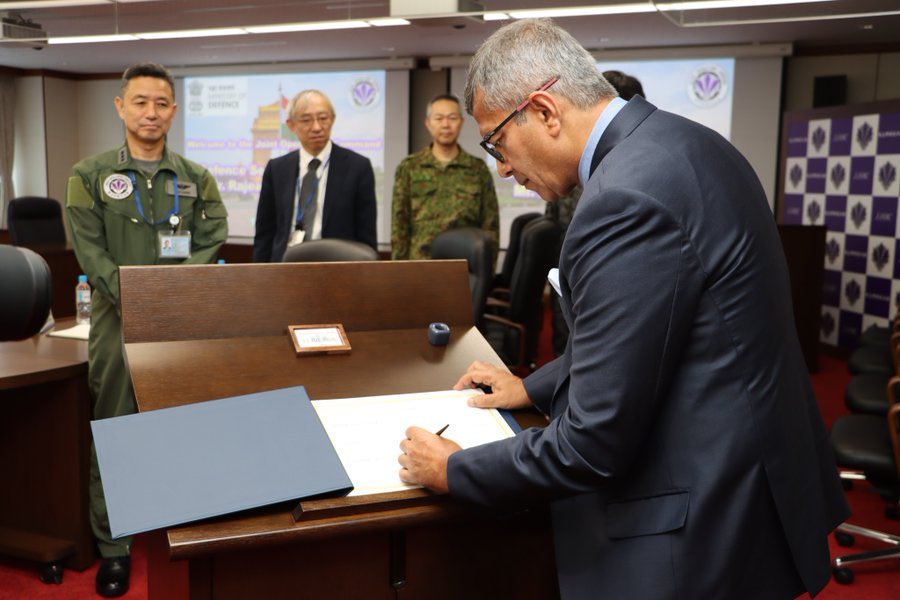
New Delhi, July 2026 : Defence Secretary Rajesh Kumar Singh held extensive discussions with senior Japanese officials in Tokyo to further strengthen the rapidly expanding India-Japan defence partnership, with both sides focusing on defence manufacturing, maritime security, cybersecurity, space cooperation and emerging technologies. The high-level visit also coincided with Japan’s renewed effort to secure an Indian order for its advanced Mogami-class stealth frigates through a technology-transfer and local production arrangement under India’s ‘Make in India’ initiative.
The eighth India-Japan Defence Policy Dialogue, held on Monday, was co-chaired by Rajesh Kumar Singh and Japan’s Vice Minister of Defence for International Affairs, Kano Koji. The two leaders reviewed the entire spectrum of bilateral defence cooperation, assessing progress made since the previous dialogue while reaffirming their commitment to deepening the India-Japan Special Strategic and Global Partnership.
The discussions reflected the growing strategic convergence between New Delhi and Tokyo amid evolving geopolitical developments in the Indo-Pacific region. Both countries emphasized the importance of strengthening cooperation to ensure regional peace, stability and a rules-based international order.
The dialogue covered a broad range of defence-related issues, including the changing regional and global security environment, military-to-military cooperation, operational coordination between the armed forces, and expanding engagements between the two countries’ joint headquarters. Maritime security remained one of the central themes of the discussions, given the increasing strategic importance of the Indo-Pacific and the shared interest of both nations in safeguarding freedom of navigation and secure sea lanes.
The two sides also reviewed the progress of bilateral and multilateral military exercises, defence exchanges, and capacity-building initiatives. They agreed to significantly enhance cooperation in emerging sectors such as defence manufacturing, advanced military technologies, cybersecurity, artificial intelligence, space-based defence capabilities and innovation-driven security solutions.
Officials stressed the need for maintaining regular high-level interactions and institutional dialogue to sustain the growing momentum in bilateral defence ties. Preparations for the next India-Japan 2+2 Foreign and Defence Ministers’ Dialogue, scheduled later this year, also featured prominently during the discussions.
As part of his visit, Singh toured Japan’s Joint Operations Command on July 13, highlighting the increasing operational cooperation between the two countries. The visit underscored India’s and Japan’s shared commitment to strengthening strategic coordination and promoting a Free and Open Indo-Pacific through closer defence collaboration.
One of the major highlights of the visit was Singh’s inspection of the Japan Maritime Self-Defence Force’s JS Niyodo, the seventh vessel of the state-of-the-art Mogami-class stealth frigates, at the Kure naval base in Hiroshima. During the visit, he also met Vice Admiral Matsumoto Tamotsu, Commandant of the Kure District, where both sides discussed avenues to deepen maritime cooperation and strengthen naval interoperability.
The visit assumes added significance as India evaluates Japan’s proposal to manufacture the next generation Mogami-class frigates domestically. According to Defence Ministry sources, Tokyo has offered one of its most comprehensive defence technology transfer packages, including the transfer of ship designs, production rights and several critical technologies required for indigenous construction.
If approved, the project would represent Japan’s first major defence platform export to India and one of the most significant departures from Tokyo’s traditionally restrictive defence export policy.
Under the proposal, the stealth warships would likely be built in India by either Mazagon Dock Shipbuilders Limited (MDL) or Garden Reach Shipbuilders & Engineers (GRSE). Japan has also expressed its willingness to integrate Indian-developed systems, including the BrahMos supersonic cruise missile, into the vessels, significantly enhancing their operational capability while supporting India’s indigenous defence manufacturing objectives.
Japan’s proposal follows its recent relaxation of defence export regulations, allowing greater participation in international defence partnerships. The confidence in the Mogami-class design has also been strengthened after Australia selected an upgraded version of the warship under its SEA 3000 General Purpose Frigate programme, marking Japan’s biggest overseas naval export opportunity to date.
The 3,900-tonne Mogami-class frigates are among the world’s most advanced multi-role warships in their category. Designed with stealth characteristics and a high level of automation, the ships require a crew of only about 90 personnel, substantially lower than conventional frigates of similar size. They are equipped with a powerful weapons suite that includes a 127-mm Mk 45 naval gun, Type-17 anti-ship missiles, the SeaRAM close-in weapon system and a 16-cell Mk 41 Vertical Launching System capable of deploying multiple missile types.
Despite the attractiveness of Japan’s proposal, the Indian Navy is expected to carefully evaluate it alongside its long-term indigenous shipbuilding plans. With the Project 17A frigate programme nearing completion and the follow-on Project 17B programme under consideration, any decision to induct a new foreign-designed platform would require establishing an entirely new logistics, maintenance and training ecosystem, although Japan’s offer of extensive technology transfer could substantially ease that transition.
The growing defence partnership between India and Japan also received a major boost earlier this month when Japanese Prime Minister Sanae Takaichi visited New Delhi for the 16th Annual India-Japan Summit. During the visit, Prime Minister Narendra Modi and Takaichi signed the first-ever bilateral defence co-development agreement, paving the way for joint development of the Unified Complex Radio Antenna (UNICORN) system for Indian naval warships, expanded maritime exercises and broader cooperation in defence technology and economic security.
With defence cooperation steadily expanding across multiple domains, both countries are positioning themselves as key strategic partners in ensuring stability, security and technological advancement across the Indo-Pacific region while creating new opportunities for defence industrial collaboration.



US Mint to Issue New $1 Coin Featuring Donald Trump for America’s 250th Independence Anniversary
Washington, July 2026 : The United States Mint will introduce a new $1 commemorative coin …
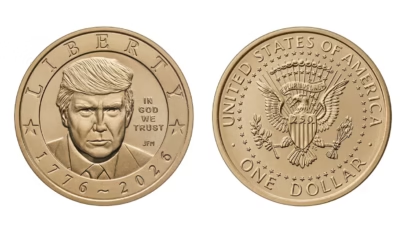
US Mint to Issue New $1 Coin Featuring Donald Trump for America’s 250th Independence Anniversary
Washington, July 2026 : The United States Mint will introduce a new $1 commemorative …