US farmers are renting out sheep as lawn mowers for solar sites

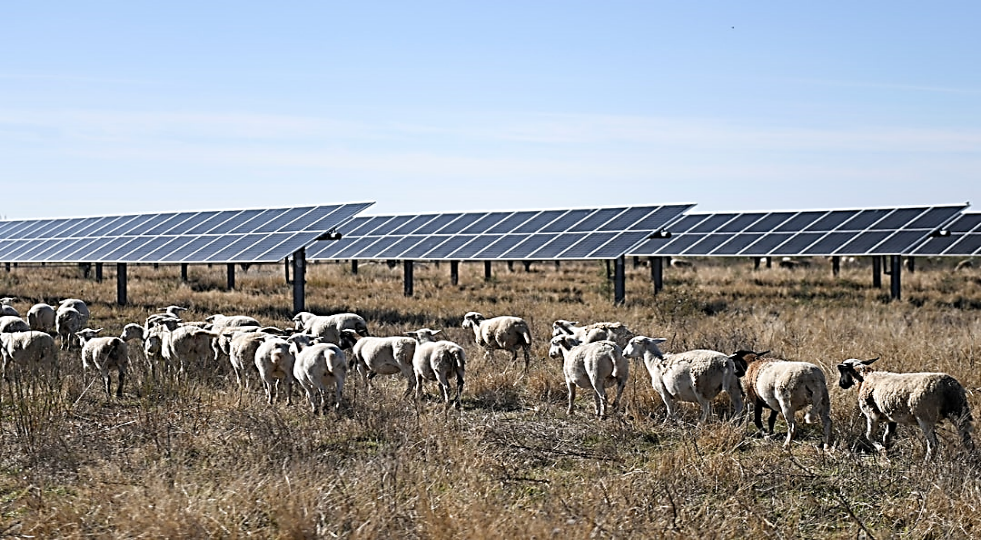
As the Farm Economy in the United States remains sluggish, crop farmers are persistently finding it difficult to sustain, and hence is resorting to diversification. It is Chad Raine and his family dwelling in Texas, United States deserves been mention worthy, as he and his family had not planted a single cotton seed last year – which the Raines were engaged into for the last four generations. On the contrary he had rented out most of his Texas farmland to a neighbour, as he has reiterated that “Cotton prices have been terrible for so long, I had to do something different”. Instead of plowing fields, Raines spent the year ferrying his flock of sheep to solar farms, to munch on the grass that grows around the gleaming panels. The deals he struck for this natural lawn-mowing service with five solar companies were more lucrative than growing cotton.

The striking phenomena by Chad Raine have led to the catapulting of sheep herd in the United States since 2016. As the U.S. farmers are fragmented with soaring debt and slumping incomes, some crop producers have resorted to compromise with their tractors for flocks of sheep, and starting up solar grazing businesses to help make ends meet. Sheep-herding for solar is one of the ways farmers are deploring to diversify their income, as a multi-year slump in the U.S. agricultural economy has hit crop producers particularly hard, economists said.
If Raines had raised cotton last year, his farm would have seen a $200,000 loss, he said. Making money farming sheep only for meat would be tough too. Instead, Raines cleared a profit of about $300,000, thanks to the solar sheep grazing payments and starting to sell lamb meat to a restaurant supplier, he said. “Every expense I have, from the labour to the $2,000-a-month I spend a month on dog food for the guard dogs, is covered by solar,” said Raines, whose son joins him at his farm to help.
But such opportunities are appearing to be disoriented, as the newly elected United States President Mr. Donald Trump has issued an executive order that, among other things, ends clean energy-related appropriated funds, which could impact a swath of clean energy, opens new tax incentives through the Inflation Reduction Act (IRA) in the future. IRA funding has been frozen, as part of the Trump administration’s sweeping push to review all government grants and loans. A recent court order led to some IRA funds being unfrozen, but many groups have reported still being unable to access them.
“Farmers and ranchers should not have to rely on far-left climate programs for grazing land or ‘economic lifelines’,” a USDA spokesperson said in an email statement to Reuters, adding the agency is focused on rural prosperity and is “putting a stop to spending that has nothing to do with agriculture.”
CROP FARM BLUES –
U.S. cotton future prices have slumped nearly 40% over the past two years, as hefty global stocks have overwhelmed global demand. U.S. exports have dropped sharply, losing out to cheaper Brazilian supplies and falling Chinese demand, U.S. Department of Agriculture data shows. “The last three years have been brutal for Texas cotton growers,” said Louis Barbera, a managing partner at cotton broker VLM Commodities.
While U.S. farm income overall is expected to improve this year, the upturn is being driven by high livestock prices and a massive boom in anticipated government aid from the American Relief Act of 2025, a USDA forecast in early February showed. But when adjusted for inflation, corn and soybean farm businesses will see incomes at the lowest levels since 2010 – even if producers receive that aid, said Jennifer Ifft, an agricultural economist at Kansas State University.
Farmers who rely heavily on debt to operate were slower to pay back their loans in 2024, and a growing number are selling assets to stay afloat, according to data from Federal Reserve Banks of Kansas City and Minneapolis. “Income diversification in ag downturns can mean saving the farm”, said Tait Berg, senior examiner and agricultural risk specialist at the Minneapolis Fed.
For those farmers faced with pricey seed bills and expensive equipment parts for repairing their machinery, these solar land-management contracts can be an economic lifeline.
Sheep grazed on more than 129,000 acres of U.S. solar panel sites last October, compared to 15,000 acres in 2021, according to the non-profit American Solar Grazing Association. The number of solar-site sheep jumped from 80,000 to more than 113,000 between January and October last year, the group said. While that represents a tiny fraction of the nation’s total 5.05 million sheep and lamb herd, opens new horizon, the new business opportunity has helped herd numbers tick higher for the first time since 2016, said Peter Orwick, executive director of the trade group American Sheep Industry Association.
NEW OPPORTUNITIES –
The U.S. solar industry grew under President Donald Trump’s first term, and development surged after a 2022 law passed under former President Joe Biden provided subsidies for new clean-energy projects, said Abigail Ross Hopper, president and CEO of the Solar Energy Industries Association.
The sector expects to continue to grow under Trump’s second term, she said.
White House deputy press secretary Anna Kelly in a statement to the Press has demonstrated that “Ultimately, President Trump will cut programs that do not serve the interests of the American people and keep programs that put America First.”
In Indiana and Illinois, the solar boom has attracted twenty- and thirty-somethings eager to jump into farming, without taking on millions of dollars in debt to rent land and machinery, industry analysts said. Whereas, in Virginia, farmers like Marcus and Jess Gray have put their planting dreams on hold after securing lucrative contracts with Dominion Energy and Urban Grid. Now, they graze their 900-head flocks across 4,000 acres where solar is being built. “It’s steady income, where we get to set and negotiate the price, rather than taking our grain from our bin to the local elevator and they tell us what it’s worth,” said Jess Gray who is just 39 years of age.
FLEECE ON THE RISE –
Using sheep for clearing local flora can mean substantial savings once a site is up and running.
The initial capital expenditures can be higher, depending on the project site, said Reagan Farr, chief executive officer of Tennessee-based solar firm Silicon Ranch. Some locations require wells to be drilled for water supplies or more complex gating systems for corrals. Still, the company saves about 20% in operating expenses once a site is running by using managed grazing, Farr said.
“The economics work, when you’re not trucking a flock of sheep across the country or hauling in trucks of water,” Farr said. “It’s much easier and less costly to pay our shepherds a living wage, than it is to hire someone to sit on a lawnmower for 10 hours a day, day in and day out.”
Demand for solar grazing animals prompted Silicon Ranch, in which Shell owns a stake, to launch its own sheep breeding program in Georgia to bolster local farmer supplies.
Team Maverick.







Parliament Paralysed for Second Day as Opposition Protests Over NEET Leak, Student Crackdown
New Delhi, July 2026 : Parliament remained deadlocked for the second consecutive day of th…

Parliament Paralysed for Second Day as Opposition Protests Over NEET Leak, Student Crackdown
New Delhi, July 2026 : Parliament remained deadlocked for the second consecutive day of …