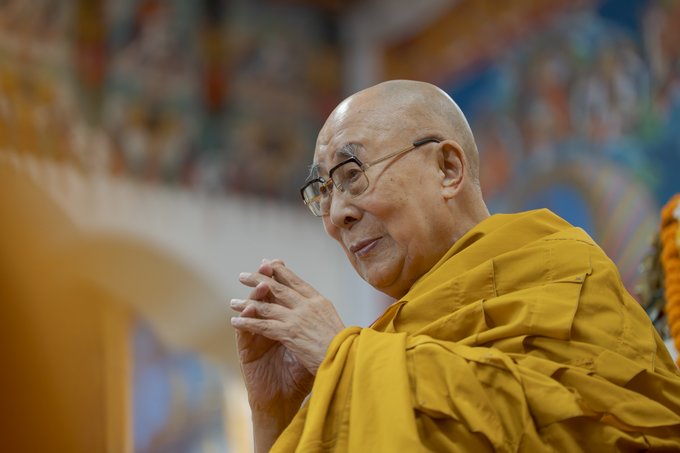
PM Modi Greets Dalai Lama on 90th Birthday Amid China Tensions

As India honours the Tibetan spiritual leader with warm wishes, the Dalai Lama reaffirms his global mission of compassion while Beijing reiterates warnings over Tibet policy.
Prime Minister Narendra Modi led the nation in extending heartfelt birthday wishes to His Holiness the Dalai Lama on his 90th birthday on Sunday, calling him a global symbol of love, compassion, and moral integrity. Modi’s greeting, shared via a post on social media platform X, underscored the deep respect and admiration the Tibetan spiritual leader commands across India and the world.
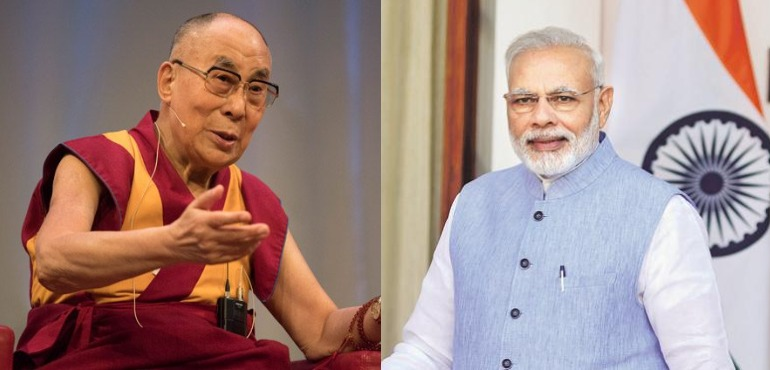
“I join 1.4 billion Indians in extending our warmest wishes to His Holiness the Dalai Lama on his 90th birthday,” Modi posted. “He has been an enduring symbol of love, compassion, patience and moral discipline. His message has inspired respect and admiration across all faiths. We pray for his continued good health and long life.”
The Prime Minister’s message came during his visit to Rio de Janeiro, Brazil, where he is attending the 17th BRICS Summit and conducting a state visit. While the message was celebratory, it also carried geopolitical implications, coming at a time when China has again expressed its displeasure over India’s engagement with the Tibetan leader.
China’s Foreign Ministry spokesperson Mao Ning recently reiterated Beijing’s position, urging India to “act cautiously” on matters related to Tibet (referred to by China as Xizang), warning against interference in China’s internal affairs. The Dalai Lama, who has lived in exile in India since 1959, is considered by China to be a separatist—a label he rejects, maintaining a nonviolent approach advocating for genuine autonomy under Chinese rule.
Modi’s gesture continued a significant shift from previous Indian governments’ tendency to maintain diplomatic distance from the Dalai Lama to avoid antagonizing China. In 2021, Modi publicly greeted the spiritual leader on his 86th birthday, breaking with past precedent and marking a more assertive approach in India’s Tibet policy.
As the Dalai Lama marked his 90th milestone, the Tibetan spiritual and cultural community also had something to celebrate. The Central Tibetan Administration (CTA), the democratically elected government-in-exile representing Tibetans globally, has declared the period from July 2025 to July 2026 as “The Year of Compassion.” This initiative seeks to honour His Holiness not just as a religious figure but as a global advocate of peace, interfaith harmony, and secular ethics.
In a statement released on the eve of his birthday, the Dalai Lama reiterated his lifelong commitments: “I will continue to focus on promoting human values, religious harmony, and highlighting ancient Indian wisdom, particularly about the mind and emotions. Tibetan culture, with its focus on inner peace and compassion, has much to offer the world.”
Revered not only as a religious leader but as a living embodiment of moral clarity, the Dalai Lama remains a powerful voice for nonviolence and dialogue. Despite advancing age, the Nobel Peace Prize laureate continues to be deeply engaged in global humanitarian causes and recently confirmed that the 600-year-old institution of the Dalai Lama would continue with a chosen successor, quelling speculation that the lineage might end with him.
For decades, the Dalai Lama has described himself as a “son of India,” often referencing his intellectual and cultural debt to India’s ancient Buddhist heritage. “All particles in my mind contain thoughts from Nalanda. And it’s Indian ‘dal’ and ‘chapati’ that have built this body. I am mentally and physically a son of India,” he once said in a public address.
He also emphasized the spiritual and cultural bond between India and Tibet, likening it to the sacred teacher-disciple (guru-chela) relationship. “When I see some part of my guru being corrupt, as a chela, I feel ashamed,” he remarked, in a subtle critique of ethical decline in parts of Indian society.
Meanwhile, calls are growing louder from Indian lawmakers, civil society, and his followers to award the Dalai Lama India’s highest civilian honour, the Bharat Ratna, in recognition of his lifelong service to peace, humanity, and global ethics.
Born on July 6, 1935, in the remote Amdo region of Tibet, the 14th Dalai Lama was recognized as the reincarnation of his predecessor at the age of two. Following a failed uprising against Chinese rule in 1959, he fled to India and established his base in McLeodganj near Dharamsala, which remains the heart of the Tibetan exile community.
Now 90, the Dalai Lama continues to serve as a spiritual compass for millions across the globe. His call for compassion, mindfulness, and dialogue resonates more than ever in a world beset by division and conflict. As Tibetans and supporters worldwide celebrate this historic birthday, the question of his successor and India’s evolving Tibet policy will remain under close international watch.



Israel, Lebanon Agree on Ceasefire Framework Amid Continued Cross-Border Hostilities
Washington/Beirut, June 2026 : Israel and Lebanon on Wednesday agreed to move forward with…

Israel, Lebanon Agree on Ceasefire Framework Amid Continued Cross-Border Hostilities
Washington/Beirut, June 2026 : Israel and Lebanon on Wednesday agreed to move forward with …