Judicial Work Must Not Be Confined to Legal Compliance Alone, but Must Also Include Human Sensitivity: Justice Ramesh Sinha

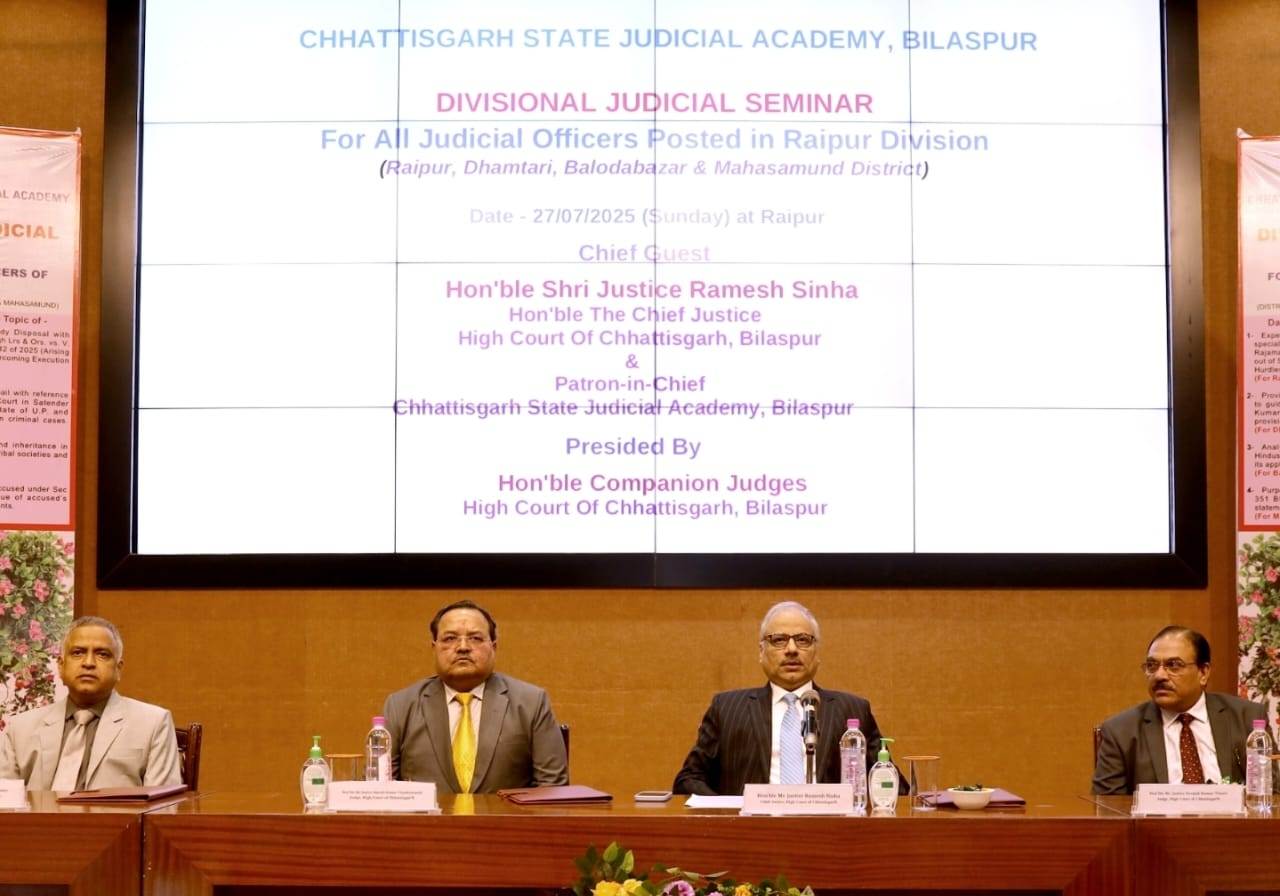
Raipur : A one-day divisional judicial seminar was organized by the Chhattisgarh State Judicial Academy at the New Circuit House, Civil Lines, Raipur, for judicial officers of the Raipur Division. A total of 126 judicial officers from four districts participated in the seminar. The workshop covered key topics including speedy disposal of cases, provisions related to arrest, remand, and bail, the objective and process of examining an accused, and analysis of laws related to Hindu succession and inheritance.
The seminar was inaugurated by Hon’ble Chief Justice of the Chhattisgarh High Court and Patron-in-Chief of the Judicial Academy, Justice Ramesh Sinha, who symbolically lit the lamp representing justice and the dissemination of legal knowledge. Hon’ble Justices Naresh Kumar Chandravanshi, Deepak Kumar Tiwari, and Rakesh Mohan Pandey of the Chhattisgarh High Court, Bilaspur, also graced the occasion.
Justice Ramesh Sinha’s Address
In his address, Chief Justice Ramesh Sinha stated that judicial expectations have significantly increased in the present era. The public expects the judiciary to be impartial, swift, and sensitive. The topics of this seminar are core pillars of criminal and civil jurisprudence. Proficiency in these areas goes beyond procedural adherence—it is central to delivering fair justice, protecting individual liberties, and strengthening public trust in the judicial process.
Justice Sinha emphasized the importance of being well-versed with the recently enacted Bharatiya Nagarik Suraksha Sanhita (BNSS) and related new laws—especially those pertaining to bail. He stressed the need for uniformity and legal precision in judicial decisions. Judges must be cautious in identifying what is presented and what is omitted, particularly if there’s any possibility of infringing on the rights of the accused.
He noted that while a judge may have their own perspective on the facts and circumstances of a case, they remain bound by the limits of law and the precedents set by the Supreme Court and High Courts. When passing bail orders, magistrates must ensure accuracy in recording the crime number, the sections under which the accused is charged, and all relevant details. Any error or omission could delay proceedings at the High Court level, potentially affecting the accused’s personal liberty.
Uplifting Judicial Excellence
The Chief Justice defined the purpose of this divisional workshop as promoting judicial excellence and nurturing a culture of learning, collaboration, and continual improvement in the justice delivery system. He said the judiciary plays a fundamental role in upholding the rule of law and ensuring justice to all sections of society.
As custodians of the Constitution, it is essential for the judiciary to be not only legally sound but also socially aware, accountable, and ethically resolute, he added.
In his impactful keynote, Justice Sinha stated:
“Judicial work is not confined to merely following the law—it must be infused with human empathy. Behind every file lies a human story—of pain, struggle, and hope. Law is our instrument, but justice is our ultimate objective.”
He expressed hope that this seminar would lead to constructive insights, actionable outcomes, and a renewed commitment to serve the people of this nation with fairness, humility, and dedication.
About the Event
The seminar was attended by the Registrar General of the Chhattisgarh High Court, officials of the Chhattisgarh State Judicial Academy, and judicial officers from Raipur, Dhamtari, Balodabazar, and Mahasamund districts.
- The welcome address was delivered by the Principal District and Sessions Judge, Raipur.
- The introductory remarks were given by the Director of the Judicial Academy.
- The vote of thanks was presented by the Chief Judicial Magistrate, Raipur.
All 126 participating officers contributed to thematic sessions covering:
- Accelerating case execution
- Legal provisions around arrest, remand, and bail
- Hindu succession and inheritance laws
- Examination of the accused: purpose and procedure





Microsoft Cuts 4,800 Jobs as AI Investments Reshape Business Strategy
New Delhi, July 2026: Microsoft has announced another major round of layoffs, cutting appr…

Microsoft Cuts 4,800 Jobs as AI Investments Reshape Business Strategy
New Delhi, July 2026: Microsoft has announced another major round of layoffs, cutting approximately …