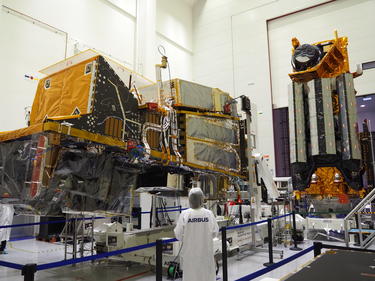
Europe’s new era of weather forecasting begins with successful launch of MetOp-SG A1.

The first of Europe’s next-generation meteorological satellites, MetOp-SG A1, has launched from Europe’s Spaceport in Kourou, French Guiana, on board an Ariane 6 rocket.
The Airbus-built satellite, developed under the lead of the European Space Agency for EUMETSAT, the European Organisation for the Exploitation of Meteorological Satellites, has established communication and is beginning its commissioning phase. This launch marks the start of a new era that will enhance significantly weather forecasting accuracy, providing critical data for years to come.
“The successful launch of MetOp-SG A1 is a landmark moment for Europe and for global weather forecasting”, said Alain Fauré, Head of Space Systems at Airbus. “Having designed and built the first generation of MetOp satellites, we now see the first of this powerful new series in orbit. These satellites will be the sentinels of our planet, helping to deliver more accurate weather predictions that benefit citizens across the globe”.
MetOp-SG A1 is the first in a new series of six satellites that will ensure the continuity and enhancement of meteorological data from space into the mid-2040s. The program consists of two types of satellites with three satellites each, ‘A’ and ‘B’, which carry complementary instrument packages. This first ‘A’ satellite is equipped with sophisticated atmospheric sounding and imaging instruments. The MetOp-SG B satellites carry instruments for microwave imaging and radar observations.
The advanced payload on MetOp-SG A1 includes the Infrared Atmospheric Sounding Interferometer – Next Generation (IASI-NG), which will provide highly detailed data for weather forecasting and climate research. It also carries the METimage visible and infrared imager, a Microwave Sounder, a Radio Occultation Sounder, and the innovative Multi-viewing, Multi-channel, Multi-polarization Imager, designed to improve aerosol and cloud monitoring. Furthermore, the satellite hosts the Copernicus Sentinel-5 instrument, which will measure trace gases and pollutants to monitor atmospheric composition in unprecedented detail.
This mission is a testament to European collaboration, developed through a partnership between EUMETSAT, the European Space Agency (ESA), the European Union’s Copernicus programme, the French Space Agency (CNES), the German Aerospace Center (DLR), the UK Space Agency, and an industrial consortium led by Airbus. While Airbus has confirmed that the A series satellites are being built at Airbus in Toulouse, France, and the B series at Airbus in Friedrichshafen, in southern Germany. The nominal operational lifetime of each MetOp-SG satellite is 7.5 years, ensuring full operational coverage over a 21 years period.
Ariane 6 is a program developed within the framework of the European Space Agency (ESA). As prime contractor and design authority for the launcher, Ariane Group is responsible for development and production alongside its industrial partners. Arianespace, the launch service provider, oversees launch operations from the Guiana Space Centre, including the integration and deployment of the MetOp-SG A1 satellite into orbit.
The accuracy of forecasting weather condition ranging from “12 hours to 10 days in advance” will be greatly improved thanks to the new MetOp-SG spacecraft’ capabilities.
“EUMETSAT operates meteorological satellites and disseminates data to our member states in real time”, explains Rosemary Munro, EUMETSAT Polar System-Second Generation (EPS-SG) Programme Scientist. “The national meteorological services rely on accurate and timely operational data flow of the atmosphere, oceans and land that they inject in their own prediction models to build weather forecasts”.
Weather forecasting indeed requires a lot of data in improving mathematical modelling. The ability to detect extreme weather events such as storms and heatwaves, depends partly on these models. Philippe Chambon, researcher at Météo-France, says: “For our numerical weather prediction models, issuing forecasts up to four days ahead, around 90% of our data comes from Earth observation satellites. The MetOp-SG satellites, with their very high performance instruments, will improve our forecasts both at the global and at the regional levels”.
MetOp-SG’s 10 instruments will help scientists improve their understanding of climate changes and their projections. “One of the big game-changers for climate research will be the Infrared Atmospheric Sounding Interferometer (IASI-NG) which is able to monitor a wide range of chemical compounds of the atmosphere such as methane that is a potent greenhouse gas and ammonia that impacts air quality“, says Munro.
For Chambon, the Ice Cloud Imager (ICI) instrument will bring a completely new perspective to the study of ice clouds. “We will be able to quantify the amount of small ice crystals in the atmosphere. It is really important because these ice clouds have an impact on the Earth’s radiation energy balance. It is one of the sources of uncertainty in climate projections. Thanks to this data, scientists will be able to improve their predictive models and their understanding of global warming”.
The planned MetOp-SG A1 and B1 satellite launches in 2025-2026 will ensure continuity with the current MetOp fleet, without a gap. This long term data continuity is essential for weather forecasting and to detect changes in climate monitoring.
Team Maverick







Amarnath Yatra Resumes After Six-Day Rain Halt, Pilgrims Hail Safety Arrangements and Renew Their Journey of Faith
Jammu, July 2026 : The annual Shri Amarnath Yatra resumed on Saturday after remaining susp…

Amarnath Yatra Resumes After Six-Day Rain Halt, Pilgrims Hail Safety Arrangements and Renew Their Journey of Faith
Jammu, July 2026 : The annual Shri Amarnath Yatra resumed on Saturday after remaining …