European Leaders Praise Trump for Hosting Landmark White House Talks with Zelensky, Push for Path to Peace in Ukraine

Washington, Aug 2025 : European leaders on Monday commended U.S. President Donald Trump for convening a high-level meeting at the White House with Ukrainian President Volodymyr Zelensky, describing it as a critical moment in the search for peace in Ukraine and stability across Europe.
The meeting, which included several key European heads of state and NATO leadership, was hailed as a potential breakthrough in efforts to end Russia’s ongoing war in Ukraine. Trump, speaking alongside Zelensky before the talks began, assured the Ukrainian leader of “very good protection and very good security” — language interpreted by many as the clearest signal yet of his willingness to provide firm security guarantees to Kyiv.
A Gathering of Leaders
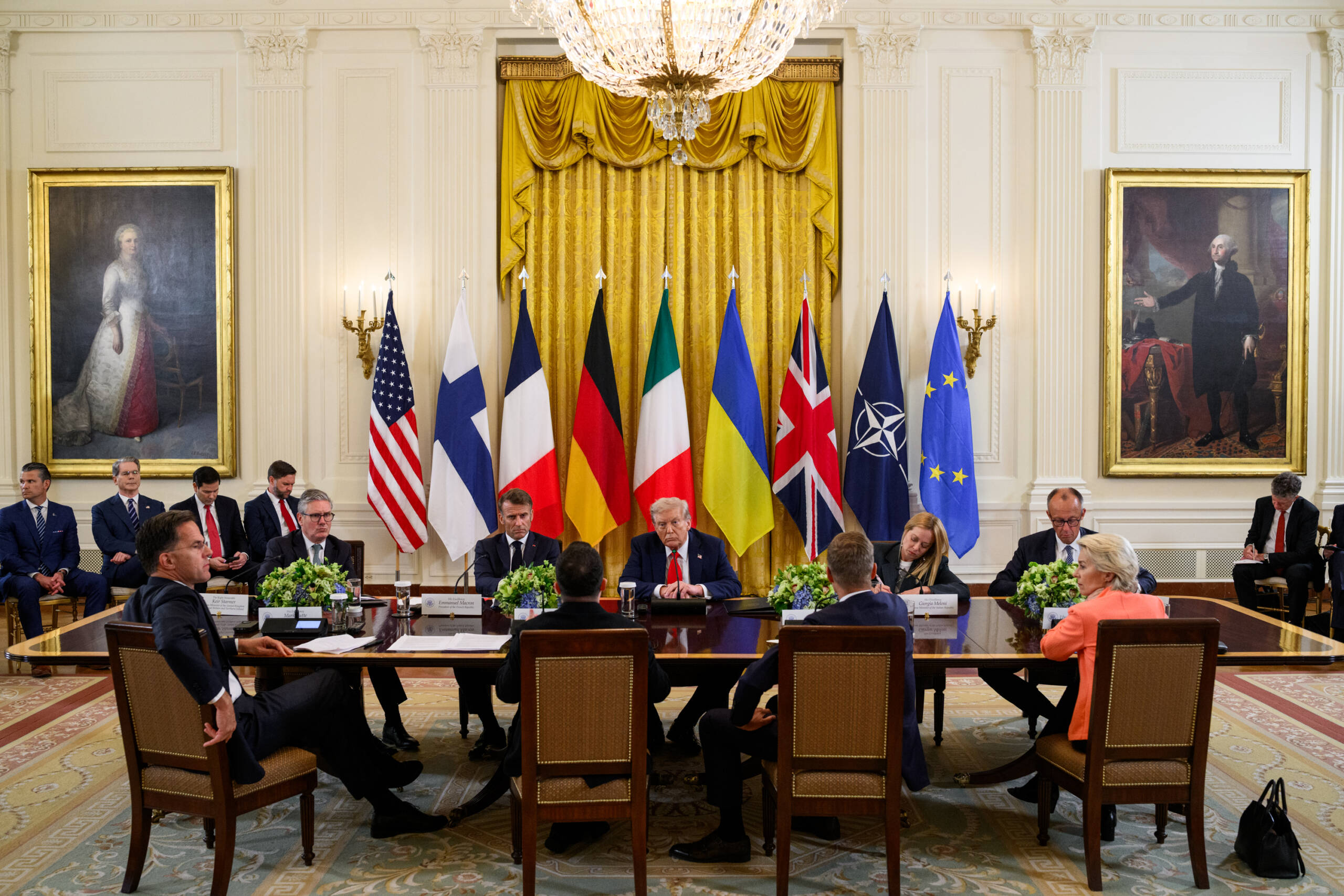
Joining Trump and Zelensky at the White House were British Prime Minister Keir Starmer, French President Emmanuel Macron, Italian Prime Minister Giorgia Meloni, German Chancellor Friedrich Merz, Finnish President Alexander Stubb, European Commission President Ursula von der Leyen, and NATO Secretary-General Mark Rutte.
The closed-door session began shortly before 3:30 p.m. EDT in the East Room, following a brief press availability in which Trump and European leaders presented a united front. Later in the afternoon, the group reconvened for further discussions in the Oval Office, underscoring the gravity and momentum of the day’s talks.
For many of the European leaders present, Trump’s direct engagement with Zelensky and willingness to articulate security commitments marked a dramatic shift in tone compared with his earlier skepticism of Ukraine’s demands.
Starmer: A “Historic Step” for Ukraine and Europe
British Prime Minister Keir Starmer, who has consistently pushed for deeper transatlantic coordination on Ukraine, said the gathering could prove to be a turning point.
“I think we could take a really important step forward today, a historic step actually, in terms of security for Ukraine and security in Europe,” Starmer told reporters at the White House. He highlighted that Trump’s reference to “Article 5-style” commitments mirrored the work of the so-called “Coalition of the Willing” — a group of Ukraine’s closest European allies that have been shaping long-term security assurances for Kyiv.
NATO’s Article 5 principle — which declares an attack on one member as an attack on all — has long been seen by Kyiv as the gold standard of protection. While Ukraine is not a NATO member, Starmer suggested that extending similar guarantees could provide the foundation for a lasting peace deal.
Stubb: “More Progress in Two Weeks than Three Years”
Finnish President Alexander Stubb, whose country joined NATO in April 2023 after centuries of neutrality, praised the meeting’s progress.
“I think in the past two weeks, we’ve probably had more progress in ending this war than we have in the past three and a half years,” Stubb said, calling attention to the symbolic power of the gathering itself.
He reminded fellow leaders of Finland’s deep and complex history with Russia, including an 800-mile shared border and decades of cautious diplomacy. The war in Ukraine, he said, underscored why Finland had abandoned its long-standing non-aligned stance in favor of NATO protection.
Merz: Path Open for Negotiations
German Chancellor Friedrich Merz emphasized that Trump’s direct contact with Russian President Vladimir Putin — whom he met in Alaska just days earlier — had created new momentum.
“The path is open for complicated negotiations,” Merz told the White House press pool. He stressed, however, that a ceasefire must come first. “I can’t imagine that the next meeting will take place without a ceasefire. So let’s work on that.”
Merz’s comments highlighted Europe’s insistence on halting hostilities before attempting a durable political settlement.
Rutte: A “Breakthrough” in Security Guarantees
NATO Secretary-General Mark Rutte was even more explicit in his praise. “The fact that you have said, ‘I am willing to participate in the security guarantees,’ is a big step, it’s really a breakthrough, and it makes all the difference,” he told Trump during the multilateral session.
Rutte also thanked the U.S. President for “breaking the deadlock” and successfully coaxing Putin into preliminary discussions. NATO, he said, stood ready to support any arrangements that provided Ukraine with credible assurances against future aggression.
Macron: Europe Must Have a Seat at the Table
French President Emmanuel Macron urged that Europe’s security concerns be fully represented in any direct negotiations with Russia. While Trump has floated the idea of a trilateral meeting with Putin and Zelensky, Macron argued that a “quadrilateral” format would be more appropriate.
“When we speak about security guarantees, we speak about the whole security of the European continent,” Macron said. His remarks reflected long-standing French concerns that decisions affecting European stability should not be made exclusively by Washington and Moscow.
Although Trump did not commit to Macron’s proposal, analysts suggested that the idea of a European representative at the table could gain traction as talks advance.
Trump’s Direct Role
Trump’s own role in the unfolding diplomatic choreography was on full display. He walked alongside Zelensky, Macron, and other leaders for a photo-op before the meeting, then disclosed that he had personally spoken to Putin earlier in the day to begin “arrangements” for potential talks with Zelensky.
According to reports, Trump briefly paused his meeting with European leaders to hold a call with the Russian president. The Europeans were not present for the exchange, fueling speculation about what exactly was discussed.
On his Truth Social account, Trump later confirmed that he intended to pursue a trilateral meeting between himself, Zelensky, and Putin, with the location yet to be determined. Initially cautious in his wording — saying the meeting “may or may not” happen — Trump later revised his language to declare it was a matter of “when, not if.”
“I think if we have a trilat, there’s a good chance of maybe ending the war,” he said.
Questions on U.S. Troop Role
Pressed on whether the United States would be prepared to send troops to Ukraine as part of a potential peacekeeping arrangement, Trump offered a typically ambiguous response. “We’ll let you know that, maybe later today,” he said in the Oval Office, leaving the door open without making any binding commitment.
Such a move would represent a dramatic escalation of U.S. involvement, and analysts noted that Trump’s phrasing was likely intended to project leverage rather than signal imminent military action.
Toward Ceasefire and Prisoner Releases
Among the potential outcomes discussed during Monday’s talks was the release of more than 1,000 Ukrainian prisoners currently held in Russian custody. Trump indicated he expected Putin to authorize such a release after a trilateral meeting, though Moscow had not confirmed any agreement by Monday evening.
Zelensky, for his part, reiterated his demand for binding guarantees that any ceasefire not become a prelude to renewed Russian aggression. European leaders strongly supported his position, arguing that without enforceable security mechanisms, no peace would hold.
A Tentative Step Toward Peace
For now, the White House meeting represents more of a symbolic alignment than a concrete agreement. But leaders across Europe stressed that symbolism matters in this war, and that the act of Trump, Zelensky, and multiple European heads of state sitting together to discuss security guarantees was itself a powerful signal.
“Now the way is open,” said Merz, summing up the cautious optimism shared by many participants.
Whether that path leads to an enforceable ceasefire, meaningful prisoner exchanges, or ultimately a comprehensive peace deal remains to be seen. But after nearly three years of grinding war, Monday’s meeting was described by several leaders as the most significant step yet toward ending the bloodshed.
Team Maverick.



Sugar Prices Rise Sharply Across India Amid Monsoon Concerns, Strong Demand
New Delhi, July 2026 : Sugar prices have witnessed a sharp increase across India over the …

Sugar Prices Rise Sharply Across India Amid Monsoon Concerns, Strong Demand
New Delhi, July 2026 : Sugar prices have witnessed a sharp increase across India …