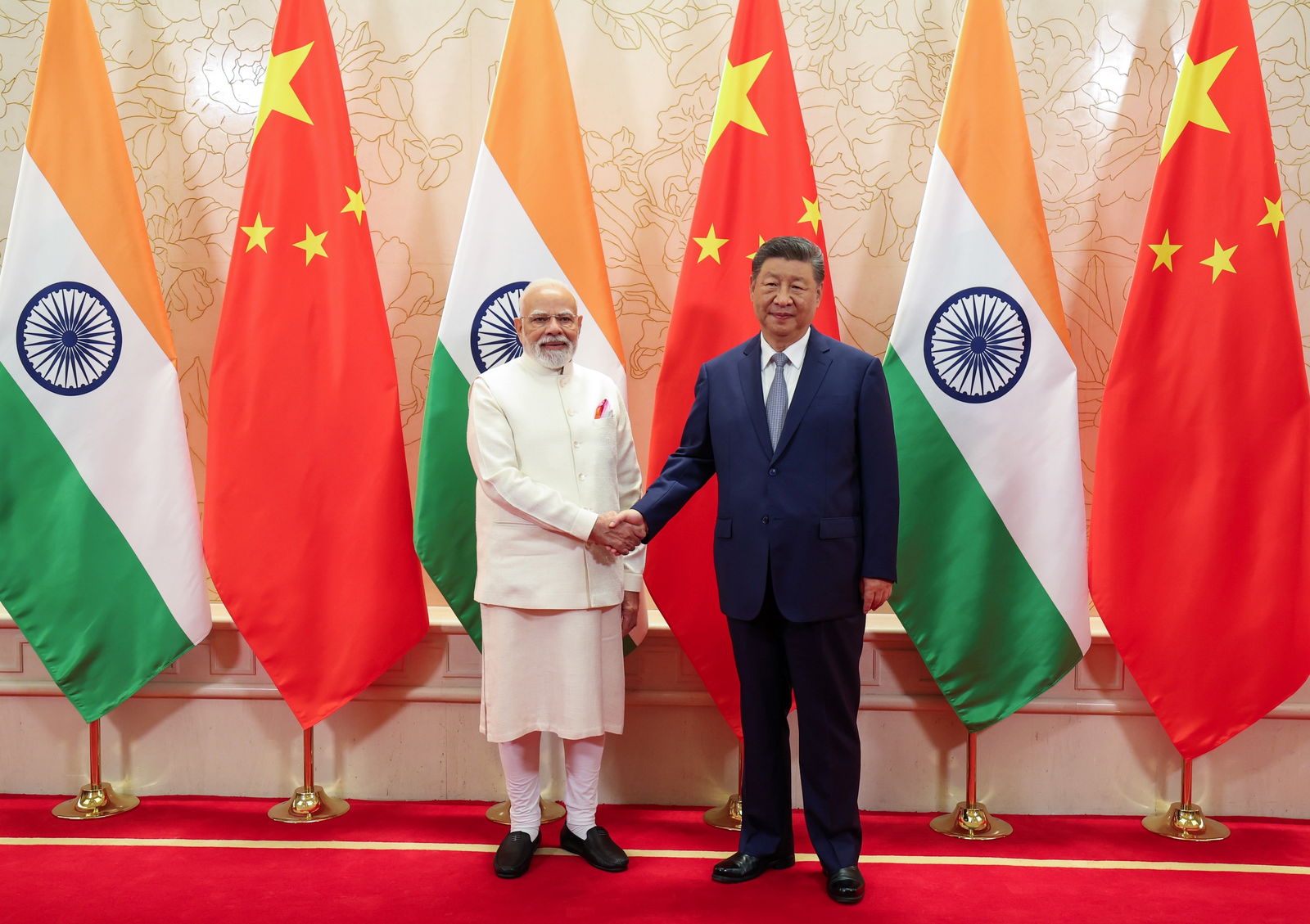
PM Modi Meets Xi Jinping in Tianjin: India-China Talks Mark New Chapter in Bilateral Ties Amid Global Uncertainty

Prime Minister Narendra Modi met Chinese President Xi Jinping in Tianjin on the sidelines of the Shanghai Cooperation Organisation (SCO) summit, marking their first interaction in ten months. The meeting comes after a breakthrough agreement on border patrolling protocols, which eased a four-year confrontation along the Line of Actual Control (LAC). Both leaders emphasized mutual trust, respect, and sensitivity as the foundation for stronger ties, while also acknowledging the importance of cooperation for regional stability and global economic balance. The talks, viewed as both symbolic and strategic, hold significance amid growing US tariff threats and the shifting dynamics of a multi-polar world.
Tianjin, Aug 2025 : Prime Minister Narendra Modi held a significant meeting with Chinese President Xi Jinping in Tianjin on Sunday during the two-day Shanghai Cooperation Organisation (SCO) summit. This marked their first face-to-face interaction in ten months, following their last engagement at the BRICS Summit in Kazan, Russia, in 2024. The talks carry weight not only for bilateral relations but also for broader regional and global stability.
A New Phase in India-China Dialogue
The Modi-Xi meeting comes in the wake of a major diplomatic breakthrough earlier this year, when New Delhi and Beijing reached an agreement on patrolling protocols along the 3,500-km-long Line of Actual Control (LAC). This understanding effectively eased a tense four-year confrontation on the border, allowing both sides to shift focus toward dialogue and cooperation.
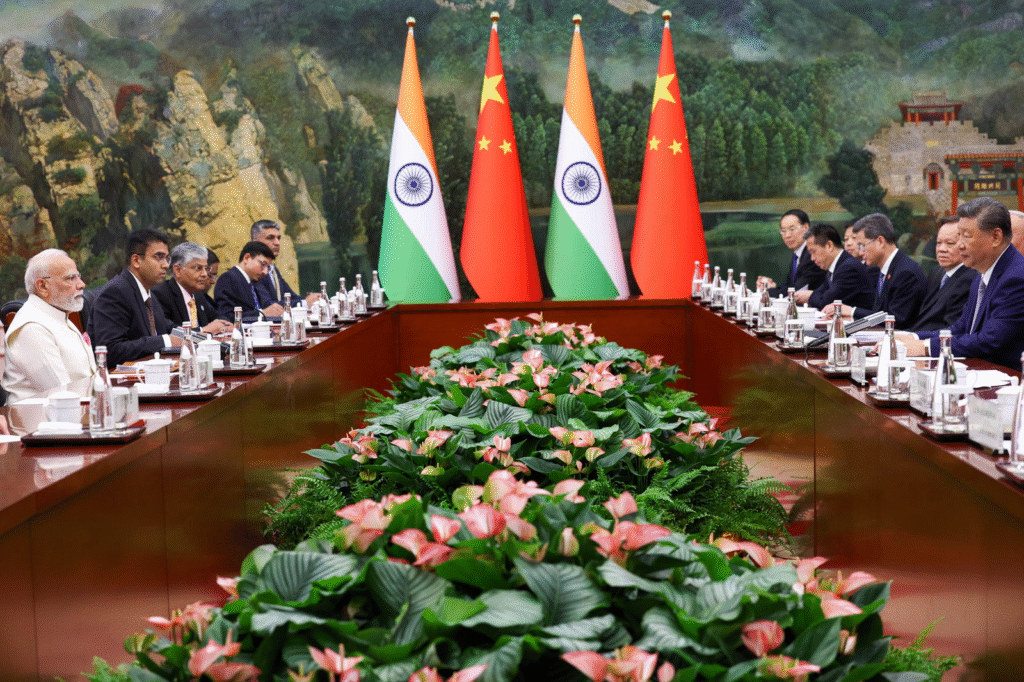
Prime Minister Modi, in his opening remarks, expressed gratitude to President Xi for the invitation and underscored the importance of restoring peace and stability along the border. “Last year, we held fruitful discussions in Kazan, which helped in providing a positive trend to our relations. After the disengagement on the border, an atmosphere of peace and stability has been created,” Modi stated.
He also highlighted concrete outcomes of this renewed engagement: the resumption of the Kailash Mansarovar Yatra, the revival of direct flights between India and China, and enhanced cooperation on border management.
Strengthening Bilateral Ties
The Prime Minister reiterated that the cooperation between India and China was crucial not only for their combined 2.8 billion citizens but also for the “welfare of the entire humanity.” Stressing the pillars of mutual trust, respect, and sensitivity, Modi said, “We are committed to taking our relations forward on this basis.”
President Xi, for his part, welcomed Modi’s participation in the SCO summit and expressed optimism that India-China cooperation would contribute to both regional prosperity and a successful SCO under China’s current chairmanship.
Global Economic Context
The timing of the meeting is also notable, as it coincides with heightened tensions in the global economic order. With US tariff threats and protectionist policies adding uncertainty to global trade, Modi emphasized the need for India and China, as two of the world’s largest economies, to work together.
“Given the current volatility in the world economy, it is also important for India and China, as two major economies, to work together to bring stability to the world economic order,” he said. Modi also underlined that stable and predictable relations between the two countries would positively impact not just Asia but the world at large.
Xi echoed these sentiments, reaffirming that a stable and cooperative India-China relationship served not only bilateral interests but also those of developing nations worldwide.
Diplomatic Build-Up to the Meeting
The meeting in Tianjin was preceded by weeks of diplomatic exchanges. Earlier this month, Chinese Foreign Minister Wang Yi visited India for Special Representatives (SR) talks on the boundary question. During his meeting with National Security Advisor Ajit Doval, Wang emphasized Beijing’s “great importance” attached to Modi’s visit, describing it as a step toward a healthy and stable relationship.
PM Modi had also set the stage during an interview with Japan’s Yomiuri Shimbun, where he spoke of advancing ties with China on the basis of “mutual respect, mutual interest, and mutual sensitivity.” He noted that since his meeting with Xi in Kazan last year, bilateral relations had seen “steady and positive progress.”
A Symbolic but Strategic Encounter
Observers view the Tianjin meeting as both symbolic and strategic. Symbolic, because it demonstrates a willingness by both sides to move beyond past confrontations and signal to the international community that Asia’s two giants can cooperate. Strategic, because the meeting provides both leaders an opportunity to counterbalance US trade pressures and showcase the potential of a multi-polar world order.
Experts also point out that the resumption of dialogue at the highest level reinforces the perception that border tensions are no longer the sole defining feature of India-China ties. Instead, both countries appear intent on broadening their engagement to include trade, connectivity, cultural exchanges, and global governance.
Looking Ahead
The presence of top officials—NSA Ajit Doval and Foreign Secretary Vikram Misri from the Indian side, and Foreign Minister Wang Yi from the Chinese side—underlined the seriousness of the engagement. Both governments have agreed to continue dialogue at multiple levels to ensure sustained progress.
By placing emphasis on peace, stability, and economic cooperation, the meeting has set a constructive tone for the future. However, experts caution that challenges remain, particularly on border management and regional competition. Yet, the willingness to talk and agree on frameworks for cooperation suggests that both sides recognize the high stakes involved.
Conclusion
The Modi-Xi meeting in Tianjin has been widely interpreted as a milestone in India-China relations. After years of confrontation along the LAC, the renewed dialogue reflects a shared understanding of the need for stability, not just for bilateral prosperity but for regional and global balance.
As PM Modi put it, “Stable, predictable, and amicable bilateral relations between India and China can have a positive impact on regional and global peace and prosperity. This is also crucial for a multi-polar Asia and a multi-polar world.”
The Tianjin engagement may not resolve all outstanding issues, but it represents a decisive step toward a more cooperative and balanced relationship between two of the world’s largest nations.
Team Maverick.



Vijay’s TVK Surges Ahead in Tamil Nadu Polls, Wins Praise from Film Fraternity
Chennai, May 2026 : As the Tamil Nadu Assembly election results continue to unfold, actor-…

Vijay’s TVK Surges Ahead in Tamil Nadu Polls, Wins Praise from Film Fraternity
Chennai, May 2026 : As the Tamil Nadu Assembly election results continue to unfold, …