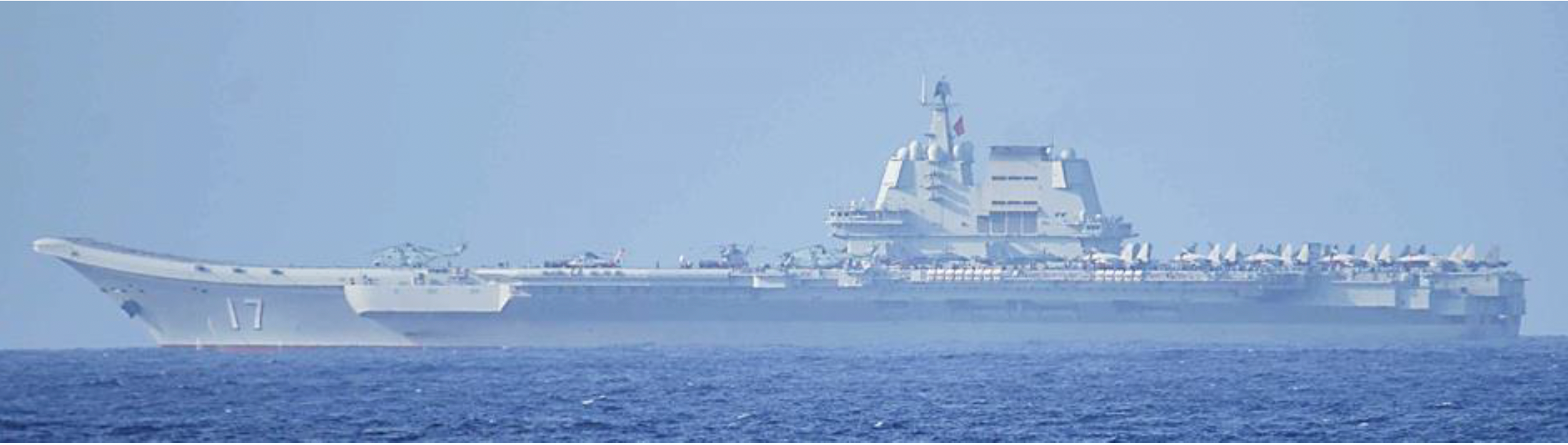
New Chinese Aircraft Carrier Fujian patrolling in Taiwan poses threat to U.S. Naval Dominance in Pacific.

Sept 2025 : China’s most advanced aircraft carrier, Fujian Type 003, has entered a critical phase of sea trials near the Taiwan Strait, marking a dramatic shift in Beijing’s naval posture. The trials, verified through satellite tracking and social media footage, show the 80,000-ton flat-deck carrier operating in one of the most sensitive maritime zones in the Indo-Pacific, triggering heightened scrutiny from U.S. defence officials and allies.
The emergence of the new Chinese Fujian aircraft carrier in waters close to Taiwan signals a calculated demonstration of China’s maturing power projection capability. It is the first time the People’s Liberation Army Navy (PLAN) has positioned its new-generation carrier so close to Taiwan’s Air Defence Identification Zone (ADIZ), raising concerns at U.S. Indo-Pacific Command about the speed and intent of China’s naval modernization. Senior U.S. Navy officers speaking on background describe the trials as “designed to send a clear message” ahead of Taiwan’s upcoming elections and amid increased U.S. arms deliveries to Taipei.
Launched in 2022, Fujian is China’s first carrier outfitted with a CATOBAR (Catapult Assisted Take-Off But Arrested Recovery) system, which allows fixed-wing aircraft to launch using a catapult and land using arresting wires, using electromagnetic aircraft launch technology EMALS (Electromagnetic Aircraft Launch System), a system that replaces traditional steam catapults with linear electric motors to launch aircraft more efficiently and with less wear). This approach is akin to the U.S. Navy’s Gerald R. Ford-class. With three catapults and an expansive flight deck, Fujian is designed to field a next-generation carrier air wing that includes stealth-capable J-35 fighters, J-15T strike aircraft, and KJ-600 Airborne Early Warning and Control (AEW&C) platforms. This configuration is intended to close the gap with U.S. supercarriers, enabling high sortie rates, heavier payloads, and sustained flight operations in blue-water conditions.
U.S. intelligence sources tracking the vessel via overhead ISR (Intelligence, Surveillance and Reconnaissance) assets confirm that Fujian conducted multiple high-speed runs and course changes, consistent with manoeuverability trials under operational stress conditions. While no confirmed aircraft launches occurred during the near-Strait testing, Chinese military bloggers claim that electromagnetic launch sequences without manned aircraft were observed, an indication of further EMALS testing likely involving telemetry and catapult stress trials.
Defence officials in Washington and Tokyo interpret this as a dry run for forward-deployed operations. A U.S. Navy analyst at ONI noted that “China wants to normalize carrier operations inside contested airspace, not just outside of it. The fact they’re willing to trial Fujian so close to Taiwan, before it’s even commissioned, shows they’re confident enough to accept the intelligence exposure and operational risks involved”.
The U.S. Navy is expected to respond by intensifying monitoring flights out of Kadena Air Base in Okinawa and forward-deploying ISR platforms such as MQ-4C Triton and P-8 Poseidon across the Philippine Sea. Additionally, U.S. Carrier Strike Group 5, currently operating out of Yokosuka, has been placed on elevated alert, according to a U.S. Pacific Fleet official familiar with the matter.
In strategic terms, Fujian represents a paradigm shift in the balance of naval power in the Western Pacific. Though it remains months, if not a full year, from formal commissioning, its emergence near Taiwan is a live demonstration of China’s strategic intent to impose maritime pressure zones during crises. For Taiwan, the carrier’s presence is a rehearsal of potential blockade scenarios. For U.S. forces, it poses an evolving multi-domain challenge that will require more agile deterrence postures, carrier dispersal concepts, and increased integration with regional allies like Japan and Australia.
Fujian is not an isolated leap but the culmination of a decade-long sprint in Chinese carrier development. The PLAN commissioned its first aircraft carrier, Liaoning, in 2012 after refitting a Ukrainian hull. Though largely a training and experimental platform, Liaoning marked the beginning of China’s ambitions to join the elite group of carrier-operating nations. In 2019, China launched its first domestically built carrier, Shandong, which retained the ski-jump layout but improved overall air wing capacity and onboard systems.
In just over a decade, China has moved from legacy Soviet hardware to an indigenous EMALS-powered supercarrier. This transition reflects a broader shift in Beijing’s military doctrine, away from coastal defence and toward expeditionary capability. With each successive hull, China has shortened its carrier construction timeline and increased design sophistication, including improvements in radar cross-section management, deck automation, and aircraft handling systems.
According to Chinese shipyard planning documents leaked in 2023, a nuclear-powered Type 004 carrier is already under development and is expected to enter dry dock at Jiangnan Shipyard by 2026. This next-generation platform is projected to exceed 90,000 tons, carry a larger AEW&C fleet, and support unmanned carrier-launched aircraft for ISR and strike roles. If realized, Type 004 would move China into a class of naval power currently occupied only by the United States.
Despite the pace of Chinese advancements, significant capability gaps remain between Fujian and the U.S. Navy’s Gerald R. Ford-class carriers. The Ford-class, now fully operational with multiple deployments, offers superior endurance, more powerful EMALS catapults, and the most advanced dual-band radar system in service. U.S. carriers are built around a highly interoperable joint strike group concept, integrating with destroyers, submarines, and airborne early warning platforms with battle-tested command-and-control architecture.
Sortie generation rates also favour the U.S., with the Ford-class designed to launch 25% more sorties per day than its Nimitz-class predecessors, a benchmark Fujian is unlikely to meet in the short term. Additionally, the U.S. Navy benefits from over 75 years of continuous carrier warfare experience, joint-force integration, and a global logistical support network that China has yet to match.
However, PLAN’s proximity advantage and growing anti-access/area denial (A2/AD) umbrella could change the risk calculus in a Taiwan scenario. Operating under protective layers of DF-21D and DF-26 ballistic anti-ship missiles, China may seek to use Fujian not in a head-on carrier duel but as a tool for coercive power projection, amphibious support, and regional intimidation.
U.S. naval planners must also contend with the volume of Chinese shipbuilding. While the United States maintains 11 nuclear-powered carriers, China’s rapidly expanding navy already exceeds the U.S. in total hull count. If current trends hold, the PLAN could field up to four carriers by the early 2030s, including at least two with full CATOBAR capability and nuclear propulsion.
The recent trials of Fujian near the Taiwan Strait mark a turning point in China’s naval evolution. No longer content with symbolic shows of force, Beijing is now demonstrating real, deployable carrier capabilities with strategic consequences for U.S. force posture across the Indo-Pacific. As Fujian nears operational status, it will test the assumptions underpinning U.S. maritime dominance in the region and force a recalibration of how American power is projected, contested, and sustained in an era of near-peer competition.
Team Maverick







Trump Says US Maintains Clear AI Lead Over China Amid Probe Into Technology Misuse
Washington, July 2026 : US President Donald Trump on Monday asserted that the United State…

Trump Says US Maintains Clear AI Lead Over China Amid Probe Into Technology Misuse
Washington, July 2026 : US President Donald Trump on Monday asserted that the United …