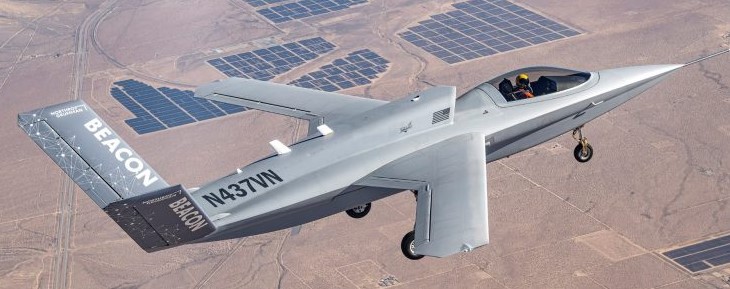
Scaled Composites’ Model 437 Vanguard returns to flight, ahead of Northrop Grumman’s Beacon autonomy flight testing.

Sept 2025 : The Scaled Composites Model 437 Vanguard has resumed flight testing at Mojave Air and Space Port, entering a new phase of envelope expansion flights that will prepare the aircraft for its role in Northrop Grumman’s Beacon autonomous testbed ecosystem. The flight, announced by Scaled Composites on Sep. 20, 2025, comes after extensive modifications to the airframe for its new role since its first flight in August 2024.
The company reported updates about the hydraulic system, cockpit integration of new pilot interfaces, and the incorporation of autonomy subsystems developed by Northrop Grumman for Beacon. These upgrades pave the way for the Model 437 to serve as a versatile airborne platform for experimentation with autonomy and artificial intelligence-driven mission software.
“We had the challenge of taking an airplane that has only flown once and converting it into a versatile autonomous testbed, which demonstrates Scaled’s agility and flexibility in achieving new test objectives”, said project engineer Yuto Shinagawa, highlighting the integration of flight safety protections for autonomous operations. As an example, he mentioned the introduction of protections in the flight control system to assure flight safety when engaging the autonomous system.
The Model 437 Vanguard was originally conceived as an unmanned loyal wingman concept in 2021, designed to operate alongside crewed aircraft in attritable roles. Renderings at the time depicted an uncrewed platform with a range of around 3,000 nautical miles, a cruise speed near Mach 0.8, and payload options including AIM-120 AMRAAMs or side-looking radar systems.
However, its first flight in August 2024 exhibited a cockpit, making the Vanguard an optionally piloted aircraft. The Vanguard is powered by a single Pratt & Whitney PW535 turbofan engine producing 3,400 pounds of thrust, and features a wingspan of 41 ft (12.5 m), gross takeoff weight of 10,000 lb (4,536 kg), and endurance of six hours.
Northrop Grumman contributed to the program through its Digital Pathfinder initiative, using advanced digital engineering methods to design and build the Model 437’s wings. The process, the company said, reduced rework to less than one percent compared to the 15–20% typical of conventional design programs, drawing directly on lessons from the B-21 Raider stealth bomber program.
The Model 437 now forms the backbone of Northrop Grumman’s Beacon program, described as a “next-generation testbed ecosystem” that enables third-party developers to integrate, validate, and mature autonomy software in operationally relevant scenarios.
According to Northrop Grumman, Beacon is positioned to fill a critical gap in autonomy development. “The market is striving for autonomous testbeds”, said Dan Salluce, the company’s director of advanced autonomy. Many AI and autonomy companies, he explained, lack access to dedicated hardware platforms. Beacon provides them with a means to flight-test and refine their mission autonomy software at a relatively low cost, while leveraging Northrop’s expertise in system integration.
Beacon will employ Northrop’s internally developed PRISM flight software to manage core flight safety tasks, while leaving mission-specific functions to the third-party autonomy stacks being tested. Partners such as Applied Intuition, Autonodyne, Merlin, Red 6, Shield AI, and SoarTech have already been announced. Tom Jones, president of Northrop Grumman Aeronautics Systems, described Beacon as “sixth-generation autonomous software development”, further emphasizing its role in reducing the time and cost of delivering new mission capabilities to customers.
As Scaled Composites resumes envelope expansion flights, the focus will be on validating the integration of Beacon’s autonomy ecosystem and ensuring safe transitions between crewed and autonomous modes. The aircraft’s optional manned capability allows safety pilots to supervise tests while gradually handing over control to autonomy software, reducing risks in early phases. Beacon’s ultimate value lies in its ability to shorten development cycles for autonomy solutions, giving defense customers and industry partners alike a flexible proving ground. With test campaigns set to accelerate through 2025, the Vanguard may play an increasingly central role in shaping how the next generation of autonomous combat aircraft are designed, validated, and fielded.
Team Maverick







President Of India Reviews Passing Out Parade at Indian Military Academy, Dehradun.
Dehradun; June 2026: The Supreme Commander of the Armed Forces and President of India, Dro…

President Of India Reviews Passing Out Parade at Indian Military Academy, Dehradun.
Dehradun; June 2026: The Supreme Commander of the Armed Forces and President of India, …