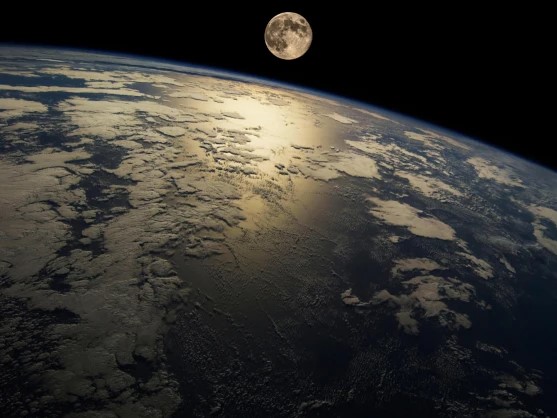
Wind blowing from the Earth is causing the Moon to Rust.

“Lunar minerals generate the rust mineral haematite when bombarded
with high-energy oxygen particles, experiments show”.
Sept 2025 : Scientists have found that oxygen particles blown from Earth to the Moon can turn lunar minerals into haematite, also known as rust1. The discovery adds to researchers’ growing understanding of the deep interconnection between Earth and the Moon — and shows how the Moon keeps a geological record of those interactions, says Ziliang Jin, a planetary scientist at Macau University of Science and Technology in China. He and his colleagues reported their findings earlier this month in Geophysical Research Letters.
Most of the time, both Earth and the Moon are bathed in a stream of charged particles emanating from the Sun. But for around five days each month, Earth passes between the Sun and the Moon, blocking most of the flood of solar particles. During that time, the Moon is exposed mainly to particles that had been part of Earth’s atmosphere before blowing into space, a phenomenon known as Earth wind. That wind contains ions of various elements, including hydrogen, oxygen and nitrogen. When those charged particles hit the Moon, they can implant themselves into the upper layers of lunar soil2 and trigger chemical reactions.
In 2020, scientists reported that India’s Chandrayaan-1 mission had spotted haematite near the Moon’s poles3. Haematite is an iron-rich mineral that can form when rocks react with water and oxygen. But the Moon’s chemical environment isn’t conducive to the presence of oxygen, meaning that the oxygen for the haematite might have arrived from somewhere else. The authors of the 2020 paper proposed that it might have arrived in the Earth wind.
Jin and his colleagues decided to test that idea in the laboratory. They simulated the Earth wind by accelerating hydrogen and oxygen ions to high energies. They then sent the ions whizzing into single crystals of iron-rich minerals that are known to exist on the Moon. Pelting the minerals with high-energy oxygen caused some of the crystals to transform into haematite. And pelting the haematite with hydrogen caused some of it to revert to iron. The results show that the Moon undergoes many chemical and mineralogical changes as it passes through the Earth wind each month, Jin says. Perhaps most importantly, they show that oxygen in the Earth wind can form haematite on the Moon.
“This is a great experiment”, says Shuai Li, a planetary scientist at the University of Hawaii at Mānoa, who led the team that made the 2020 discovery. “It is a very wise design” that helps to tease out the various factors that help to create haematite on the Moon.
Li says he would like to see a future mission bring back samples of the lunar haematite, so that researchers can analyse the oxygen and confirm that it traces back to the Earth wind.
Team Maverick







Jesus Backs Cristiano Ronaldo, Takes Charge as Portugal Coach Until 2030
Lisbon, July 2026 : Newly appointed Portugal head coach Jorge Jesus has thrown his full su…

Jesus Backs Cristiano Ronaldo, Takes Charge as Portugal Coach Until 2030
Lisbon, July 2026 : Newly appointed Portugal head coach Jorge Jesus has thrown his …