Democracy to restore in Syria.

Oct 2025 : Syria will hold an indirect vote (Regional committees have selected electoral colleges that will elect two-thirds of the 210-member People’s Assembly, while Sharaa appoints the remaining third) on Sunday (05th October, 2025) to establish its first parliament since Bashar al-Assad was ousted, a key step in the transition from his rule but one that has stirred concerns about political inclusivity under the country’s new leaders. The process is unfolding as President Ahmed al-Sharaa tries to consolidate his hold over a nation fractured by 14 years of war and recent bouts of sectarian violence that have fueled suspicion of his Islamist-led administration among minorities.
The Electoral Process is run by an 11-member body appointed by Sharaa in the month of June, 2025. This body in turn appointed regional subcommittees that selected members of regional electoral colleges, after local consultations. A preliminary list of some 6,000 electors has been announced. To run for parliament, you must first be selected as a member of an electoral college. The criteria rule out supporters of the former regime, and advocates of secession, division or seeking foreign intervention.
The authorities say they resorted to this system rather than universal suffrage due to a lack of reliable population data and following the displacement of millions of Syrians by the war. Citing security and political reasons, they also decided to postpone the process in the northeast, held by Kurdish-led authorities, and in the province of Sweida, largely held by Druze armed groups. That means 19 seats in parliament are expected to be left empty.
Critics have slammed those moves, saying a partial and indirect vote is unrepresentative and too centrally managed. The eastern city of Deir al-Zor is a stark example. The winding Euphrates river divides it in two: the government-held western half where a vote will be held, and on the other bank is the Kurdish -controlled east with no election.
“It does not satisfy me that there are elections there, and here there aren’t. We want something that serves the whole region. Syria is united”, said Hassan Mohamed Dalli, a resident of the eastern bank.
Critics say the process also fails to guarantee the participation of women or religious and ethnic minorities.
Women make up at least 20% of candidates in just a quarter of electoral districts. But in half of the districts, 10% or fewer of the candidates are women. No quotas have been set for women or minority lawmakers. Women fared no better under the Assad family’s rule. They also had no quotas in parliament then, and female lawmakers made up only 6% to 13% of the legislature from 1981 until Bashar was toppled, according to the Inter-Parliamentary Union, which collects data on national parliaments worldwide.
The parliament was slightly larger under Assad, with 250 seats of which two-thirds were reserved for members of his Baath party. The last elections, in July 2024, were labelled a farce by Assad’s opponents.
Analysts say that the current winner-takes-all voting system could produce a result dominated by men from Syria’s Sunni Muslim majority. This may put the onus on Sharaa, who has repeatedly promised inclusivity, to use his third to appoint female lawmakers and members of minority groups. But observers worry that he could also use appointees to centralise power.
“If the president selects individuals subject to his influence, he could issue laws through decrees without effective challenge“, Haid Haid, a senior fellow at the Arab Reform Initiative, wrote in an analysis of the process. “This moment could either legitimise a fragile transition or deepen long-standing public cynicism“.
Team Maverick



Prashant Kishor to Contest Bankipur Bypoll, Jan Suraaj Eyes Breakthrough in BJP Stronghold
Patna, July 2026 : Election strategist-turned-politician Prashant Kishor will contest the …
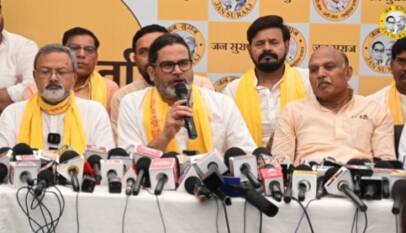
Prashant Kishor to Contest Bankipur Bypoll, Jan Suraaj Eyes Breakthrough in BJP Stronghold
Patna, July 2026 : Election strategist-turned-politician Prashant Kishor will contest the upcoming by-election from …