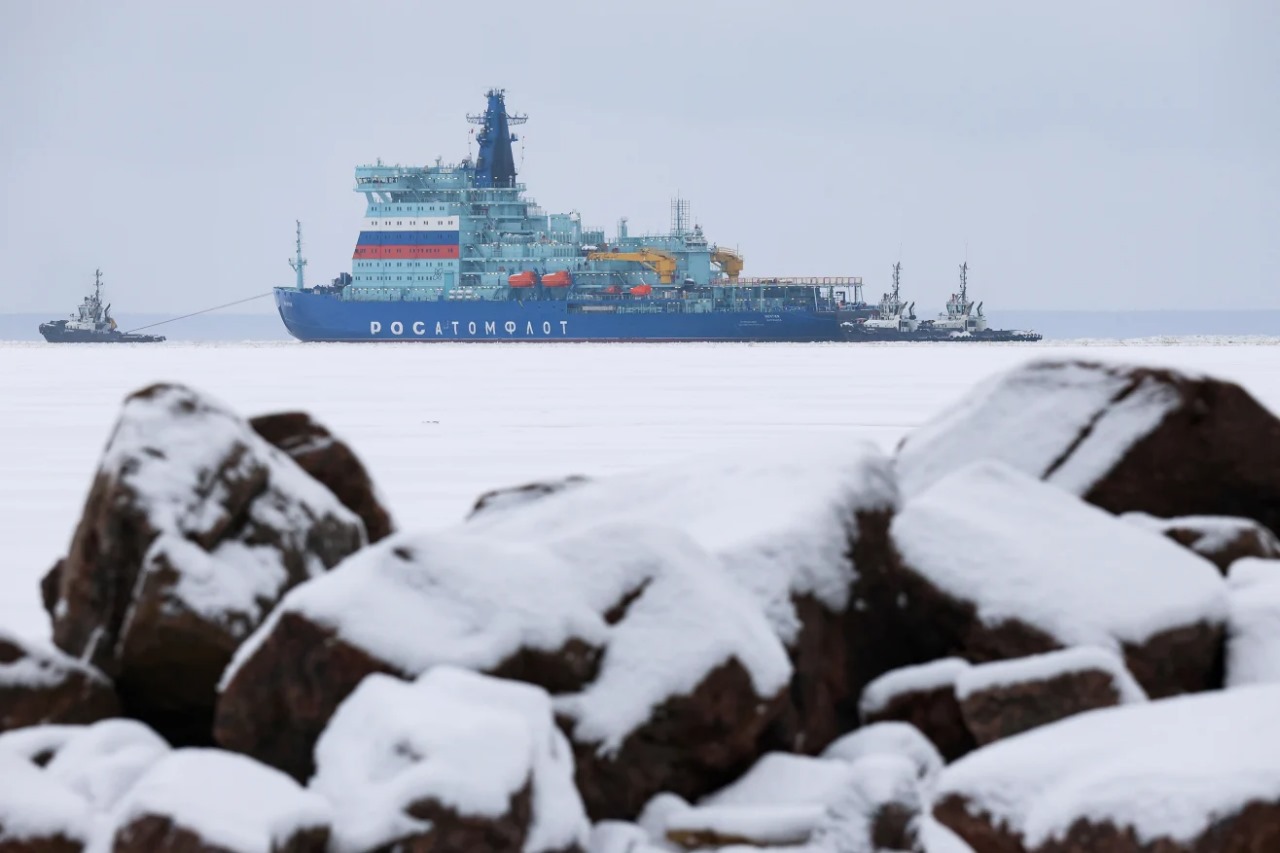
China is venturing into a very high risky waterways often attributed as treacherous.

Oct 2025 : Any container ship setting sail from China, destined for Europe and laden with cargo everything from batteries to clothing, navigates towards south enroute Suez Canal. But of late the Chinese ships are divulging from this traditional Suez Canal route to pursue the northern route through the frigid water of the Arctic Ocean. The journey is seen as a major step forward in China’s quest to build out a “Polar Silk Road”, an infrastructure and shipping corridor across the top of the world, and it’s only made possible by climate change.
The icy landscape of the Arctic has transformed much faster than expected, as humans burn fossil fuels and heat the planet. The region is warming around four times the rate of the rest of the world. Rock Hard Sea Ice are fracturing and melting. Rising temperatures are shrinking summer Arctic sea ice. As global temperatures increase, summer Arctic sea ice is shrinking at a rate of 12.2% per decade. Each September the ice shrinks to its annual minimum extent, with this year 2025 saw the 10th lowest year on record on September 10th.
Developing this route could bring big economic and geopolitical rewards for China, which is looking ahead to an ice-free Arctic and the strategic opportunities it can provide, experts say. However, they warn, sending fleets of ships through this pristine, remote and dangerous environment is an ecological and human disaster waiting to happen. Ships have used the Northern Sea Route before, which is currently only accessible for a few months during the summer and fall. The first container ships started going through the Arctic more than a decade ago, but usually on specialised, that too ad hoc voyages.
Shipping vessels are undertaking an 18-day course from the Chinese port of Ningbo-Zhoushan to the farthestmore UK, accompanied by ice breakers. Thet are currently navigating through the Bering Strait separating Russia and Alaska, sailing across the Arctic, hugging Russia’s north coast, heading toward the North Sea, stopping in the UK and then ports in the Netherlands, Germany and Poland. These voyages “marks the official opening of the world’s first China-Europe Arctic Express container route”, according to a statement by Ningbo Customs, a “major breakthrough” in the polar region that will get goods to Europe in time for peak Christmas season.
Melting Arctic ice makes new shipping route possible, as China reiterates that it has launched the first China-Europe Arctic Express shipping route, and the first vessel is on an 18-day journey to the United Kingdom using the Northern Sea Route. Melting sea ice is allowing ships to make more use of this route, which is far shorter than sailing through the Suez Canal which consumes more than 40 days, or, around the southern tip of Africa in more than 50 days.
Commercialising the Northern Sea Route would reorient trade, said Elizabeth Buchanan, senior fellow at the Australian Strategic Policy Institute, a nonpartisan think tank. “A new global economic corridor is about to come online. This is a gamechanger”, she told Press Reporters. The potential advantages are clear. First: The Northern Sea Route is comparatively short, taking around half the time as the journey south via the Suez Canal. It could also help sidestep potential chokepoints along traditional routes, including attacks on commercial ships by Yemen’s Iran-backed Houthi rebels in the Red Sea, which have been ongoing since 2023. Global routes via the Panama Canal, meanwhile, have been disrupted by low water levels as the region grapples with severe drought.
The shorter route also cuts the amount of planet-heating pollution produced by 50%, according to Ningbo Customs. But it’s no environmental win, said Andrew Dumbrille, the North American advisor to the Clean Arctic Alliance, a network of non-profits. “It comes with a high degree of concern and risk and hazard”. It’s a misconception to think that melting ice gives ships an easy run of clear blue waters. Instead, it can make the Arctic even more treacherous. Unprecedented sea ice can damage ships or stop them in their tracks, forcing them to re-route or turn back. Vessels must also grapple with what Dumbrille called the “enemies of shipping – darkness, icy temperatures and fog”.
If anything goes wrong in this harsh and remote environment, it can quickly turn into catastrophe. Human lives are at risk, with scarce rescue resources, as is the marine environment. “There aren’t oil spill response assets at the ready like they are in other climates”, Dumbrille said. That means any spills will stay in the water for longer, wreaking more damage.
It’s not clear what fuel the Vessels are powered by, but if it’s heavy fuel oil, which is obviously thick and polluting, and the consequences of spills can be particularly bad. These kinds of fuels “emulsify on the surface, they expand, they spread to shorelines”, Dumbrille said.
Heavy fuel oil also produces black carbon, a kind of soot that can settle on the ice and accelerate melt by darkening the surface, meaning more of the sun’s energy is absorbed. Regulations to ban heavy fuel oil in the Arctic came into effect last year but there are transition times and loopholes that mean it is still in use, Dumbrille said.
For now, the Northern Sea Route is a miniscule part of global trade. Around 90 ships sailed through it last year, according to Rosatom, Russia’s state nuclear corporation, compared with the more than 13,000 that passed through the Suez Canal. Whether the Northern Sea Route catches on depends on a tangle of factors. There are economic considerations including freight costs, the cargo transported and how quickly it’s needed, said Klaus Dodds, a geopolitical analyst and senior research fellow at RAND Europe, a research institute.
Then there are geopolitical factors. If hostility escalates along the Suez Canal route, including in the Red Sea and the South China Sea, it may create chokepoints that make the Arctic more attractive. Conversely, a big environmental disaster or loss of life could make the route politically untenable.
A big advantage for China in the Arctic is that western ship operators have largely stepped away from it, put off by environmental dangers and the risk of relying on a route over which Russia exerts large amounts of control, Dodds said. The Mediterranean Shipping Company, the world’s biggest, this week announced its commitment not to use the Northern Sea Route, citing reasons including the environmental impact of operating in a “fragile ecosystem” and the risks of a route where “safe navigation and transit are not assured”.
Team Maverick







Shivakumar Says Congress United, Assures Women Will Get Cabinet Berth
Bengaluru, Aug 2026 : Karnataka Chief Minister D.K. Shivakumar on Monday sought to dismiss…

Shivakumar Says Congress United, Assures Women Will Get Cabinet Berth
Bengaluru, Aug 2026 : Karnataka Chief Minister D.K. Shivakumar on Monday sought to dismiss …