The Historic Australia-Papua New Guinea Pukpuk Treaty and its impact on the Pacific Region.

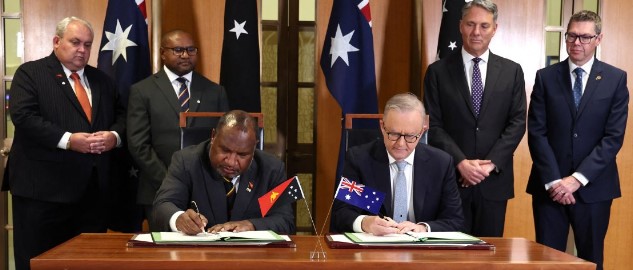
Australia and Papua New Guinea (PNG) have signed a mutual defence treaty on the 17th September, 2025, known as the Pukpuk Treaty. “Pukpuk” is a local word in PNG for crocodile, and Australia has emphasised the Pukpuk Treaty as a historic moment that has “elevated” the binational relations to unprecedented levels.
The Pukpuk Treaty is PNG’s first alliance ever and Australia’s first, since the trinational Security Treaty of 1951 encompassing Australia, New Zealand, and United States. Not only does this agreement establish mutual defence ties, and commitments diplomatic relations between Australia and its largest Pacific Island neighbour, but it also provides the architecture to vastly enhance the capacity of PNG’s defence forces through increased joint exercises, enhanced intelligence sharing, and allowing for up to 10,000 PNG troops to serve in the Australian Defense Force (ADF). Given the ADF’s recruitment challenges and PNG’s undermanned defence forces, the arrangement offers clear benefits for both nations.
The signing of the treaty is the culmination of years of diplomatic legwork by both countries to deepen security and cultural ties, a process that formally began in December 2023 with the two governments signing a security agreement that provided a framework to enhance the security relationship between the two countries. As a mutual defence treaty, the ‘Pukpuk Treaty’ stands as both a continuation of previous aspects of the Australian-PNG relationship but also constitutes a fundamental change in the depth of that relationship.
While Australia’s increased focus on the Pacific is bipartisan in nature and reaches back nearly a decade, its efforts accelerated markedly following the secret Solomon Islands–China security deal of 2022. This Solomon Islands–China security agreement represented a point of success for China, which has been steadily increasing its outreach to the Pacific over the past decade, for a potential effort to establish a security foothold in the region. Immediately thereafter, the Australia’s 2024 National Defence Strategy clearly articulated the government’s alarm over Chinese ambitions in the Pacific, setting the groundwork for a series of agreements with security stipulations, including in Nauru, Tuvalu, and even via a rugby deal with PNG; all of these are subtle efforts in limiting avenues for China to integrate into the security architecture of the Pacific region.
For PNG, which abides by a “friends to all” foreign policy, the imperative behind this treaty is much more pragmatic, which speaks of a formalised commitment by its biggest security partner to the defence of PNG territory, and the opportunity to further professionalise its growing defence forces.
While PNG Prime Minister James Marape has repeatedly emphasised that his country looks to Australia and other Western countries for its security relationships, he has just as adamantly maintained the importance of China as a key economic partner. And yet PNG’s proximity to Chinese harassment in the South China Sea and its location at the nexus of what would be any major contingency in the Indo-Pacific also likely informed the government’s decision to sign the Pukpuk Treaty.
Its leaders are not ignorant of Chinese ambitions in the Pacific, neither is PNG free from Chinese territorial incursions as demonstrated when a Chinese drone flew unannounced into PNG territory during a Chinese naval deployment earlier this year, a blatant violation of PNG’s sovereignty. To affirm this delicate balance, the PNG government has described the treaty as creating “one bigger fence that secures two houses that has its own yard space”. Such descriptions allow Marape to avoid describing the treaty as an arrangement aimed directly at China, and avoid antagonising PNG’s Chinese partners, while still allowing the construction of a fence to define, and protect PNG’s territorial integrity.
Australia’s approach in dealing with its Pacific neighbours contains many different elements, including deepening engagement across the economic, development, infrastructure, and climate spaces, as well as enhancing labour mobility and people-to-people ties. And yet, over the past several years, and in direct, if often implicit, response to Beijing’s growing security connections in the region, Australia has elevated the importance of its own security relationships with the region, looking to consolidate its position as the regional partner of choice on all security matters.
The country has tried to implement this imperative in a variety of ways, including through regional policing initiatives, deepening police training with several countries, explicitly elevating security in its bilateral relationships, and even in some cases, giving itself a veto power over Pacific islands’ security ties with other countries. Australia has also doubled down on working more closely with other external partners, such as New Zealand, Japan, and the United States.
US too has a strong interest in ensuring China does not make significant gains in the Pacific island region. If China were able to consolidate its influence in the Pacific, especially in the security realm, it would not only come at the expense of Washington but also of Canberra and Wellington. A permanent (or even semipermanent) Chinese foothold would its country to extend its presence in the Pacific and undercut U.S. access to the region, circumscribing freedom of movement for the United States and others in the vital cross-Pacific sea lanes, all while further strengthening Beijing’s tools of authoritarian control.
Australia’s long-standing view is that a hostile power occupying territory surrounding its northern approaches would be inimical to the nation’s interests. In this, Australia’s strategic imperative aligns with the United States’ geopolitical interests.
Whereas, PNG, the region’s largest and most populous country by several orders of magnitude, this imperative has prompted significant actions by both countries. In 2023, the United States and PNG signed a Defense Cooperation Agreement, elevating defence ties between the nations and allowing the United States access for basing in the country. The Pukpuk Treaty complements U.S. efforts and takes the Australia-PNG relationship even further in cementing security ties.
However, the recent rollback of some U.S. engagement abroad is complicating this synergy. A growing perception of an unreliable and self-interested United States is lending credence to China’s assertions that the region should look to Beijing, not Washington, to uphold global rules and norms. Australia has to figure out how to calibrate its engagement with the region, not just to fill material gaps left by U.S. shortfalls, but, more critically, to counter Chinese messaging across the Pacific and stem any additional tailwinds on Chinese security initiatives.
Questions remain, however, on complex issues such as Bougainville’s upcoming referendum on its potential independence and the potential for tensions between Indonesia and PNG. If and to what extent Australia might be involved in such a conflict is not completely clear, although both Australia and PNG have worked to assuage concerns, especially with their large and important neighbour, Indonesia.
The real question, however, is how or if this treaty, which is truly unprecedented in the Pacific will affect the current trajectory of increasing Chinese influence across the Pacific. China’s semi-successful campaign to exclude Taiwan from this year’s Pacific Islands Forum Leaders’ Meeting (PIFLM), resulting in all dialogue and development partners being excluded, and a recent policing arrangement with Vanuatu show that China’s will and capacity to exert influence in the Pacific remains strong. Growing exhaustion on the push and pull of Great Power Competition may work in China’s favour, as China is increasingly seen as a reliable development partner versus a mercurial and unreliable United States, allowing it to promote itself as working purely in Pacific interests rather than playing at great power rivalry.
Ultimately, much will depend on the degree to which Australia will be able to maximize the most practical aspects of this treaty, such as integrating PNG defence personnel into Australia’s own defence forces. Should this treaty really result in up to 10,000 PNG defence personnel serving in the ADF, which is a huge undertaking given that the current PNG defence force currently numbers under 4,000. This would reap enormous benefits for PNG’s ability to develop a capable, regional force able to assist with not just security assistance in the Pacific but also disaster assistance efforts as well. Likewise, this development could also fill significant gaps in Australia’s own defence recruitment efforts especially at a time when Australia’s defence needs are only increasing.
Team Maverick





IDF Claims Elimination of Hamas Operations Commander in Gaza Airstrike
Jerusalem, May 2026 : The Israel Defense Forces on Sunday claimed that it had eliminated a…
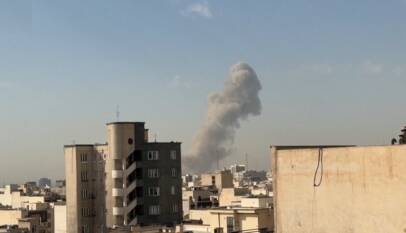
IDF Claims Elimination of Hamas Operations Commander in Gaza Airstrike
Jerusalem, May 2026 : The Israel Defense Forces on Sunday claimed that it had …