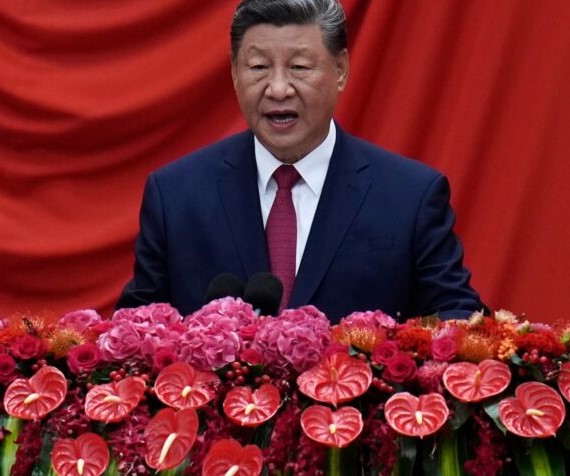
China reasserts its Four Red Lines.

In November 2024, when Chinese Premier Xi Jinping had met the former US President Joe Biden, he had mentioned in a statement for the first time about the “Four Red Lines” which was considered to be a narrative reflecting China’s clear indication of non-interference by the US in China’s sovereignty.
It envisioned China’s core interests by asserting, “The Taiwan question, democracy and human rights, China’s path and system, and China’s development right are four red lines for China. They must not be challenged”. While China has always emphasised these issues, this was the first time that a Chinese President so clearly named and associated them together as the “most crucial guardrails and safety nets” necessary to maintain stable bilateral relations.
Recently, following the trade truce announced after Trump and Chinese leader Xi Jinping met in South Korea last month, Xie Feng, China’s ambassador to the U.S., has reiterated China’s “four red lines” in a virtual address to the China – U.S. Business Council. First articulated last year as a set of four “no go” areas, these red lines are instructive for understanding what the Chinese regime is worried about and how it seeks to prevent Trump from pursuing his hawkish policies.
China likely feels emboldened to reassert these principles now that it has established its economic leverage over the United States through export controls on rare earth metals, and other critical industrial inputs. Understanding these red lines and how they tie together is crucial. They aren’t just a laundry list of interests; they represent critical areas of vulnerability that the ruling Communist Party wants to safeguard against. Notably, they link China’s national sovereignty to the Party’s control over society and the economy.
The first red line is the quintessential status of Taiwan, which has been separated from China since 1895, when it was colonised by Japan. It later retroceded to the Republic of China, and after the communists won the Chinese Civil War in 1949, the nationalist Kuomintang retreated to the island. For the Chinese Communist Party (CCP), particularly for Xi, the status of Taiwan is the most important unresolved issue from China’s long recovery from colonialism.
In Xi’s statements and editorials on this red line, he has demanded more from the United States than what the two sides already agreed to in the three joint communiques of the 1970s and 1980s. U.S. policy since then has been to advocate for a peaceful resolution of the dispute over Taiwan, without taking a position on the island’s ultimate status. But in its new red line, China is pressing the United States to support peaceful unification between mainland China and Taiwan. They also ask that the U.S. oppose Taiwan’s independence and do more to condemn President Lai Ching-te and his Democratic Progressive Party, which advocates for a more permanent separation between China and Taiwan while stopping short of declaring independence.
What unites Beijing’s four red lines is its concern that U.S. support for Taiwan is increasingly linked to the island’s identity as a vibrant East Asian democracy. China’s leaders clearly sense a moment of opportunity amid U.S. political tumult and a president who desires big wins and peace deals. Indeed, Trump has rolled back some public support for Lai by preventing him from transiting through New York on a recent overseas trip and downgrading some bilateral talks with Taipei. Moreover, the Republican Party has a number of influential members who have questioned U.S. military support for Taiwan, including Trump ally Marjorie Taylor Greene, who recently proposed an amendment to a major defence bill that would have eliminated funding for security cooperation with Taipei.
The second red line, “democracy and human rights” is an admonition against using anti-authoritarian and human rights-oriented narratives as pretexts to criticise China’s domestic politics. This red line speaks directly to U.S. criticism of China’s human rights abuses, particularly its use of concentration camps and other repressive policies against predominantly Muslim Uyghurs in Xinjiang, which the first Trump administration called a genocide, and the stifling of dissent in Hong Kong after the 2019 unrest. It is also an obvious critique of Biden’s Summit for Democracy, which attempted to bring together a group of nations allied by their shared commitment to political pluralism.
The third red line defends the legitimacy of China’s own “path” and calls for each side to refrain from regime change. This red line is a response to statements from China hawks in Trump’s first regime like Secretary of State Mike Pompeo and Deputy National Security Adviser Matt Pottinger, both of whom made speeches that urged people in China to rise up against the Communist Party. More recently, Pottinger co-authored an essay in Foreign Affairs last year in which he labeled Xi an “agent of chaos” and argued that “America’s competition with China must be won, not managed”.
Finally, the fourth red line invokes China’s right to economic development and criticises the U.S. for use of trade restrictions and export controls to decouple the two economies or otherwise cause damage to China’s rise. This red line opposes international criticism of China’s economic impact on other countries, rejecting notions of “overcapacity” and demanding that trading partners like the U.S. do not stand against China’s version of state capitalism.
What unites these four red lines is Beijing’s overarching concern that U.S. defence and support for Taiwan is increasingly linked not to the Cold War but to Taiwan’s identity as a vibrant East Asian democracy alongside other key U.S. allies, Japan and South Korea. The Biden administration was explicit in advocating for stronger alliances among democracies. To China’s chagrin, Biden’s Summit for Democracy included representatives from Taiwan.
Recent policy changes, since Trump returned to power in January, may bode well for China’s reinforcement of its four red lines. Many of the China hawks in the GOP are absent or quiet. While Trump talks of ousting Maduro in Venezuela, he has often expressed envy of Xi’s authoritarian grip on power. With two more meetings between Trump and Xi planned in the coming months, China will have opportunities to use its leverage to press for greater advantage, especially on the status of Taiwan.
That makes recent remarks by Japan’s hawkish new Prime Minister, Takaichi Sanae, on the importance of Taiwan to Japan’s security all the more interesting. Growing support for Taiwan in Japan, which ruled Taiwan as a colony from 1895 to 1945 and maintains close economic and security ties with the island, is toxic to Beijing. It underlines the fact that China is surrounded by East Asian democracies that have their own reasons to defend the status of Taiwan.
Team Maverick





Union Minister Bhupender Yadav and Chief Minister Rekha Gupta Digitally Inaugurate 18 ‘Namo Oxygen Parks’ Across the Capital
Centre and Delhi Government Join Hands, 100 Such Parks to Be Developed Across Delhi ‘Ek Pe…

Union Minister Bhupender Yadav and Chief Minister Rekha Gupta Digitally Inaugurate 18 ‘Namo Oxygen Parks’ Across the Capital
Centre and Delhi Government Join Hands, 100 Such Parks to Be Developed Across Delhi …