Dialogue Is ‘Not Naïve, It Is Necessary’ As Global Divisions Deepen, UN Riyadh Forum Reiterates.

Riyadh; December 2025: The 11th Global Forum opened in Riyadh on Sunday – 14th December, with a blunt message for a world riven by distrust: dialogue is not a luxury, rather a survival strategy.
Over the next two days, participants in the Saudi capital are expected to insist that cooperation across cultures, religions, and communities remains the only viable way to navigate an era marked by rising polarization and conflict.
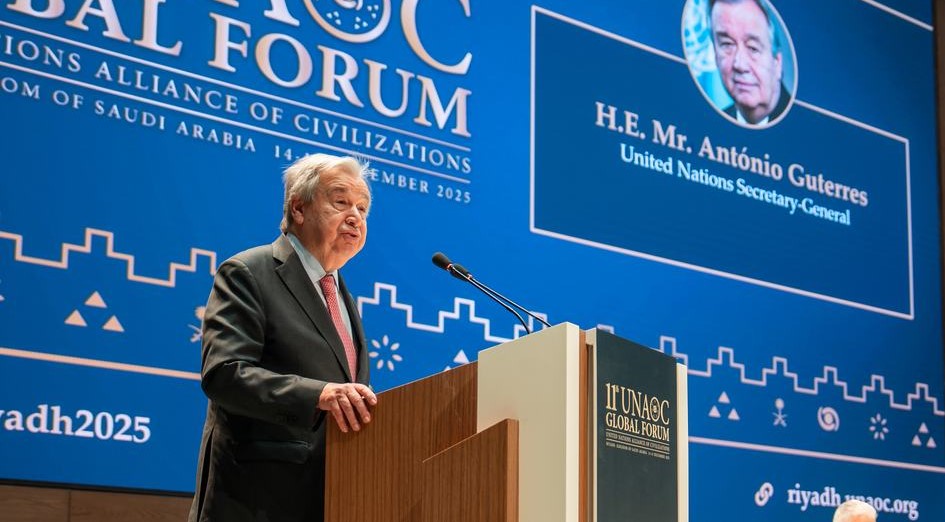
Speaking at the opening session, UN Secretary‑General António Guterres pushed back against the notion that the Alliance’s mission is unrealistic or, as critics suggest, “too soft for our hard world”.
Those who dismiss dialogue as naïve, he warned, are mistaken. Diplomacy and cooperation, he said, are not optional, they are essential.
Two decades have passed since former Secretary General Kofi Annan launched the initiative in 2005 with support from Spain and Türkiye. The geopolitical landscape has shifted dramatically since, yet the Alliance’s core purpose remains constant: countering extremism and intolerance and helping societies of different cultures and faiths live together in dignity.
The present UN Chief Guterres described the paradox of an age in which humanity is “more connected, yet never more fragmented”, and outlined two divergent futures: one defined by fear, walls, and escalating wars; and another built on bridges between cultures. Only the second path, he stressed, leads to sustainable peace: “No more 07th of Octobers. No more Gaza’s destroyed. No more El‑Fashers starved. No more communities massacred, expelled, or scapegoated”.
The Secretary General has pointed to three forces capable of driving positive global change: young people, women and girls, and people of faith. He urged delegates to advance the Alliance’s mission “with courage, clarity, and hope.”
Countries participating in the Forum endorsed the Riyadh Communiqué, which calls for combating all forms of religious intolerance as a global priority. The document underscores the central role of education in fostering dialogue, human rights, and peaceful societies, and reaffirms the Alliance’s founding aim: strengthening cooperation among cultures and religions while promoting respect, mutual understanding, and inclusion.
United Nations Alliance Of Civilizations (UNAOC) High Representative Miguel Moratinos, who also serves as the UN Special Envoy to Combat Islamophobia, opened the session by stressing that every culture must have an equal voice in shaping the world’s future. No single perspective should dominate, he said; instead, a truly peaceful and inclusive global community must draw on the wisdom and values of all civilisations.
Mr. Moratinos warned of “the return of hatred”, urging vigilance against growing discrimination. Quoting a verse from the Qur’an’s Surat Al‑Hujurat, he emphasised that human diversity is a source of strength, not division. He advocated that Islam is a religion of peace and reiterated that Islamophobia must have no place anywhere. At the same time, he insisted that antisemitism must be eradicated, adding: “Legitimate criticism of governments should not be perceived as antisemitic nor as a motive to demonise entire communities”.
Saudi Arabia’s Foreign Minister, Prince Faisal bin Farhan Al Saud, reaffirmed the Kingdom’s “longstanding commitment to intercultural dialogue”. He said Saudi support for the Alliance reflects a firm belief that engagement among cultures and civilizations is essential to peace, cooperation, and conflict prevention. He highlighted several Saudi initiatives aimed at promoting dialogue and countering extremism and warned of the increasing spread of religiously and nationally motivated extremist movements, as well as a worrying rise in hate speech and Islamophobia over the past two decades.
Rather than prompting disengagement, he said, these challenges must push nations to reinforce, not abandon the values of dialogue, communication, and coexistence.
Representatives from Spain and Türkiye, the Alliance’s original co‑sponsors, also spoke, reaffirming the enduring importance of inclusion, mutual respect, and sustained dialogue.
The opening day of the Forum also turned its attention to one of the fastest‑moving challenges shaping today’s information landscape: AI‑driven misinformation. Speakers warned that deepfakes, algorithm amplified hate speech, and unregulated systems are already reshaping public debate and not for the better.
Ismail Serageldin, co‑chair of the Nizami Ganjavi International Center and former Vice President of the World Bank Group, said the use of artificial intelligence is now unavoidable. He urged the public not to fear new technologies, likening the current moment to the invention of the calculator, when many predicted the end of accounting jobs. “Instead”, he noted, “they adapted”, and he argued society will do the same today. With the right safeguards, he added, AI could even help people achieve a better work‑life balance.
Mr. Serageldin went on to underscore that AI will not replace humans, but people who understand how to use it will gain a decisive advantage. Smart regulations must protect the public without smothering innovation or creativity, he explained.
Achraf Tasfaout, a data scientist working in the banking sector, warned that AI is accelerating the spread of hate speech and making it harder for people to tell real content from deepfakes. He called for clear rules that set boundaries for safe use while still enabling new ideas to flourish. Policymakers and journalists, he said, have a crucial role to play in defending society. Moreover, young people, as the most active users of AI, will be central to creating the solutions. He added that AI itself can be harnessed to counter many of the problems it creates.
Atif Rashid, Editor‑in‑Chief of Analyst News, cautioned that AI systems are being released “too quickly”, often without essential safety measures. He said it can feel as if “humans are guinea pigs” in a global experiment, with regulation arriving only after widespread public exposure. Mr. Rashid pointed to examples where AI has encouraged harmful behaviour, which he described as ‘AI psychosis’, and stressed that new systems must be designed to serve all of humanity, grounded firmly in human values.
Team Maverick.


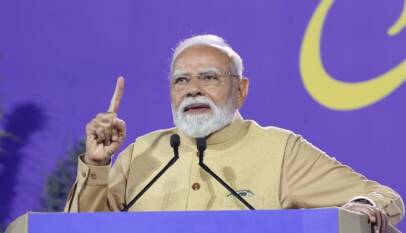





Prime Minister visits the Melbourne Cricket Ground for a Sporting event
Prime Minister Shri Narendra Modi today visited the Melbourne Cricket Ground accompanied b…

Prime Minister visits the Melbourne Cricket Ground for a Sporting event
Prime Minister Shri Narendra Modi today visited the Melbourne Cricket Ground accompanied by the …