Is AI Driving Productivity Or Redefining Work Itself?

January 2026: The World Economic Forum has reiterated that AI commercialization is poised to redefine business strategy, yet its most disruptive impact may be organizational rather than technological. As firms integrate agentic AI into workflows, productivity gains rise alongside job displacement, skill erosion and governance gaps. With executives divided on outcomes, competitive advantage will hinge on foresight, human-AI collaboration and aligning talent strategies with technology adoption.
The World Economic Forum’s Four Futures for Jobs in the New Economy: AI and Talent in 2030 examines how accelerating AI adoption and evolving talent dynamics could reshape jobs, business models and the global economy.
Four Futures for Jobs in the New Economy: AI and Talent in 2030 explores how AI advancement and talent trends, and their potential trajectories until 2030, could transform the future of jobs and the global economy. The paper consolidates views and insights from chief strategy officers and other experts around cross-cutting risks and opportunities, and “no-regret” strategies to help leaders understand critical uncertainties, stress-test assumptions and enhance foresight to navigate, and lead in the new economy.
This report is the second output of the World Economic Forum’s Scenarios for the Global Economy Dialogue Series, which uses scenario analysis and cross-industry dialogue to help decision-makers navigate global economic developments and their implications for strategy, investment decisions and resilience. Throughout 2026, the dialogue series will continue to explore scenarios related to key economic topics, focusing on business-relevant challenges and uncertainties.
The rapid commercialization of emerging technologies is reshaping workflows, business models and talent pipelines. As artificial intelligence (AI) shifts from experimentation to integration, the pace and trajectory of its advancement deepen the uncertainty about its implications on businesses, workers and the global economy.
The views of business executives on the impact of AI vary too: globally, about 54% expect AI to displace existing jobs, and 24% said AI will create new jobs. Nearly 45% also cited an increase in profit margins as a likely impact of AI, and only 12% expect it to lead to higher wages. The future of workplaces and value chains will not be defined by the technologies alone. Human capital strategies and investments prioritized today will determine how well societies and individual businesses can adapt to – and lead in – the new economy.
Turning uncertainty into foresight The World Economic Forum’s Scenarios for the Global Economy Dialogue Series uses scenario analysis and cross-industry dialogue to help decisionmakers navigate global economic developments and their implications for strategy and investment decisions. This white paper consolidates the views and insights from the members of the Forum’s Chief Strategy Officers Community and other experts across the Forum’s Industry Communities and Global Foresight Network.
This second edition in the series explores how AI advancements and talent trends, and their potential trajectories until 2030, could shape the future of jobs, with varying implications for corporate strategies and investment decisions.
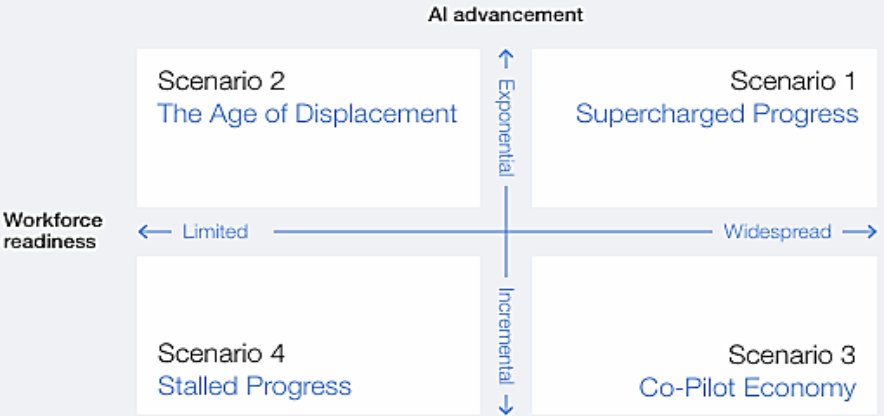
Four scenarios for the future of jobs in 2030 –
Taken together, AI advancement and talent development vectors generate the following four scenarios for the future of jobs in 2030.
- Supercharged Progress: Exponential AI breakthroughs reshape industries, business models and workflows. Productivity soars and innovation flourishes. Widespread AI readiness allows people to harness the “agentic leap”, adapt to AI-centric economies and partially contain displacement. Many jobs have disappeared, but new occupations emerge and scale fast, in part with humans directing portfolios of capable machines and becoming agent orchestrators. Social safety nets, ethics and governance frameworks struggle to keep up with the pace and scale of change.
- The Age of Displacement: Exponential AI advancement outpaces the capacity of the workforce to adapt. Businesses race to automate as a stopgap, displacing workers faster than education and reskilling systems can respond. Agentic AI takes over key processes, creating a productivity upsurge, but also new risks. Economies race ahead technologically but fracture socially: unemployment spikes, consumer confidence erodes and governments face mounting societal risks and instability.
- Co-Pilot Economy: Gradual AI progress and availability of AI-ready skillsets shift the focus towards augmentation rather than mass automation. The AI hype of the 2020s has given way to pragmatic integration: most industries see incremental transformation as human–AI teams reshape value chains. Countries and businesses that invested early in training, mobility, digital infrastructure and AI governance have created conditions to absorb and advance emerging technologies.
- Stalled Progress: Steady AI progress meets a workforce lacking critical skills. Productivity growth is patchy, and businesses lean on automation to backfill scarce talent. Gains concentrate within businesses and geographies with AI expertise, while others face eroding competitiveness. Displacement hits primarily routine roles, while the value of skilled trades and manual occupations increases. The hope of AI-enabled prosperity fades into frustration, as adoption gaps fuel inequality, create a bifurcated economy and limit growth.
Strategies for the future –
Drawing on the scenario narratives, analysis of business implications across the alternative futures,
and dialogues with chief strategy officers and experts, the following “no-regret” strategies have been identified to help businesses prepare today for any scenario.
- Start small, build fast, scale what works;
- Align technology and talent strategies;
- Invest in human-AI collaboration and agentic workflows;
- Invest in data governance and infrastructure;
- Anticipate talent needs and future-proof value chains;
- Strengthen organisational culture and trust in emerging technologies;
- Prepare for different implications across occupations, tasks and markets;
- Design multi-generational workflows;
- Leverage strategic partnerships.
Team Maverick.








Museums will be named after India’s National Heroes, not invaders: Chief Minister
Grand museum named after Chhatrapati Shivaji Maharaj being constructed at a rapid pace: CM…

Museums will be named after India’s National Heroes, not invaders: Chief Minister
Grand museum named after Chhatrapati Shivaji Maharaj being constructed at a rapid pace: CM …